
Wrap-Around Mortgages in Illinois: The Legal Guide for Investors and Seller-Financed Sales
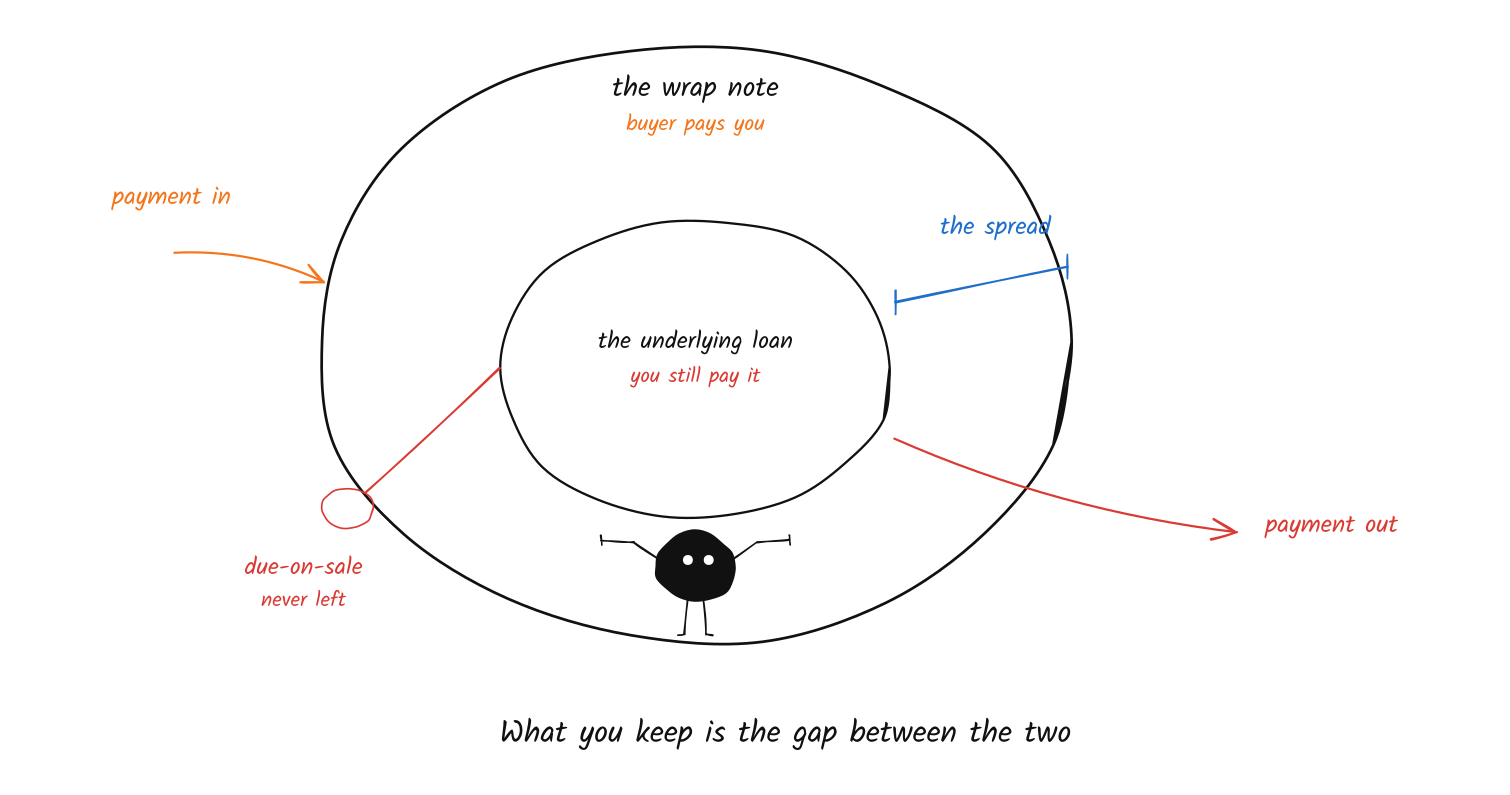
A wrap-around mortgage creates a new loan that wraps around the seller's existing mortgage. The buyer pays the seller at one rate. The seller pays the underlying lender at a lower rate. The difference is the yield spread, and it is how the seller profits from financing the sale instead of cashing out. I handle the full legal package for these transactions: the promissory note, the recorded mortgage instrument, the TILA disclosures, and the RESPA compliance documentation. I built the turnkey wrap mortgage infrastructure for a creative finance company doing these deals at scale across Illinois, Florida, and Virginia.

What a Wrap-Around Mortgage Is
A wrap-around mortgage (sometimes called a wrap, an all-inclusive mortgage, or an all-inclusive trust deed) is a financing arrangement where the seller creates a new loan to the buyer that "wraps around" the seller's existing mortgage. The buyer does not get a loan from a bank. The buyer borrows from the seller. The seller's existing mortgage stays in place, and the seller continues making payments on it out of the payments received from the buyer.
The wrap mortgage is a recorded instrument. It gets filed with the county recorder just like any other mortgage. The buyer has a note (the promise to pay) and a mortgage (the lien on the property securing the note). The seller retains their existing mortgage obligation to the original lender and also holds the new wrap note from the buyer.
The interest rate on the wrap is higher than the rate on the underlying mortgage. That is the whole point. If the seller's existing mortgage is at 3.5% and the wrap is at 6%, the seller earns a 2.5% spread on the remaining balance of the underlying loan for as long as the wrap is outstanding. On a $250,000 balance, that spread generates roughly $6,250 per year in passive income before accounting for principal amortization.
From the buyer's perspective, 6% may still be attractive compared to current conventional rates above 7%. The buyer gets financing without a bank, without a credit qualification process, and often with more flexible terms than any institutional lender would offer. The closing is faster. The costs are lower. And the property is available to buyers who might not qualify for traditional financing for any number of reasons.
Does this sound like you?
- I want to sell my property with seller financing
- I am an investor structuring a wrap deal
- I need TILA/RESPA compliance for a seller-financed sale
- I am a creative finance company that needs legal infrastructure
How Wraps Differ from Subject-To
People confuse these two structures constantly, so it is worth being precise about the difference.
In a subject-to deal, the buyer takes ownership and makes payments directly on the seller's existing mortgage. The buyer has loan and insurance authorizations that let them interact with the lender. The buyer controls the payment process. The seller is out of the picture operationally, even though their name is still on the note.
In a wrap deal, the buyer makes payments to the seller. The seller then makes payments on the underlying mortgage. The seller sits between the buyer and the original lender. The buyer has no direct relationship with the underlying lender and typically no authorization to contact them. The seller is an active participant in the deal for the entire life of the wrap.
| Subject-To | Wrap Mortgage | |
|---|---|---|
| Who makes the payment on the existing loan? | Buyer (directly to lender) | Seller (from buyer's payment) |
| Does the buyer have a new note? | No | Yes (the wrap note) |
| Is the new loan recorded? | No new loan exists | Yes, as a recorded mortgage |
| TILA/RESPA required? | No (no loan origination) | Yes (this is a loan) |
| Seller involvement after closing | Minimal | Ongoing (seller services the underlying debt) |
| Yield spread for seller | None | Yes (rate difference is seller's profit) |
The structural implication is that wraps carry a risk that subject-to deals do not: the seller can stop paying the underlying mortgage. In a sub-to deal, the buyer controls the payments and would know immediately if something went wrong. In a wrap, the buyer sends money to the seller and trusts the seller to pass it along. If the seller does not, the underlying lender forecloses, and the buyer's wrap mortgage is wiped out because it is junior to the existing lien. Proper documentation addresses this with payment verification mechanisms and default triggers, but the risk is inherent to the structure.
The Document Stack
A wrap mortgage is a loan origination. The documentation reflects that. For every wrap transaction, I prepare the following:
Promissory note. This is the buyer's promise to pay the seller. It specifies the principal amount, interest rate, payment schedule, maturity date, late fee provisions, default terms, and prepayment rights. The note is the core financial instrument of the deal. It needs to be drafted to comply with Regulation Z (the federal regulation implementing TILA) and to protect both parties in the event of a dispute.
Wrap mortgage agreement. This is the recorded instrument that creates the lien on the property securing the promissory note. It gets filed with the county recorder, which means it is a public record and gives the buyer an enforceable lien position. The mortgage references the underlying senior lien, establishes the wrap as a junior mortgage, and includes provisions for the buyer's right to cure if the seller defaults on the underlying loan.
TILA disclosure package. Because the seller is extending credit to the buyer, the Truth in Lending Act requires a written disclosure of the annual percentage rate (APR), the finance charge, the amount financed, the total of payments, and the payment schedule. These disclosures must be delivered to the buyer before closing. Regulation Z (12 CFR Part 1026) specifies the format, timing, and content requirements. Getting this wrong does not just create a compliance issue. It gives the buyer a federal cause of action against the seller, including statutory damages and potential rescission of the entire transaction.
RESPA estimate. The Real Estate Settlement Procedures Act requires a good faith estimate of settlement costs for transactions involving a federally related mortgage loan. While the applicability of RESPA to private wrap transactions is debated in some circles, I include the estimate as a matter of practice because the cost of providing it is minimal and the cost of not providing it, if a court later determines it was required, is substantial.
Seller disclosures. The seller signs a disclosure package confirming they understand the wrap structure, their ongoing obligation to pay the underlying mortgage, the consequences of defaulting on that obligation, and the buyer's remedies if they do. This is the equivalent of the seller acknowledgement in a sub-to deal. It prevents the seller from claiming ignorance if the deal goes sideways.
TILA Is Not Optional, and RESPA Is Cheap Insurance
I want to be direct about something because I see investors get this wrong regularly. A wrap-around mortgage is a credit transaction. The seller is extending credit to the buyer. That makes the seller a creditor under the Truth in Lending Act, and the transaction is subject to federal lending disclosure requirements.
Regulation Z (12 CFR Part 1026) requires the creditor to provide the borrower with specific written disclosures before the transaction closes. The required disclosures include the annual percentage rate, the finance charge (the total cost of credit expressed as a dollar amount), the amount financed, the total of payments over the life of the loan, and the payment schedule. The APR calculation in particular has specific rules about what fees and charges must be included, and getting it wrong is a violation even if the intent was correct.
Investors who skip this step are originating unregistered loans. The legal exposure includes statutory damages under TILA (up to $4,000 per transaction in individual actions, higher in class actions), the buyer's right to rescind the transaction for up to three years after closing if the disclosures were materially deficient, and potential state-level penalties under Illinois lending regulations. I have reviewed wrap deals put together by other attorneys who either did not know TILA applied or decided to ignore it. In every case, the seller was exposed to liability that far exceeded the cost of doing the compliance work properly.
There are limited exemptions under Regulation Z for sellers who make five or fewer credit transactions in a 12-month period and who are selling their own property. But even where the exemption arguably applies, the prudent practice is to provide the disclosures anyway. The cost is a few hundred dollars of legal work. The cost of defending a TILA claim is orders of magnitude higher.
If you have already closed a wrap deal without TILA disclosures: Call me. It may be possible to provide the disclosures retroactively and cure the deficiency before the buyer discovers it or before a dispute arises. This is a time-sensitive issue because the buyer's rescission window runs from the date the disclosures should have been provided, not from the date they actually were.
When Wrap Mortgages Make Sense
Wraps are not the right structure for every deal. They work best in specific situations where both the buyer and seller benefit from the arrangement.
The seller wants ongoing income. Some sellers do not want a lump sum. They want monthly cash flow. A wrap gives the seller a yield spread that generates passive income for the life of the loan, and the underlying mortgage continues to amortize, so the seller's equity in the property grows even while the buyer is making payments. This is particularly attractive for sellers who are retired or semi-retired and want to convert a property into an income stream without the management burden of being a landlord.
The buyer cannot qualify for conventional financing. Self-employed borrowers, people with credit events, borrowers with non-traditional income documentation, foreign nationals, and buyers who simply cannot get through the underwriting gauntlet at a traditional lender are all candidates for wrap deals. The seller is making a private lending decision based on whatever criteria they choose, rather than the rigid qualification standards that banks apply.
Halal finance. Conventional interest-bearing mortgages are not permissible under Islamic finance principles. Wrap structures can be adapted as cost-plus arrangements or installment sales that achieve the same economic result without being structured as an interest-bearing loan. I have handled transactions with this specific requirement, and the documentation needs to be drafted carefully to reflect the structure both parties intend.
From Our Deal Files
I have closed about half a dozen halal-structured wraps. The typical deal looks like this: a property worth $280,000, and the buyer agrees to purchase it for $450,000. The $170,000 above market value is the seller's profit, amortized over 30 years with early termination penalties at every stage. There is no interest component. The buyer pays more for the property in exchange for financing that complies with Islamic principles. If the buyer wants the arrangement certified as truly halal, that requires an imam's review. What I draft is a halal-compliant form that avoids interest entirely while giving both parties an enforceable contract. I am Arab-American, so I understand what the community needs from this documentation, even though I happen to be Catholic.
Investor-to-investor transactions. When one investor is selling to another and both understand the mechanics, wraps are efficient. The closing is fast, there is no lender involvement, and the terms can be customized in ways that institutional lending does not allow. Wraps are common in the BRRRR (buy, rehab, rent, refinance, repeat) community as a way to move properties between investors without touching a bank.
From Our Deal Files
I closed a deal where the property owner seller-financed to a wholesaler at zero down. The wholesaler then wrapped that seller-financed mortgage to the end buyer at a rate four points above the underlying note. The result was a $240 per month yield spread that will pay the wholesaler for the life of the loan, and he put zero dollars into the transaction. He found the property, found the buyer, structured the paper, and walked away with passive income. That is what wraps make possible when both sides understand the mechanics.
Wraps are not free money. The yield spread works for the seller only as long as the buyer keeps paying and the seller keeps servicing the underlying debt. If the buyer defaults, the seller has to resume making the full payment on the underlying mortgage while pursuing remedies on the wrap note. If the seller stops paying the underlying note, the lender forecloses and the entire structure collapses. Both parties need to understand the risks before closing.