

Chicago Real Estate Attorney: Flat-Fee Closings, Contract Review, and Property Disputes
Real estate transactions and disputes for Chicagoland. Published fees, and a free consultation on every matter.
Key Facts
- Abdilla and Associates is a flat-fee Illinois real estate law firm based in Lisle serving nine Illinois counties.
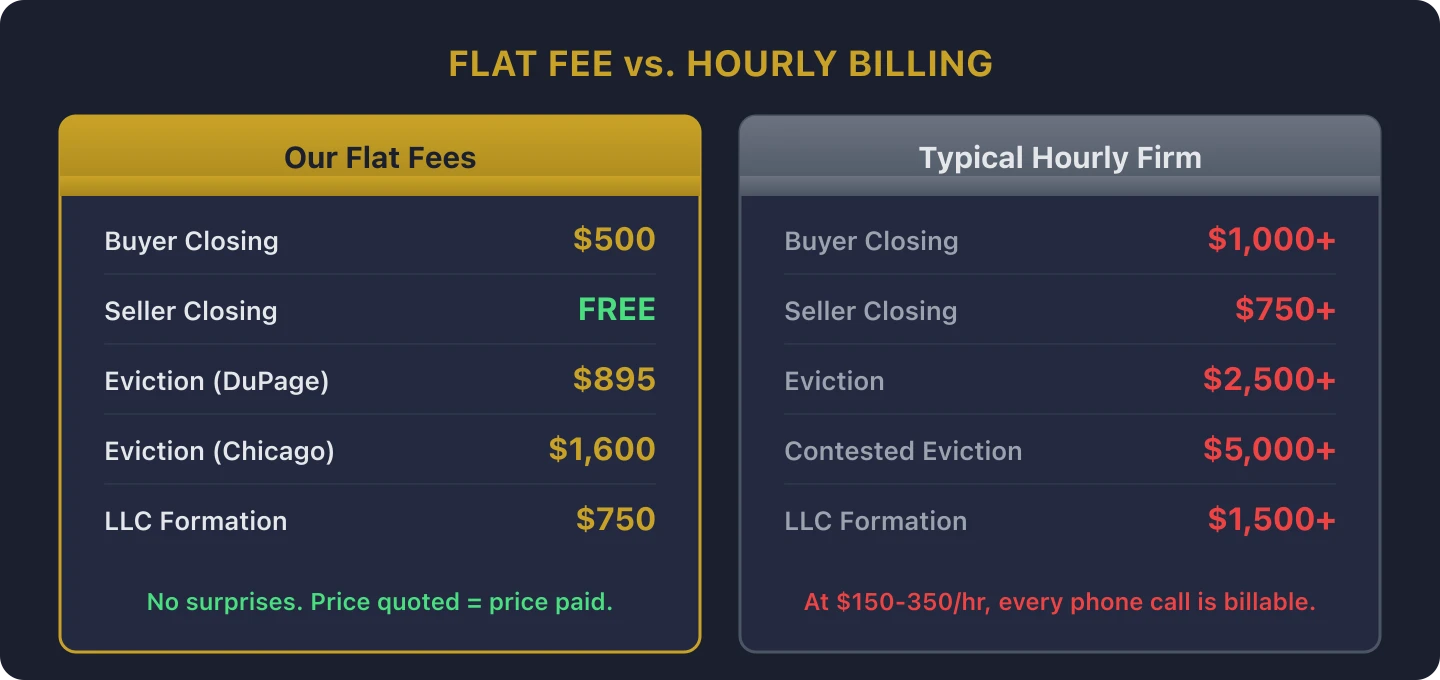
- Buyer-side closing representation is a $500 flat fee from attorney review through closing.
- Seller-side representation is free when the firm acts as title agent and a realtor handles the sale; a private sale with no realtor is a $500 flat fee.
- Multi-Board 8.0 contract review and the five business day attorney review period are included in closing representation.
- Real estate disputes outside the flat-fee list are billed at $350 per hour out of court and $450 per hour in court.
- The firm has handled more than 1,000 files across twelve years and carries more than 90 reviews with a 4.4 average on Google and Avvo.
Fees verified September 21, 2026.
Illinois is one of the few states where attorney review is built into every residential contract. For the commercial minded, Chicago layers on the RLTO, rent control provisions, and tenant protections that don't exist anywhere else in the state. For the usual homebuyer, the Multi-Board 8.0 contract governs most residential transactions, and it changed significantly in 2025.
This page is the menu. It lists every real estate transaction and dispute service my firm sells, with its fee. Most services carry a published flat fee. Zoning and construction disputes are the exceptions, because their scope varies too much. Every consultation is free. My firm is built around one idea: your attorney should make you more money than you spend on legal fees.

Watch: What Your Closing Actually Looks Like
Ninety seconds, plain words, no legal jargon. Pick your side of the table.
Selling and want the numbers first? The free Chicago closing statement tool gives you a seller net sheet with transfer taxes computed from the statutes and from your own municipality's ordinance.

The Short Version
Selling with a realtor? You pay us nothing. Here is what we do for you.

The Contract
You accept an offer. We get a short window to fix the contract, and we use it.

Inspection Fights
The buyer asks for repairs. We push back and protect your price.

Title
We order title and clear anything hanging over your home, like old liens and old loans.

Survey & Taxes
We check the survey, order your loan payoff, and prorate the taxes.

The Numbers
We build your closing figures. You see every dollar before closing day.

Closing Day
You usually do not even need to come. We sign, the money moves, done.

The Price
With a realtor on the sale, you pay $0 and we act as title agent. No realtor? $500 flat.

The Short Version
Buying in Illinois? $500 flat. Here is what we actually do for you.
Attorney Review
After you sign, we get a short window to improve your deal. We use every day of it.
Inspection
Bad inspection? We demand repairs or money back, or we walk you away safely.

Your Loan
We track your mortgage and appraisal so no deadline slips.
Title & Survey
We check who really owns the home, and where the property lines truly are.

The Fine Print
Condo or HOA? We read the budget and the rules before you are stuck with them.
Chicago Extras
In Cook County we also pull the tax history and city building records.

Closing Day
We check every figure, fix every error, and hand you the keys.
The Price
$500 flat. No hourly billing. Call (630) 839-9195.
What Does a $500 Closing Include? →
The $500 closing fee includes attorney review, title examination, document preparation, and closing attendance.
What We Handle
We represent buyers and sellers from attorney review through closing. That means contract modifications during the 5-business-day attorney review window, title examination to surface liens and encumbrances before you own them, preparation of deeds and affidavits and transfer declarations and proration agreements, and attendance at closing, whether in person or remote. It's usually remote these days.
Don't DIY In Illinois
In most states, a real estate agent handles the entire transaction. Illinois is different because the courts have drawn a hard line between what agents can do and what requires an attorney.
The Illinois Supreme Court drew that line in Chicago Bar Association v. Quinlan & Tyson (1966): an agent may fill in the blanks on the standard form offer, but preparing deeds, mortgages, and the other legal instruments of a sale "requires the peculiar skill of a lawyer." A separate rule reaches the conflict of interest rather than the unauthorized practice. Section 20-20(a)(34) of the Real Estate License Act of 2000 (225 ILCS 454/20-20(a)(34)) lets the Department discipline a licensee who acts as the attorney for the buyer or the seller in the same transaction in which that licensee is acting or has acted as broker. In Curielli v. Quinn, 2015 IL App (1st) 143511, the First District upheld that provision against special legislation, equal protection, and separation of powers challenges. The plaintiff there was never disciplined: after a consumer complaint the Department offered him a non-disciplinary order and 12 hours of continuing education, he declined it and sued instead, and the court held the statute rationally related to protecting the public from the conflict that arises when one person earns a commission on closing and owes a lawyer's duty in the same deal. Your agent can negotiate the deal and fill in the Multi-Board offer. Everything after that, from contract modifications to inspection responses to title objection letters to closing documents, requires an attorney. There is no workaround. Your trusted agent, who probably does know the right way to do everything, just can't do it. While that's great job security for me, it usually does mean some added costs to the transaction.
Flat-Fee Pricing
Our buy-side closing representation is a flat fee of $500. A multi-unit property adds $150 for each unit after the first. That covers attorney review through closing: contract modifications, title examination, document preparation, and closing attendance. No hourly billing, no surprise invoices at the table. Remote closings are available statewide through our client portal and digital document execution.
My seller-side closing representation is free when two conditions are met. My firm is the title agent, and a realtor runs the sale. In that case my firm earns its fee by writing your title insurance. I also cover the cost of a remote notary, so you can sign from your couch. A private sale with no realtor is a $500 flat fee.
"Mr. Abdilla was better than I could have asked for. Made my life easy and took care of business exactly as he said."
Katrina K., Google Review
What Does Multi-Board 8.0 Contract Review Cover? →
The office reviews the Multi-Board 8.0 contract for financing terms, disclosures, and the new agent compensation rules. Contract review is $350 for a contract under 10 pages, then $350 an hour after the first 10 pages. A $500 buyer closing already includes it.
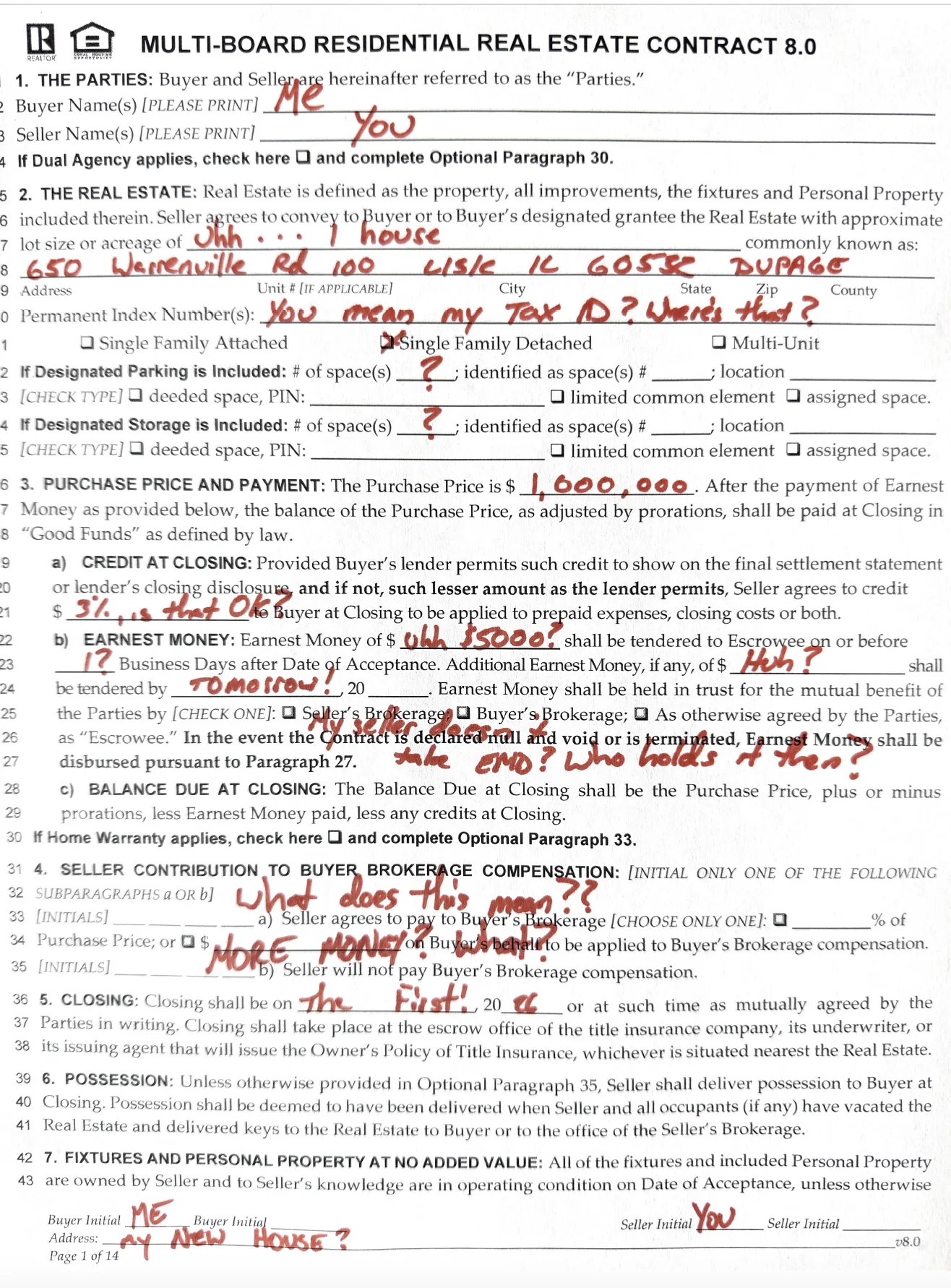
The Multi-Board Residential Real Estate Contract is the standard purchase agreement for residential transactions across Chicagoland. Version 8.0, released February 2025, is the most significant update in years, largely because the NAR settlement rewrote the rules on how buyer's agents get paid. But, there's lots of other goodies in there like solar panels and fixing the as-is loophole too.
What Changed in 8.0
The headline change is Paragraph 4, a brand-new section on buyer brokerage compensation. Under the old rules, the seller's listing agreement typically covered both agents' commissions. Now buyer brokerage compensation must be addressed in the purchase contract itself. This is about twenty years overdue if you ask me.
Beyond that, 8.0 introduced a non-counteroffer proposal mechanism in Paragraph 13(d) that lets attorneys make proposals without killing the deal if they're rejected. The fixtures checklist now covers EV chargers, video doorbells, smart thermostats, and surveillance systems. And the three-tier financing structure (contingency, cash-no-financing, cash-financing-allowed) is more clearly separated. Finally, the inspection provisions changed to a similar three-tier option of "accept/reject," "inspect, but only major systems," and "full inspection with requests."
Why Attorney Contract Review Matters
The attorney modification letter is the single most important document in a residential deal. Within five business days, we review every provision of the 38-paragraph contract, identify risks, and draft modifications tailored to your side of the transaction.
What we catch that agents can't: financing contingency deadlines that don't align with current lender processing times, inspection alternatives where the wrong checkbox forfeits your termination rights, proration methodologies that short-change you by thousands, and earnest money structures that leave your deposit exposed if the deal falls apart.
One example from 8.0 that catches people off guard: under the new Paragraph 15(c), if a buyer requests repair credits and the seller refuses, the seller may terminate the contract and retain the earnest money. Last year I probably had this come up 20 times! The market can be slow to change its force of habit.
Our Multi-Board 7.0 guide has been read by thousands of Illinois buyers and sellers since we published it. At one point, 1000 people a month were downloading it. The 8.0 guide covers every paragraph of the new contract in the same level of detail.
"I should have called before I signed."
Every Consultation Is Free. Most Fees Are Flat.
A quick phone call now can save thousands later. Tell us what's going on and we'll walk you through your options.
All consultations are confidential.
How Do You Sell a Home Without a Realtor in Illinois? →
The seller's attorney drafts the purchase contract and handles negotiations with the buyer's attorney.
Selling without a realtor saves you 5-6% in commission. On a $400,000 home, that's $20,000-$24,000 you keep instead of paying an agent. My $500 flat fee handles the legal work so the transaction still has professional oversight where it matters.
What We Handle for FSBO Sellers
We draft the purchase contract and handle all negotiations with the buyer's attorney. We ensure compliance with Illinois disclosure requirements, including the Residential Real Property Disclosure, lead paint disclosures, and radon testing obligations. We examine title, clear any defects, prepare closing documents, manage the earnest money through escrow, handle post-inspection negotiations and repair credit structuring, and attend closing on your behalf. You've still got to find the buyer.
Local FSBO Guides
We've published FSBO guides for 52 Chicagoland communities, including Naperville, Wheaton, Lisle, Arlington Heights, Tinley Park, and many more.
How Does a Partition Action Resolve a Co-Owner Dispute? →
When unmarried couples, family members, or business partners buy property together and the relationship falls apart, Illinois law provides one mechanism to force a resolution: a partition action. The court orders the property sold and the proceeds divided. It is a blunt tool, and it is expensive for everyone involved.
I quote partition work after a free call, once I know whether you want to force a sale or stop one.
What We Handle
Partition filings and defense: We file partition actions in the Chancery Division and defend against them. Whether you want to force a sale or prevent one, we handle the pleadings, lis pendens recording, accounting of contributions, and all motion practice through resolution.
Buyout negotiations: Most partition cases settle through a buyout where one party keeps the property and compensates the other. We negotiate the valuation, equity split, financing timeline, and deed transfer so both parties walk away with a clear result and no lingering obligations.
Co-ownership agreements: The cheapest way to handle a co-ownership dispute is to prevent it. We draft co-ownership agreements at closing that specify buyout rights, payment obligations, and forced-sale triggers before the relationship goes sideways.
When Do You Need a Chicago Zoning Attorney? →
Zoning law touches more real estate transactions than most people realize. If you're converting a two-flat, adding a unit to an investment property, or buying a commercial building for a use the current zoning doesn't allow, you need a zoning attorney before you need a contractor.
Zoning is the one service I quote per matter. A due diligence memo runs about $1,000. Variance and special use applications typically run $2,500 to $5,000.
Services
Zoning due diligence is something we recommend before any investment purchase. We verify the property's zoning classification, confirm permitted uses, and check for non-conforming status or pending code enforcement actions. You'll get a memo from me about its status and what we think you could do to change it. The cost is usually about $1,000.
Variance applications come into play when strict application of the zoning code creates an unnecessary hardship unique to a specific property. We prepare and present variance applications to the Zoning Board of Appeals under the practical difficulty and particular hardship standard in 65 ILCS 5/11-13-5 and the municipality's own variation criteria. That is the administrative route. When a zoning classification has to be attacked in court instead of worked around at the village hall, the governing test is the six-factor analysis in La Salle National Bank v. County of Cook, 12 Ill. 2d 40, 46-47 (1957). These are also extremely useful if you have a pending citation.
Special use permits are required when a zoning ordinance identifies a use as potentially compatible with a district but subject to individualized review. Religious institutions in residential zones, day care centers, and bed-and-breakfasts are classic examples. Senior living facilities come up more and more these days, but can be a much more intensive process to handle.
Chicago Planned Developments are a separate process entirely. Projects that hit the mandatory PD thresholds in CZO section 17-8-0500 require Part I legislative approval through the Plan Commission and City Council, followed by Part II building permit compliance review. We handle both phases.
Non-conforming use protection applies when a property's current use predates the zoning ordinance that would otherwise prohibit it. These grandfathered uses have legal protections, but they can be lost through abandonment or unauthorized expansion.
Chicago vs. Suburban
Chicago is a home rule municipality with its own comprehensive zoning ordinance under Title 17 of the Municipal Code, its own Plan Commission, its own ZBA, a certificate of zoning compliance process, and a Planned Development process that exists nowhere else in Illinois.
Non-home-rule suburbs draw their zoning power from Division 13 of Article 11 of the Illinois Municipal Code (65 ILCS 5/11-13-1 et seq.), which says in terms that it "does not apply to any municipality which is a home rule unit." Home rule suburbs, and there are dozens of them around Chicago, zone under their own constitutional home rule authority instead. Either way, each municipality has adopted its own zoning code with its own classifications, setbacks, density limits, and hearing procedures. Cook County has a separate code for unincorporated areas. DuPage, Kane, and Will counties each maintain their own. A variance application in Naperville is a completely different process from one in Chicago.
We handle zoning across all of these jurisdictions. Contact us for zoning consultations.
How Are Construction Defect Claims Handled? →
I handle construction defect disputes on both sides of the table. Homeowners hire me to pursue a contractor. Contractors hire me to defend a defect claim. I consult on over a hundred construction matters a year for contractors and homeowners across Chicagoland.
Most construction defect work bills hourly. I give you a budget projection before I start.
What I Handle
- Homeowner claims: breach of contract, negligence, breach of warranty, and violations of the Home Repair and Remodeling Act (815 ILCS 513).
- Contractor defense: the Spearin Doctrine, notice and opportunity to cure, acceptance, betterment, and failure to mitigate.
- Liens: mechanics liens under 770 ILCS 60, for the contractor who was not paid and for the owner who needs a lien cleared.
Deadlines
Statute of repose: Under 735 ILCS 5/13-214, a construction claim must be brought within 4 years from the time the claimant knew or should reasonably have known of the act or omission. Subsection (b) adds an outer repose period of 10 years, and it runs from the act or omission itself, not from substantial completion. That 10-year line is not absolute. The same subsection provides that anyone who discovers the act or omission before the 10 years run "shall in no event have less than 4 years to bring an action," so a defect found in year nine stays actionable into year 13. An express warranty for a longer period and fraudulent concealment extend things further still.
If you think you have a defect, call me before you let the original contractor back in to "fix it." A failed repair attempt can complicate your case.
"He made the whole thing simple."
Have Me Review Your Deal
Got a contract on your desk? A closing date coming up? An eviction you've been putting off? Tell me what you're looking at and I'll give you a flat-fee quote in one call. No hourly billing, no retainer, no surprises.
Mayra R.: "Justin was very helpful and guided me on steps I have to do prior to having a potential eviction case."
What Does the Office Do for Investors and LLCs? →
If you own rental property in your personal name, your personal assets are one slip-and-fall lawsuit away from exposure. We form LLCs for landlords and investors and handle the legal infrastructure of your entire portfolio.
An Illinois LLC is a $750 flat fee. A portfolio legal audit of entity structure, deed chain, and lease compliance is a $1,500 flat fee.
Services
LLC formation includes drafting the operating agreement, obtaining the EIN, and filing with the Illinois Secretary of State. We structure the entity to match your investment strategy, whether that's a single-member LLC per property or a holding company structure.
Rental mortgages for LLCs are harder to get than conventional loans because not every lender finances LLC-held property. We know which ones do and how to structure the application so the entity ownership doesn't kill the deal.
Due diligence for investment property goes beyond a standard title search. We investigate title, liens, zoning compliance, code violations, tenant lease status, and the financial performance of the property before you commit.
Cap rate analysis is something most attorneys can't do because they don't think in investor terms. We run the numbers on acquisition targets so you know whether a deal pencils before you sign a contract.
Portfolio legal management covers everything that comes after the purchase: lease review and drafting, tenant disputes, entity restructuring as your portfolio grows, and evictions when a tenancy goes bad.
Why Investors Need a Dedicated Attorney
A general practice attorney doesn't know what a cap rate is. A closing attorney doesn't understand subject-to financing. A corporate attorney doesn't handle evictions. We do all of it: formation, acquisition, management, and enforcement, under one roof and at flat-fee pricing for each stage.
"Very humane and landlord empathetic eviction lawyer! His answers are clear and concise."
SeyitBek U., Property Owner
What About Evictions, Creative Financing, and Short Sales?
These services have their own pages. Here is the short version of each.
Evictions
Eviction flat fees run from $895 in DuPage County to $1,600 in Chicago. The Chicago eviction attorney page lists the fee for each county and district.
Creative Financing
Subject-to and wrap-around mortgage closings are $2,000 flat, and a lease option is $1,500 flat. The creative financing page covers each structure.
Short Sales
I help sellers who owe more than the home is worth negotiate a short sale with the lender. The Illinois short sale guide explains the process.
Judgment Collection
I collect money judgments through wage deductions, bank levies, and citations to discover assets. I quote collection work after a free call.
Why Hire This Office?
This office offers flat-fee pricing, a client portal, and free consultations.
"Justin evicted a tenant of mine in record time. It's unheard of and I just did not think it was possible to get this tenant out so fast."
William G., Real Estate Investor
"Justin was highly recommended to us and we're very pleased with his services. He's an amazing attorney, very knowledgeable of landlords rights."
Bert W., Chicago Landlord
Flat-Fee Pricing
Most services we offer have a published flat fee. Closings, evictions, LLC formation, contract review. Zoning and most construction disputes are the exceptions, because their scope varies too much. You know exactly what you're paying before we start, and if a case settles early, you get a partial refund. Most firms won't publish their pricing because it forces them to be competitive. We publish ours because hiding them wastes everyone's time.
Modern Practice, Modern Tools
We set you up with a client portal where every document, every deadline, and every case update lives in one place, accessible from your phone at any hour. We handle remote closings with digital document execution. We run cap rate analysis and market data for investor clients. Most real estate lawyers are still telling you to call the office between 9 and 5. We thought that's a problem worth solving.
Free Consultations
We don't charge to give advice. Call us, tell us what's going on, and we'll walk you through your options regardless of whether you hire us. Good advice builds good relationships, and that's how this practice was built.
Which Counties Does the Office Serve?
The office serves Cook, DuPage, Kane, Will, Lake, Kendall, McHenry, McLean, and Champaign counties.
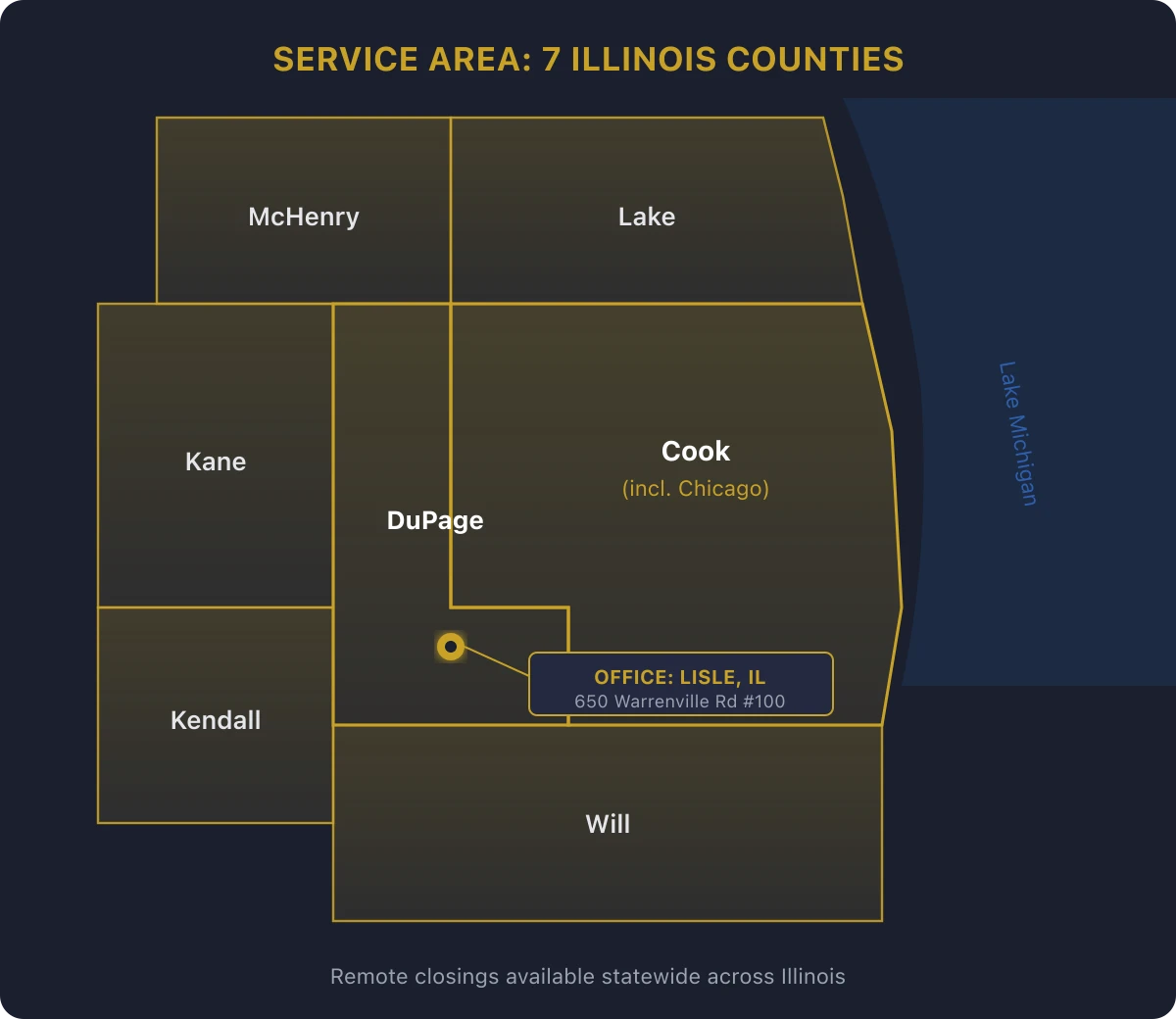
Office: 650 Warrenville Rd #100, Lisle, IL 60532
Phone: (630) 839-9195
Counties: Cook, DuPage, Kane, Will, Lake, Kendall, McHenry, McLean, Champaign
Statewide: Illinois real estate transactions via remote closing
If you need a real estate attorney in Chicago, a real estate lawyer in the suburbs, or an Illinois real estate attorney for a remote closing anywhere in the state, we handle it all.
Schedule a Free ConsultationFrequently Asked Questions
Illinois does not force you to hire one, but it does forbid anyone except a licensed attorney from doing the work, so the real choice is your attorney or no attorney. It is never your agent. Contract modifications, title objections, closing documents, and deeds all require a lawyer. Under the Illinois Supreme Court's decision in Chicago Bar Association v. Quinlan & Tyson (1966), an agent's job ends with filling in the blanks on the standard form offer; preparing deeds, closing documents, and the other legal instruments of a sale is the practice of law. Your real estate agent legally cannot perform these functions. Read our full guide.
My buy-side closing representation is a flat fee of $500. A multi-unit property adds $150 for each unit after the first. Seller-side representation is free when my firm is the title agent and a realtor runs the sale. A private sale with no realtor is a $500 flat fee. Contract review is $350 for a contract under 10 pages, then $350 an hour after the first 10 pages. The closing fee covers attorney review through closing.
The biggest change is Paragraph 4, a brand-new section on buyer brokerage compensation driven by the NAR settlement. Version 8.0 also added a non-counteroffer proposal mechanism in Paragraph 13(d), updated the fixtures checklist to cover EV chargers and smart home devices, and clarified the three financing contingency alternatives. Read our complete 8.0 guide.
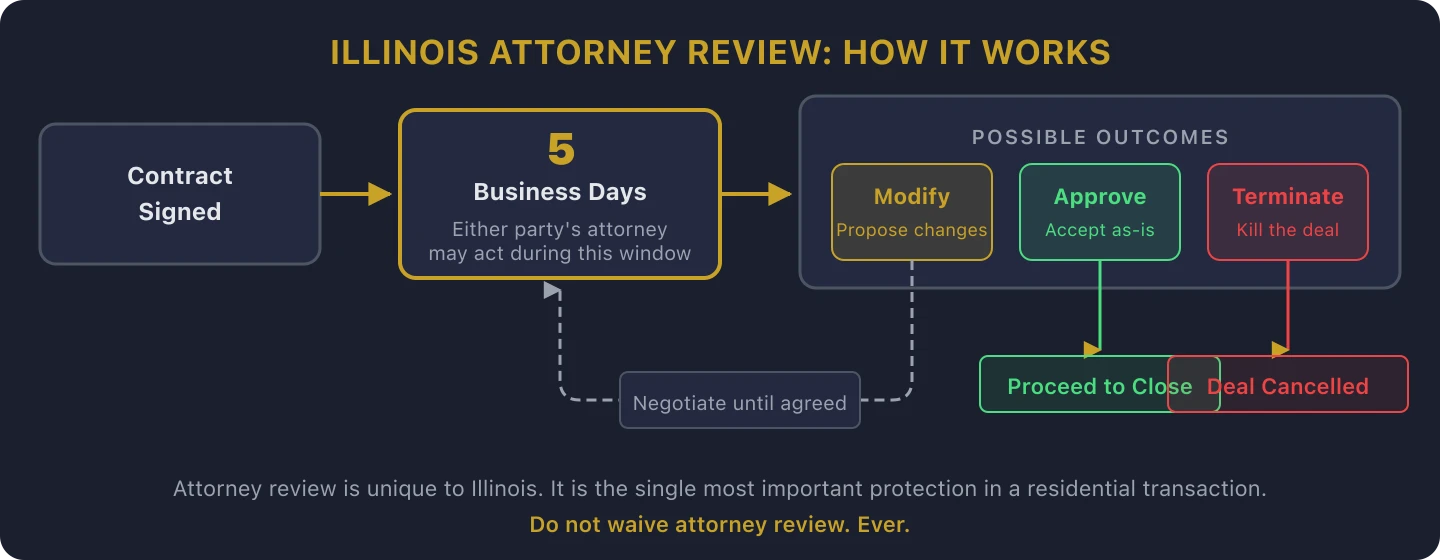
Attorney review is a 5-business-day period after the contract is signed during which either party's attorney can propose modifications, request additional terms, or terminate the contract entirely. It is unique to Illinois, and it is the single most important protection available to buyers and sellers in a residential transaction. Learn how attorney review works.
In Illinois, only a licensed attorney can draft contract modifications, prepare closing documents, and resolve title issues. We handle the complete legal side of FSBO transactions, from contract drafting through closing, across 52 Chicagoland communities.
I sure do. We will make sure your HOA is satisfied with your performance and help you get all the documents you need to sell your condo or association property. Yes, even if they're not on good terms with you now. Paid Assessment Letter Guide.
Under 735 ILCS 5/13-214(a), you have 4 years from the time you knew or should reasonably have known of the act or omission. Section 13-214(b) adds a 10-year repose period, measured from the act or omission itself and not from substantial completion, and it carries a savings clause: anyone who discovers the problem before those 10 years run gets no less than 4 years from discovery, even if that carries past year 10. Express warranties and fraudulent concealment can extend the deadline further. Latent defects hidden inside walls or underground can take years to surface, so if you suspect a problem, don't wait.
Yes. If a contractor performed work that doesn't meet contract specifications or industry standards, you can pursue claims for breach of contract, negligence, breach of warranty, or violations of the Illinois Home Repair and Remodeling Act (815 ILCS 513). For new construction, the implied warranty of habitability recognized in Petersen v. Hubschman Construction Co. (1979) provides additional protection. Document the defects with photos and professional inspection reports before allowing any repair attempts.
Get an attorney involved immediately. Several strong defenses may apply: the Spearin Doctrine protects contractors who built to the owner's design specifications, the statute of repose in 735 ILCS 5/13-214(b) bars claims more than 10 years after the act or omission itself, subject to the savings clause that gives a claimant who discovers the problem inside that window a full 4 years from discovery, and acceptance defenses apply when the owner inspected and signed off on the work. Your project documentation, including daily logs, progress photos, change orders, and RFIs, is your best evidence. Contact us for a free consultation.
We Answer the Phone. We Explain the Law. We Don't Charge to Talk.
Schedule a call or just pick up the phone. If we can help, we'll tell you exactly what it costs. If we can't, we'll point you to someone who can.
All consultations are confidential.
Flat-fee real estate law. Free consultation. 9 Illinois counties.
630-839-9195