
IDFPR Intends to Deny Your License. The Response Window Is Short. Read the Notice.
By Justin Abdilla, Illinois Attorney, ARDC #6308444. 1,000+ files across twelve years of practice. Handles closings, evictions, construction law, and zoning across 9 Illinois counties (Cook, DuPage, Kane, Will, Lake, Kendall, McHenry, McLean, Champaign).
An Intent to Deny is not a final denial, but it becomes one if you miss the response window. The deadline is not the 35-day judicial review clock. It is shorter, it is set by the notice, and it will not extend. Preserve your hearing right on time, then cure or contest.
The Deadline: It Is NOT 35 Days
In 2026, I defended a home trades business against an IDFPR Intent to Deny over an advertising-practice allegation. I argued the Department's procedures were unconstitutional. IDFPR still granted a hearing, even though it said the business had not followed those procedures. We interviewed every employee at the company. Their affidavits answered the state's claim point by point. Several employees said they could not even place themselves at the location the incident allegedly happened. The state agreed to dismiss the case on a $5,000 fine. That case turned on reading the notice closely.
The response window for an Intent to Deny is not the 35-day judicial review clock under 735 ILCS 5/3-103. That 35-day window is for judicial review in circuit court, after a final administrative decision, a later, different stage. I see people calendar 35 days for this, because that is the number everyone remembers from judicial review. It is the wrong number here. Calendar 30 days from the date of service instead. Miss that window and the denial goes final, and you forfeit both the hearing and the appeal.
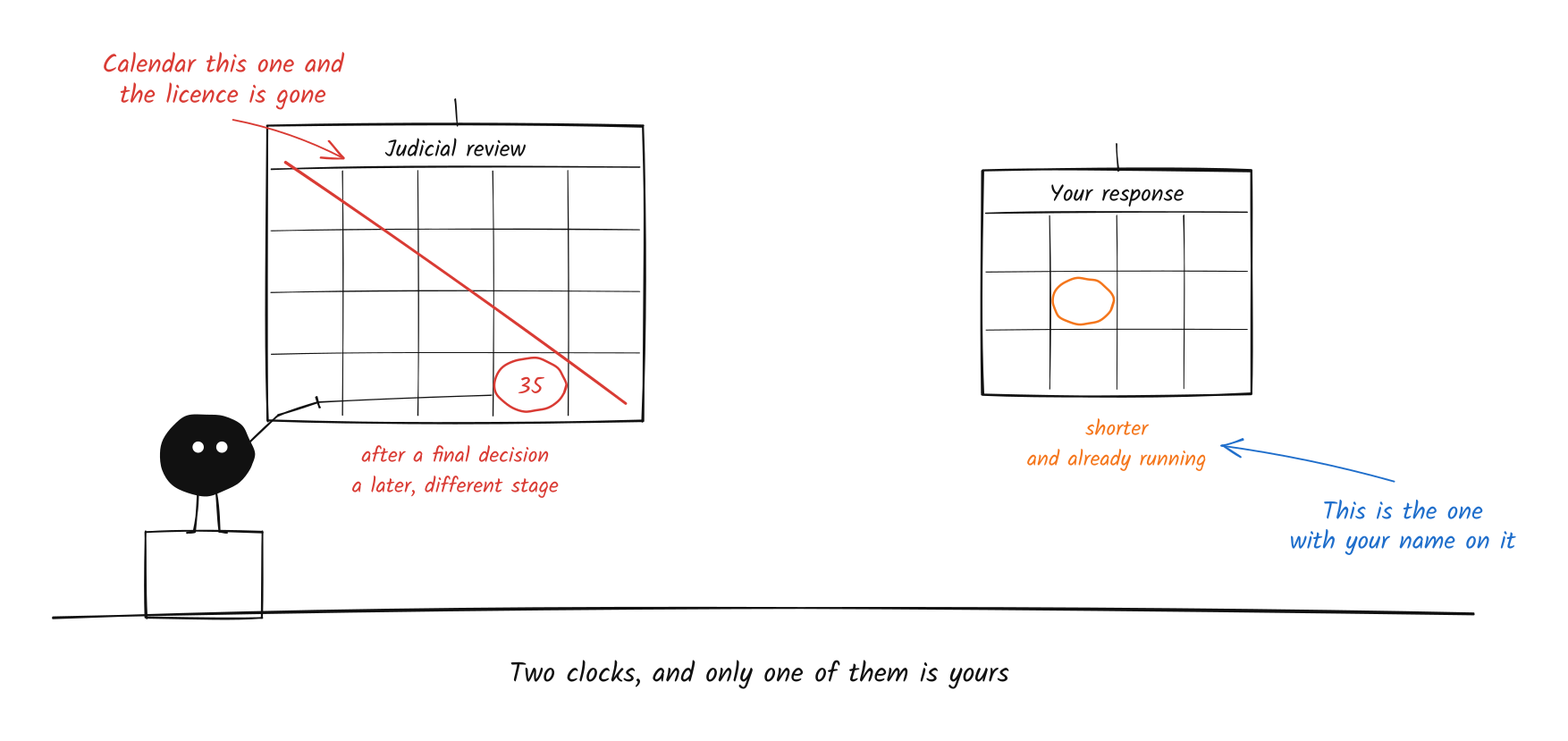
The actual response window comes from the Department's rules of practice, not from the DPR Act, and it is 30 days after service. For a Notice of Intent to Deny Licensure, 68 Ill. Adm. Code 1110.120(f) requires the applicant to file a request for hearing to contest the notice within 30 days after service. For a Notice of Intent to Refuse to Renew, 68 Ill. Adm. Code 1110.20(e) requires the same 30 days after service, and provides that if no request is filed in that time the Director may issue an order refusing renewal or refusing issuance. Part 1110 applies to all hearings conducted by the Division under the DFPR Law and the other Acts within the Department's jurisdiction, so the 30 days does not vary by profession. What it is not is 35 days. Read the notice, confirm the date of service, calendar 30 days from service the day the notice arrives, and check the notice itself in case it recites a shorter period.
Triage: Curable Defect vs. Substantive Denial
The whole strategy turns on why IDFPR intends to deny. Two very different animals require completely different responses:
| Type | Typical Triggers | Strategy |
|---|---|---|
| Curable documentation defect | Missing or expired liability insurance, missing surety bond, no qualifying party or unpassed exam, missing workers' comp/IDES proof, unpaid fee, lapsed renewal | Cure fast: provide the missing documentation within the response window |
| Substantive fitness denial | Prior discipline, criminal history, false statement on the application, tax delinquency, findings from a parallel investigation | Preserve hearing + contest/mitigate: request a hearing, prepare to prove fitness |
| Certified child support delinquency | A delinquency certified by Healthcare and Family Services, or a court finding under the Non-Support Punishment Act | Cure, do not litigate: 5 ILCS 100/10-65(c) directs refusal or suspension on the certification alone and requires no further hearing. Arrange payment of past and current support so the certification is withdrawn |
Read the notice for the specific grounds and code sections cited; they tell you which column you're in. A curable defect handled as a substantive fight wastes time and money. A substantive denial handled as a curable defect forfeits the hearing right.
The Cure Path: Fix It Fast
If the denial is based on a documentation defect, the fix is straightforward: provide the missing item within the response window. Common curable defects include:
- Liability insurance: provide a current certificate showing the required coverage minimums.
- Surety bond: file the bond with the correct surety and amount.
- Qualifying party or exam: schedule and pass the required exam, or designate a qualified party.
- Workers' comp / IDES proof: provide current compliance certificates.
- Unpaid fees: pay the outstanding amount.
- Lapsed renewal: if the renewal period has passed, pursue the restoration path rather than a new application.
If the denial is curable, the fastest resolution is to cure it, not to fight. An attorney can help you confirm exactly what's missing and submit it correctly the first time, avoiding a second denial for a different deficiency.
The Contest Path: Preserve the Hearing
If the denial is substantive (prior discipline, criminal history, a false statement on the application), you need to request a hearing in writing within the response window. If you miss the window, the denial goes final and becomes a reportable adverse action.
What happens at that hearing depends on the ground the notice cites. Where the Division alleges a violation, and a false statement or the misconduct behind prior discipline is a violation, it has to prove that violation by clear and convincing evidence before you have to prove anything. Where the denial rests on an unmet qualification, the burden is yours from the start by a preponderance. Read the notice first, then build the record. Where the burden is yours, you must affirmatively demonstrate fitness for licensure. This means:
- Rehabilitation evidence: if the denial is based on prior discipline or criminal history, demonstrate rehabilitation: time elapsed, corrective actions, character references, professional development.
- Context for the alleged false statement: if charged under a "knowing" false-statement ground, contest the knowledge element. An ambiguous application question is not a knowing false statement.
- Corrective compliance: if the denial is based on a compliance failure (tax delinquency, child support), show that it has been resolved.
5 ILCS 100/10-65: Your License Stays Active
If this is a renewal denial and you filed a timely, sufficient renewal application, 5 ILCS 100/10-65(b) keeps your existing license in full force until IDFPR's final decision. You can continue working while you fight the denial.
Additionally, 5 ILCS 100/10-65(d) entitles you to written notice of the facts or conduct the agency will rely on, and an opportunity for a hearing, before it refuses to renew. It also gives you the right at that hearing "to show compliance with all lawful requirements for the retention, continuation, or renewal of the license." If IDFPR attempts to deny renewal without providing these, the process itself may be challengeable. Two limits matter. Subsection (d) protects "any valid license," so it reaches renewal denials but not the denial of an initial application. And it opens "[e]xcept as provided in subsection (c)," which is the child support carve-out: on a certified child support delinquency the agency "shall refuse to issue or renew or shall revoke or suspend" on the certification alone, and "[f]urther process, hearings, or redetermination of the delinquency or violation by the licensing agency shall not be required." There is no fitness hearing to win on that ground. The cure is to arrange payment of past due and current support so the certification can be lifted.
Critical caveat: this protection only applies if the renewal was filed on time and was sufficient. If you let the renewal lapse, even by one day, you lose the 10-65(b) protection and may need to pursue restoration instead.
The Burden Flips: You Must Prove Fitness
This is the fundamental difference between a license denial and a license discipline action:
The rule is 68 Ill. Adm. Code 1110.190, and it splits three ways rather than two:
- Discipline (a Complaint against an existing license): the Division bears the burden, and must establish the allegations by clear and convincing evidence. §1110.190(a).
- Refusal to renew: also the Division's burden, on the same clear and convincing standard, and §1110.190(d) directs that such a case be handled in the same manner as a Complaint. This is the part most often gotten backwards. A renewal denial is not an application denial.
- Intent to deny an application: it depends on the ground. If the Division is alleging a violation, it must prove that violation by clear and convincing evidence first, and only then must you show by a preponderance that the license should issue. If the denial rests on a failure to meet qualifications, the burden is yours from the start, by a preponderance, to show the qualifications have been met. §1110.190(c).
So read the notice for which kind of ground is cited, because it decides who moves first. Where the burden is yours, silence is the loss. Showing up without affirmative evidence is the loss. The applicant must build a record demonstrating that they meet every qualification for licensure, and must do so within the hearing framework.
Administrative Review of a Final Denial
If the denial becomes final, either because you missed the response window or because you lost at hearing, you can seek judicial review:
- 735 ILCS 5/3-103: the Administrative Review Law. Within 35 days you must file a complaint and have summons issue. Filing alone does not commence the action, and that is the half that gets appeals dismissed. The 35 days run from the date a copy of the decision was served on you, not from the date it was signed, and a mailed decision counts as served when it is deposited in the mail to your last known address. This is a jurisdictional deadline; missing it forfeits the appeal entirely.
- 735 ILCS 5/3-110: there is no single standard. Section 3-110 provides that review "shall extend to all questions of law and fact presented by the entire record," and that only the agency's findings "on questions of fact" are prima facie true and correct. So the court will not reweigh evidence and will disturb fact findings only if they are against the manifest weight of the evidence, but questions of law get independent, non-deferential review, and mixed questions of law and fact are reviewed for clear error. Cinkus v. Village of Stickney Municipal Officers Electoral Board, 228 Ill. 2d 200 (2008). On a denial page that distinction is worth money: whether the Department applied the right fitness standard, or whether a conviction is disqualifying as a matter of law, are legal questions and they get no deference.
- Exhaustion required: you must complete the administrative process (including the hearing) before seeking judicial review. Failure to exhaust bars the appeal.
Because review is deferential, the record built at the hearing is what the court will see. The administrative hearing is the case, not a dress rehearsal.
← Back to License Defense Hub · IDFPR Investigation → · Roofing License Defense → · Cosmetology License Defense →
Frequently Asked Questions
The response window is set by the Department's rules of practice, not by the DPR Act: 68 Ill. Adm. Code 1110.120(f) gives an applicant 30 days after service to request a hearing contesting a Notice of Intent to Deny Licensure, and 68 Ill. Adm. Code 1110.20(e) gives the same 30 days after service on a Notice of Intent to Refuse to Renew. Read the date of service off the actual notice and calendar from there. The 35-day clock under 735 ILCS 5/3-103 is a different thing entirely: it is for judicial review after a final decision, not the intent-to-deny response. Mis-calendaring the wrong deadline forfeits the hearing and then the appeal.
If you filed a timely, sufficient renewal application, 5 ILCS 100/10-65(b) keeps your existing license in full force until IDFPR's final decision. This is the single most valuable protection for a working professional. However, this protection only applies if the renewal was filed on time and was sufficient. Do not let the renewal lapse while fighting the denial.
A curable documentation defect (missing insurance, an expired bond, an unpaid fee, a lapsed renewal) can be fixed by providing the missing documentation. A substantive fitness denial (prior discipline, criminal history, a false statement) requires a hearing. Who proves what at that hearing depends on the ground cited, so read the notice: where the Division alleges a violation it must prove that violation by clear and convincing evidence first, and where the denial rests on an unmet qualification the burden is yours by a preponderance. The strategy is completely different for each.
It depends on the notice. Under 68 Ill. Adm. Code 1110.190, the Division carries the burden, by clear and convincing evidence, in a disciplinary Complaint and also on a Notice of Intent to Refuse to Renew. On a Notice of Intent to Deny an application, the Division must first prove any alleged violation by clear and convincing evidence, but if the denial rests on failure to meet the qualifications, the applicant carries the burden by a preponderance of the evidence. Where the burden is yours, showing up to poke holes in the agency's case is not enough; you must affirmatively demonstrate that you meet the qualifications for licensure.
Yes. A final denial is reviewable under the Administrative Review Law (735 ILCS 5/3-103). Within 35 days of the date the decision was served on you, you must file a complaint and have summons issue. Both, and the deadline is jurisdictional. On the merits, only the agency's fact findings get deference (manifest weight); questions of law are reviewed independently and without deference, and mixed questions of law and fact for clear error. Cinkus v. Village of Stickney Municipal Officers Electoral Board, 228 Ill. 2d 200 (2008). You must exhaust administrative remedies before seeking judicial review.
"I wish I'd read the deadline on the notice before assuming 35 days."
Read the Notice. Then Call.
The single most important step is to read the actual notice for the stated response deadline and the cited grounds. Call now for a free consultation.
All consultations are confidential.