
The Complete Multi-Board 8.0 Guide: Every Clause of the Illinois Real Estate Contract Explained
IF YOU ARE WONDERING HOW BUYING OR SELLING A HOME WORKS, READ THIS GUIDE INSTEAD OF THIS PAGE →The 17-Point Close: the whole arc from signed contract to keys, deadline by deadline, in plain language.If you're buying or selling a home in Illinois, you're almost certainly signing a Multi-Board Residential Real Estate Contract. Version 8.0 dropped in February 2025, and it's the most significant update in years. This guide walks through all 38 paragraphs.
Does this sound like you?
- I have a Multi-Board 8.0 contract in front of me right now
- I am about to sign and want to know what I am agreeing to
- My agent is pressuring me to skip inspection
- I haven't bought a home in 5 or more years
Just need the contract?
Download the Multi-Board 8.0 Residential Real Estate Contract and get started.
Download Multi-Board 8.0 Contract (PDF)Are you the seller, or do you own rental property?
Most of my practice is property owners. Sellers: read the seller side of the 17-Point Close or how to sell without a realtor. Landlords and investors: landlord services, moving the property into an LLC, and flat-fee evictions.
Have a contract in front of you?
This guide explains every clause. But reading about it and having an attorney review yours are two different things. $500 flat fee, attorney review through closing.

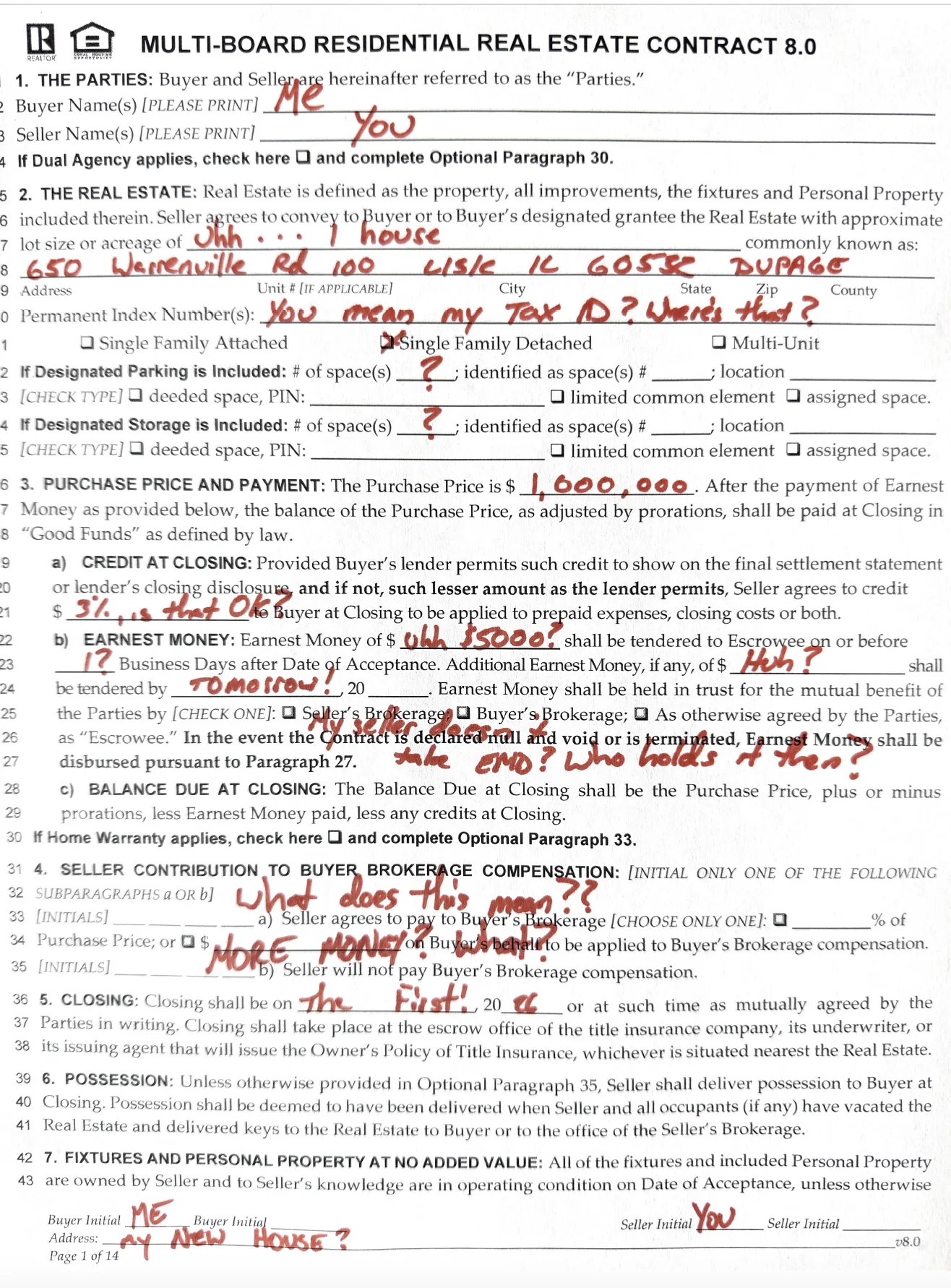
What Is the Multi-Board Contract?
The Multi-Board Residential Real Estate Contract is the standard purchase agreement for residential real estate transactions across metropolitan Chicago and most of Illinois. It's approved by over 20 REALTOR associations and bar associations, including the Chicago Association of REALTORS, the Illinois Real Estate Lawyers Association, and bar associations from Cook County to Will County.
If your agent hands you a contract for a house, condo, or townhome in Illinois, this is almost certainly the form you're signing.
What Changed from 7.0 to 8.0?
The headline change is Paragraph 4, a brand-new section on buyer brokerage compensation driven by the NAR settlement. Under the old rules, the seller's listing agreement typically covered both agents' commissions. Now, buyer brokerage compensation must be addressed separately.
Other notable changes in 8.0:
- Paragraph 13(d): A new "non-counteroffer proposal" mechanism that lets attorneys make proposals that don't kill the contract if rejected
- Updated fixtures checklist: Electric vehicle charging systems, video doorbells, and surveillance systems added
- Clarified financing alternatives: The three-tier financing structure (contingency, cash-no-financing, cash-financing-allowed) is more clearly delineated
- Copyright date: 2025 Multi-Board Joint Venture
Paragraphs 1-2: The Parties and the Property
Paragraph 1 identifies the buyer and seller. Simple enough, but watch for trusts, LLCs, and estate situations where the wrong entity name can torpedo a closing.
Paragraph 2 defines the "Real Estate," the property itself, all improvements, fixtures, and personal property included in the sale. You'll specify the address, PIN, property type (single family attached, detached, or multi-unit), and any designated parking or storage spaces.
The checkbox for dual agency (referencing Optional Paragraph 30) is right here at the top. If the same brokerage represents both sides, this must be initialed.
Attorney tip: Always verify the PIN against the legal description on the title commitment. Mismatches happen more often than you'd think.
Paragraph 3: Purchase Price and Payment
This paragraph does three things:
3(a): Credit at Closing
The seller can agree to credit the buyer a dollar amount toward prepaid expenses, closing costs, or both. The critical language new in 8.0: "and if not, such lesser amount as the lender permits." This means if the lender caps seller credits at 3% and the contract says $15,000, the credit automatically reduces to whatever the lender allows. No amendment needed.
3(b): Earnest Money
The deposit that shows the buyer is serious. Typically $5,000-$10,000 in the Chicago market, though it varies. Earnest money is held in trust by the escrowee (usually the seller's brokerage) and applied to the purchase price at closing.
The bolded language is crucial: "In the event the Contract is declared null and void or is terminated, Earnest Money shall be disbursed pursuant to Paragraph 27." This means every termination provision in the contract funnels back to Paragraph 27's disbursement mechanics.
3(c): Balance Due at Closing
Purchase price, plus or minus prorations, minus earnest money, minus credits. Paid in "Good Funds," which means wire transfer or cashier's check.
Attorney tip: The earnest money deadline is a real deadline. Missing it is a breach the seller can act on, but it does not undo the contract. In Catholic Charities of the Archdiocese of Chicago v. Thorpe, 318 Ill. App. 3d 304 (1st Dist. 2000), the court held that "the payment of the earnest money is not a condition precedent to the formation of the contract," and that a condition precedent to formation will not be found unless the intent to create one is apparent on the face of the agreement. Treat the deadline as real anyway, because the seller does have remedies under Paragraph 27.
Cost of getting this wrong:
Lost earnest money: $5,000 - $10,000. This is the most common dollar amount buyers lose when contract terms are misunderstood.
Paragraph 4: Seller Contribution to Buyer Brokerage Compensation (NEW)
This is the NAR settlement paragraph. One of two subparagraphs must be initialed:
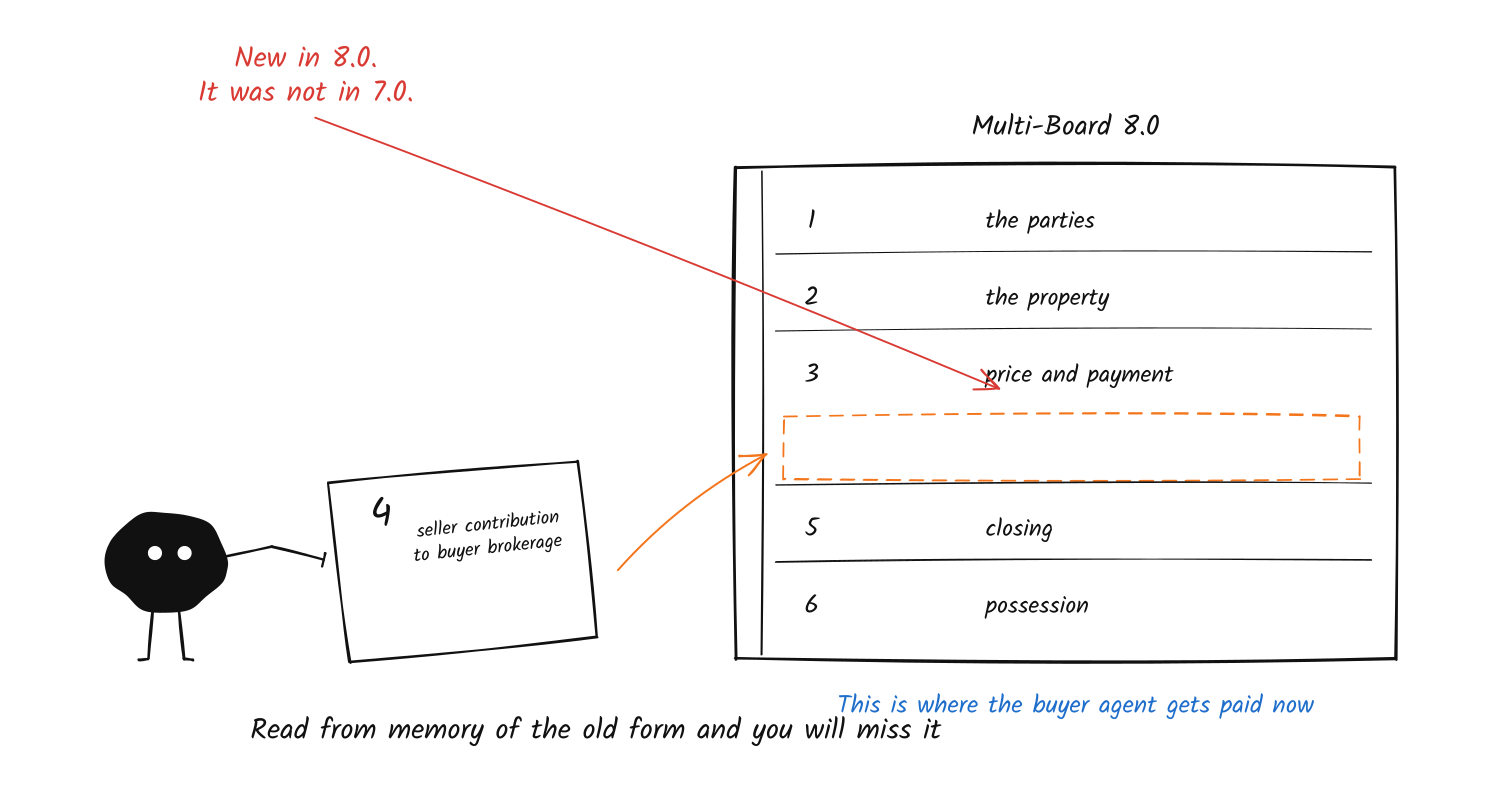
(a) Seller agrees to pay a percentage of the purchase price OR a flat dollar amount toward the buyer's brokerage compensation.
(b) Seller will not pay buyer brokerage compensation.
This is the biggest structural change from 7.0. Previously, the listing agreement handled agent compensation on both sides. Now it's explicitly addressed in the purchase contract. If you're a buyer's attorney, make sure your client understands how their agent is getting paid before they sign.
Contract Review: What Mistakes Actually Cost
- ❌ Wrong proration: $250 - $500 out of your pocket
- ❌ Missed inspection deadline: lost negotiating power
- ❌ Bad financing contingency: lost earnest money ($5K - $10K)
- ❌ "He caught something in paragraph 15 that would have cost me $12,000"
- ✅ $500 flat fee, attorney review through closing
- ✅ Every modification, negotiation, and deadline tracked
- ✅ Free consultation before you sign
- ✅ Multi-Board 8.0 contracts reviewed daily
What this costs without an attorney:
Wrong proration: $500. Missed inspection errors? $2000. Bad financing contingency: lost earnest money ($5,000 - $10,000). Our actual reviews say 'He caught something in paragraph 15 that would have cost me $12,000.'
What this costs with us:
$500 flat fee. Contract review through closing. Free consultation before you sign.