
Bought a House with Your Boyfriend or Girlfriend? What Illinois Law Says When You Split Up
Illinois does not recognize common law marriage. There is no divorce court for unmarried couples. If both of you are on the deed and one of you wants out, the law gives you a partition action, which is a lawsuit that forces the property sold. I have represented both the person trying to keep the house and the person trying to sell it. Most of these cases settle through a buyout if both sides act early enough. When they do not, a judge orders the property listed and the proceeds split, and nobody walks away happy.
Many partition fights start with an inherited house. The full selling path is here: selling an inherited house in Illinois.
Does this sound like you?
- I bought a house with my boyfriend/girlfriend and we broke up
- My ex won't agree to sell the house
- My ex stopped paying the mortgage but won't leave
- I want to keep the house but my ex wants to force a sale
- We're not married and I don't know what rights I have

Illinois Does Not Recognize Common Law Marriage
In Illinois, it does not matter if you lived together for 15 years, raised children, and told your families you were married. Unless you have a marriage certificate, you are legal strangers when it comes to property division. Illinois abolished common law marriage more than a century ago: common law marriages contracted here after June 30, 1905 are invalid. 750 ILCS 5/214. A valid Illinois marriage takes a license, solemnization, and registration. 750 ILCS 5/201. Without that, there is no marital estate, no equitable distribution, and no family court judge splitting things up.
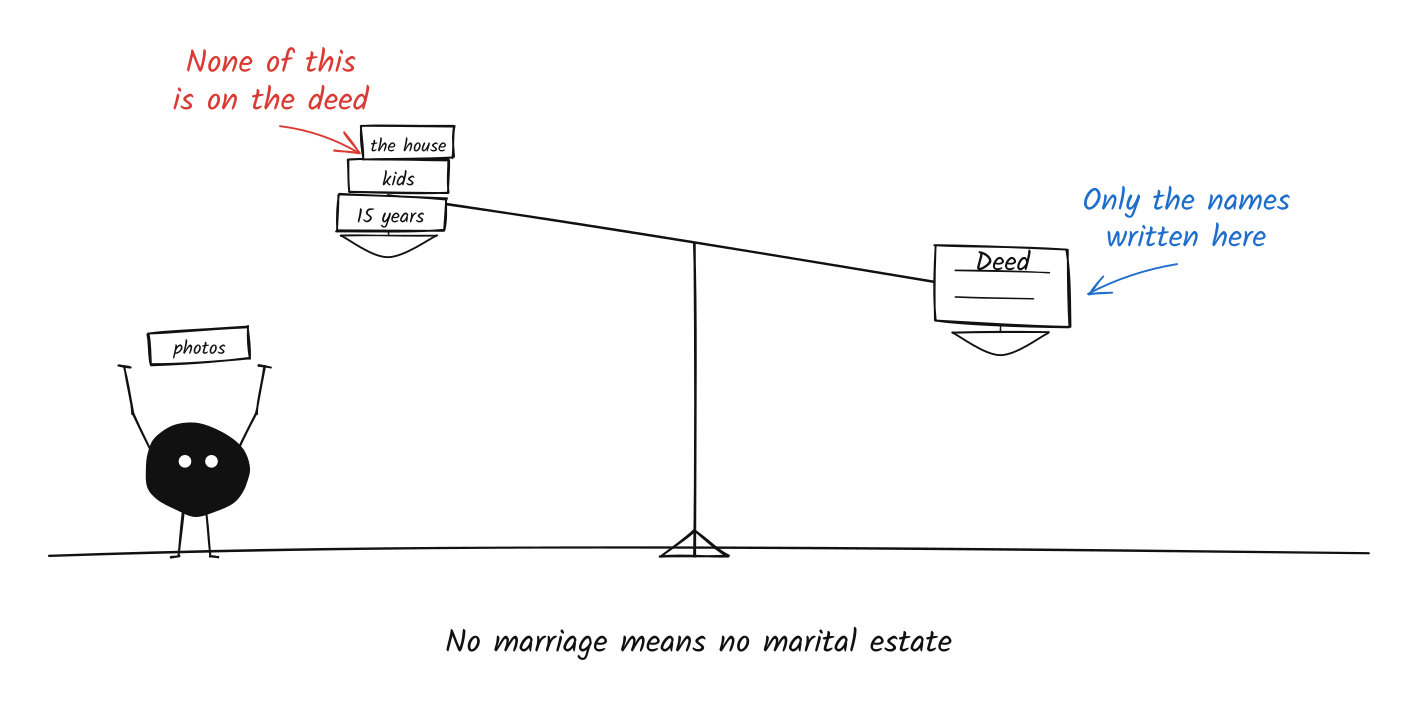
Your rights come from the deed. If both names are on it, you are both owners, and the law of co-ownership governs how you separate. If only one name is on the deed, the person who is not on it generally has no ownership claim, regardless of how much they contributed to mortgage payments or renovations.
If your name is not on the deed: You likely have no ownership interest. Paying half the mortgage for five years, putting $30,000 into the kitchen, living there the entire time, none of that creates an ownership right under Illinois law. There are narrow exceptions involving constructive trusts and unjust enrichment, but those claims require clear evidence of an actual agreement that you would receive an ownership interest. Talk to an attorney before assuming you have rights.
What Is a Partition Action
A partition action is a lawsuit under 735 ILCS 5/17-101 that asks the court to divide co-owned property. For a house or condo, "divide" means sell. You cannot split a building in half. The court orders the property sold, pays off the mortgage from the proceeds, and divides what remains between the co-owners.
Any co-owner can file at any time. You do not need the other person's consent, and you do not need to prove wrongdoing. Partition is a right, not a remedy the judge weighs, and a court will not refuse it just because the other owner does not want to sell. What can change the path is a writing. A co-ownership, buyout, or first-refusal agreement signed by both owners can control timing, price, and sequence, and courts enforce those terms. The statute also gives the court real work to do: under 735 ILCS 5/17-105 it must first decide whether the property can be divided in kind without manifest prejudice, and it orders a sale only when it cannot. Two more things in that section matter to anyone facing a forced sale. The court fixes a value before the sale, and no sale may be approved for less than two-thirds of that valuation, so a lowball auction result is not something you have to accept. And if the property came down through a family and qualifies under the Uniform Partition of Heirs Property Act, that Act governs instead, with its own appraisal and buyout procedure.
The case is filed in the Chancery Division of the circuit court where the property sits. The complaint names the co-owners and any lienholders. If the parties cannot agree on a listing agent or sale terms, the court appoints a commissioner to run the process.
The Timeline
Contested partition cases run 6 to 18 months from filing to final distribution. The court has to determine ownership interests, sort out who paid what, handle any appraisal disputes, supervise the listing and sale, and distribute the proceeds. If one side is dragging their feet, the court can order compliance, but enforcement adds more time.
When both parties agree to sell and can cooperate on choosing a realtor, the whole thing can wrap in 3 to 6 months. The delay in contested cases usually comes down to arguments about valuation, arguments about credits for contributions, and whether one party should get a chance to buy the other out.
How You Hold Title Matters
The deed you signed at closing specified how you hold title. Most unmarried couples end up as joint tenants with right of survivorship, often because the closing attorney or title company defaulted to it and nobody asked questions. Some take title as tenants in common. The difference matters when the relationship ends.
| Joint Tenancy | Tenancy in Common | |
|---|---|---|
| Ownership share | Equal (always 50/50) | Can be unequal (e.g., 60/40) |
| Survivorship | Yes. If one owner dies, the other gets the full property automatically. | No. Each owner's share passes through their estate. |
| Partition right | Yes. Either party can file. | Yes. Either party can file. |
| Can one party sell their share? | Yes, but it severs the joint tenancy and converts to tenancy in common. | Yes, and the new co-owner steps into the seller's position. |
| Common with unmarried couples? | Very common. Often chosen without understanding the implications. | Less common. More typical in investment co-ownership. |
The survivorship feature of joint tenancy is what catches people off guard. If your co-owner dies while you still hold title together, you own the entire property automatically, bypassing probate. That is a real benefit during the relationship. But it also means that if you break up and your ex dies before the partition resolves, the surviving party inherits everything. People who have been fighting for months over equity suddenly have a very different problem if something happens to one of them.
Title does not equal contribution. Joint tenancy means 50/50 regardless of who made the down payment or who has been making the mortgage payments. If you put down $60,000 and your partner put down $10,000, you are still equal owners. You can seek credit for unequal contributions during the partition accounting, but the default split is equal.
How These Cases Actually Play Out
From Our Case Files
An unmarried couple purchased a suburban townhome as joint tenants in 2020 with an FHA mortgage at 3.625% fixed and a second-position loan through the Illinois Housing Development Authority. The relationship ended in early 2023. One party stopped contributing to the mortgage but stayed in the property, while the other moved out and watched their credit deteriorate with each missed payment.
When informal negotiations failed, a partition action was filed because the parties needed to resolve whether the property would be retained or sold.
FHA Mortgage Assumption
During the pendency of the case, there was talk about retaining the property through an FHA mortgage assumption instead of forcing a sale. FHA loans originated before a certain date are assumable, meaning the party who wants to keep the house can take over the existing loan, with the lender's approval, and remove the departing party from the note entirely. In this case, the existing rate was 3.625%. New purchase rates in 2023 were above 7%. Over the remaining life of the loan, that rate difference represented over $150,000 in total interest costs.
This is why assumptions matter in partition cases. If the property carries a below-market rate, a forced sale destroys that locked-in value for everyone. The buyer gets a new loan at market rates. The co-owners split whatever equity is left after commissions and closing costs. An assumption lets one party keep the favorable financing while the other walks away with cash and a clean break from the mortgage obligation.
Assumptions require the lender's approval, a creditworthy assuming party (sometimes with a cosigner), and a negotiated payout to the departing co-owner for their equity share. They are not simple, but in a rising-rate environment, they save real money compared to a forced sale and refinance.
The Court's Order
The court was not willing to wait indefinitely. After hearing arguments, the judge ordered the property listed for sale within 21 days and ordered both parties to cooperate in selecting a listing agent. The message from the bench was plain: work it out between yourselves, or the court will do it for you, and neither side will like the result as much as the one they could have negotiated.
If you want to keep the property, show up with a plan. Judges hear "I want to keep the house" in every partition case. What they want to see is a financing commitment, a realistic timeline, and a fair offer for the other party's equity. Without that, the court orders a sale and moves on to the next case.
Attorney Fees: The Part Nobody Talks About
Under 735 ILCS 5/17-125 the court apportions the costs of a partition, including a reasonable fee for the plaintiff's attorney, among the co-owners so that each pays an equitable portion. In practice that fee comes out of the sale proceeds before anyone is paid. Two conditions matter and both get missed. The rule applies only when the complaint properly sets out everyone's rights and interests. And it does not apply at all "unless the defendants, or some of them, interpose a good and substantial defense to the complaint," in which case the statute flips: the party raising that defense "shall recover their costs against the plaintiff according to justice and equity." So a co-owner with a real defense who raises it is not funding the other side. A co-owner who simply stalls gets no such protection, and pays an equitable share of the petitioner's fee on top of their own.
I see the same pattern over and over. The boyfriend wants to keep the property. The girlfriend wants to sell and move on. She files partition. He drags his feet, misses court dates, refuses to agree on a listing agent, and stalls for months. By the time the court finally forces the sale, her legal fees are $15,000 to $20,000, and the court orders those fees paid from the proceeds before anyone sees a dollar of equity. He ends up losing the house anyway, and he effectively paid for both sides of the litigation by refusing to engage.
The math on obstruction: Suppose the house sells for $350,000 with a $250,000 mortgage payoff. That leaves $100,000 in equity. After $30,000 in combined attorney fees (much of it caused by one party's refusal to cooperate), $15,000 in realtor commissions, and the accounting adjustments, the person who spent 18 months fighting to keep the house walks away with less than $25,000 and a credit score in the 500s. They could have negotiated a buyout for $50,000 and kept the property. That is what obstruction costs.
If someone files a partition action against you, take it seriously. Hire an attorney. Respond to the complaint. Come to the table with a buyout proposal or agree to cooperate on the sale. The worst thing you can do is ignore it, because the court will proceed without you and you will pay for the privilege.
Accounting: Who Paid What
The court does not just split the sale proceeds 50/50 and close the file. There is an accounting phase where each party's contributions are tallied and the distribution is adjusted. This is where the real fight happens in most partition cases.
What Counts as a Contribution
Mortgage payments made after the separation count, including principal, interest, taxes, and insurance. Same with property tax payments made by one party alone, insurance premiums, necessary repairs that preserved the property's value, unequal down payment contributions, and capital improvements that increased market value (new roof, HVAC, a kitchen renovation that actually adds resale value).
What Does Not Count
Occupancy is its own category. The party living in the property after the split may owe the other party fair rental value for exclusive use. This cuts both ways: the occupying party gets credit for mortgage payments but may owe rent for having the place to themselves. Beyond that, cosmetic upgrades that did not increase market value, utility payments for the occupying party's benefit, and any claim based on the emotional labor of the relationship are all off the table. Illinois courts do not award property interests based on who did more around the house.
The accounting phase runs on documentation. Bank statements, cancelled checks, receipts, contractor invoices, tax records. If you have been paying the full mortgage since the breakup, start organizing those records now. The party with better paperwork gets the better result.
Start documenting today. If you are paying the full mortgage on a co-owned property right now, save every bank statement and receipt. Screenshot your payment confirmations. Take photos of any repairs you pay for. This documentation directly determines how much of the sale proceeds you receive in the accounting phase.
The Buyout: How to Keep the House
A buyout is almost always cheaper than a forced sale. In a partition sale, the property goes on the market under conditions that do not produce the best price. Both parties are paying lawyers, the listing period adds months of carrying costs, and the buyer can see from the lis pendens that this is a distressed situation. Offers come in accordingly.
In a buyout, one party keeps the property and compensates the other for their equity. The departing party gets cash and a clean break from the mortgage. Nobody pays a realtor commission. The property does not sit on the market for four months while two ex-partners try to agree on showing schedules.
What a Buyout Requires
Both parties need to agree on the property's value, either by getting an independent appraisal or negotiating a number. From there, you subtract the mortgage balance to calculate equity, adjust for each party's contributions in the accounting, and determine what the buying party owes the departing party. The buying party then refinances the mortgage into their name alone (or assumes the existing loan if the lender allows it), and the departing party executes a quitclaim deed. The whole process typically takes 60 to 120 days. If the buyout does not close within the agreed window, the partition moves forward to a sale.
A buyout negotiation, by contrast, can often be handled for a fraction of that. The variables are the property value, the mortgage balance, and what each party has contributed. When the numbers are clear and both people are willing to be reasonable, the negotiation is straightforward. The problem is that by the time people call me, reasonable has usually been off the table for months.
Lis Pendens and the Mortgage
When a partition action is filed, the plaintiff typically records a lis pendens against the property. This is a public notice that litigation is pending, and it shows up on any title search. The property cannot be sold or refinanced while it is in place without first resolving the lawsuit.
The lis pendens protects against one party selling or encumbering the property behind the other's back. It also means neither side can refinance, take out a home equity loan, or transfer the property into an LLC until the case is resolved.
The Mortgage Problem
The mortgage does not care about your breakup. Both names are on the note. Both parties are liable for the full payment. If one of you stops paying, the lender comes after both of you. Missed payments hit both credit scores. If it goes all the way to foreclosure, the deficiency judgment follows both borrowers.
This is the leverage that drives most partition cases toward settlement. The party who wants to sell is watching their credit score drop every month the other party does not pay. The party who wants to keep the house needs money to buy out the other side. Both people have a financial incentive to resolve the case, and judges know that, which is why they push hard for settlement.
Monitor the mortgage yourself. Once the relationship ends, do not assume your ex will keep paying. Set up your own login to the lender's online portal. If you are not living in the property, you will not hear from the lender until you get a default notice, and by then you may be 90 days delinquent with no way to fix the damage.
The Cost of Doing Nothing
I see the same thing repeatedly. The couple breaks up. One moves out. The other stays. Neither wants to deal with the house because it means dealing with each other. Months pass. Then years.
Every month costs money. The person in the house is paying a mortgage that benefits both owners but getting no formal credit for it. The person who moved out has their credit at risk if payments lapse. The property may be deteriorating. And if the market shifts, the equity position changes for both sides in ways neither of them planned for.
| Option | Typical Cost | Timeline |
|---|---|---|
| Negotiated buyout | $1,500 - $3,000 in legal fees | 60 - 120 days |
| Agreed sale (no litigation) | $1,000 - $2,000 in legal fees + realtor commission | 90 - 180 days |
| Contested partition action | $5,000 - $15,000+ per side, plus petitioner's fees from proceeds | 6 - 18 months |
| Doing nothing for 12 months | $0 in legal fees, but $12,000 - $24,000+ in mortgage payments with no resolution, credit damage, possible foreclosure | Indefinite |
Co-Ownership Agreements: How to Avoid All of This
If you are reading this before buying a house with your partner, you are in a good position. A co-ownership agreement signed at closing addresses every problem in this article before it becomes a crisis. Think of it as a prenup for the house, except you do not need to be getting married to need one.
The agreement is a contract between the co-owners that covers what happens if the relationship ends, if one party wants out, if someone stops paying, or if someone dies.
What It Should Cover
- Ownership percentages and how they relate to financial contributions
- Buyout rights: if one party wants out, the other gets first right of refusal at appraised value
- A buyout timeline, typically 90 to 120 days, with a forced sale trigger if the buyout does not close
- Payment obligations and what happens if someone stops paying (the other party makes the payment and receives an equity credit)
- Occupancy rights, including whether the occupant owes rent to the non-occupant
- How renovation costs are shared and how they affect the equity split
- Mediation before litigation, with the cost shared equally
I draft these as part of my closing representation. If you are buying with someone you are not married to, bring it up at the closing consultation. A co-ownership agreement costs a fraction of what partition litigation costs, and it eliminates the uncertainty that makes these disputes so expensive and so ugly.
Already own property together? You can put a co-ownership agreement in place at any time. Even if you have owned the property for years, a written agreement that addresses what happens when one party wants out is better than hoping it never comes to that.
Frequently Asked Questions
Can my ex-boyfriend or ex-girlfriend force me to sell our house?
Yes, subject to two checks. Any co-owner can file under 735 ILCS 5/17-101, but the court decides first under 735 ILCS 5/17-105 whether the property can be divided in kind, and a signed co-ownership or buyout agreement controls on its own terms. For a single-family house or a condo neither check usually stops the sale, because you cannot physically divide a house, which is why a negotiated buyout is the realistic alternative.
How long does a partition action take?
Contested cases run 6 to 18 months. If both parties agree to sell and can cooperate on choosing a realtor, the process can wrap in 3 to 6 months. Most of the delay comes from disputes about valuation, credits for unequal contributions, and whether one side gets a chance to buy the other out.
Who pays attorney fees in a partition action?
Under 735 ILCS 5/17-125 the court apportions costs, including a reasonable fee for the plaintiff's attorney, among the co-owners in their equitable shares, so the fee comes out of the proceeds. That happens only where the complaint properly sets out everyone's interests and no defendant raises a good and substantial defense. A co-owner who raises a real defense recovers costs against the plaintiff instead. A co-owner who just obstructs effectively pays for both sides, which is the single biggest reason to engage early, either negotiate a buyout or agree to a cooperative sale.
Do unmarried couples have property rights in Illinois?
Only if your name is on the deed. Illinois does not recognize common law marriage. If you are on the deed as a joint tenant or tenant in common, you have a legal ownership interest enforceable through partition. If you are not on the deed, you generally have no claim regardless of how much you contributed financially.
What is the difference between joint tenancy and tenancy in common?
Joint tenancy includes a right of survivorship: if one owner dies, the other inherits the full property automatically. Tenancy in common has no survivorship, and each owner's share passes through their estate. Both forms allow partition. Most unmarried couples who buy together end up as joint tenants, often without fully understanding what that means.
Can I get credit for paying the mortgage after we broke up?
Yes. The court conducts an accounting of each party's post-separation contributions. Mortgage payments, taxes, insurance, and necessary repairs all count. Keep every receipt and bank statement, because the documentation directly determines how the proceeds are divided.
What if my ex is not on the mortgage but is on the deed?
Being on the deed means they own an interest in the property regardless of the mortgage. They can file for partition and collect their share of the equity. Being on the mortgage but not the deed is the opposite problem: you owe the debt but own nothing.
Does this apply to a married couple?
Often not. 735 ILCS 5/17-101 reaches property held in joint tenancy, tenancy in common, or another form of co-ownership. Spouses who took title to their homestead as tenants by the entirety hold something the statute does not let one of them break apart. Under 765 ILCS 1005/1c that estate exists only for as long as the spouses remain married, and no deed, contract for deed, mortgage, or lease of the property is even effective unless both sign. On a judgment of dissolution the estate becomes a tenancy in common by operation of law, and at that point it is partitionable, though the division normally happens inside the divorce case rather than in a separate partition suit. Check the vesting language on your deed before anything else, because it decides which body of law you are in.
Can a partition action be stopped?
Not by simply objecting. A court will not refuse partition just because a co-owner does not want to sell. What can change the outcome is a signed co-ownership or buyout agreement, which courts enforce on its terms, and under 735 ILCS 5/17-105 the court decides first whether the property can be divided in kind rather than sold. The court also has discretion over the process, including allowing time for a buyout and ordering mediation. The practical way to prevent a forced sale is to negotiate a buyout that satisfies the petitioner.
What happens to the mortgage in a forced sale?
The mortgage is paid off from the sale proceeds at closing, same as any other sale. If the property is underwater (sale price less than the mortgage balance), both borrowers may face a deficiency judgment. This is another reason to resolve co-ownership disputes before property values decline.
Call Me and Tell Me Where Things Stand
Buying a house with someone you are not married to is not illegal. But it creates a co-ownership arrangement with no built-in exit ramp. When married couples divorce, Illinois law has a structured process for dividing marital property. When unmarried couples split, the only option is a partition action, a statute originally designed for co-owners of farmland, applied to couples who bought a condo together last year.
If you are already in this situation, the priority is getting to a resolution. The longer you wait, the more it costs both of you. If you are about to buy property with a partner, get a co-ownership agreement at closing. It is the cheapest insurance you will ever buy.
Either way, call my office. Tell me the property address, who is on the deed, who is on the mortgage, and whether your ex is being reasonable. I will tell you what your options are and what they cost.
Related Guides
If you are buying property with a partner and want closing representation that includes a co-ownership agreement, read the closing attorney guide. For investors acquiring properties through LLCs that sidestep co-ownership complications entirely, the investor services guide covers entity structuring. If you need to transfer a property interest into an LLC after resolving a co-ownership dispute, the transfer guide walks through the process.
Published: April 2026