

How Much Does It Cost to Transfer Property Into an LLC in Illinois?
It depends on your county and how many deeds you need. My fee is $100 per deed. That covers a warranty deed, the PTAX-203 exemption filing, and recording. The county recording fee is extra, at cost. In DuPage, the total is $176. If the deed states under $100 in consideration, you owe no state or county transfer tax. If a bank holds your loan on its own books, get its written consent first. A DIY quit claim deed costs $50 to $100. But it gives the title company an argument that your coverage ended.
You formed your LLC. You have an operating agreement. Now the property needs to actually move into the entity. This is the step where people either do it right or create expensive problems they don't discover until they file an insurance claim or try to refinance.
Why Transfer Property into an LLC
If your rental property is titled in your personal name and a tenant gets injured, the tenant can sue you personally. A judgment against you reaches everything you own: your house, your savings, your other properties. An LLC creates a liability wall between the rental property and your personal assets. The tenant sues the LLC, and the LLC's assets are the only thing at risk.
That protection is only real if the property is actually titled in the LLC's name. I see landlords every month who formed an LLC two years ago but never transferred the deed. The LLC is just a piece of paper at the Secretary of State's office. It does not own anything. Until the deed is recorded in the LLC's name at your county recorder's office, you have no asset protection at all.
Effective January 1, 2025, P.A. 103-920 added 805 ILCS 180/10-10(a-5), which confirms that a member or manager can be personally liable under law other than the LLC Act, "including, but not limited to, the law of agency, contracts, and torts," for his or her own wrongful acts, even when acting for the company. The amendment did not tighten veil piercing; 10-10(c) still provides that failing to observe the usual company formalities "is not a ground for imposing personal liability." What the change does mean is that titling and paperwork will not insulate you from your own conduct, so getting the property titled correctly is the floor, not the ceiling.

Quit Claim vs. Warranty Deed
Every article you'll find online says to use a quit claim deed for this transfer. The reasoning is simple: you're transferring to yourself (through your LLC), so you don't need title warranties. That reasoning is wrong, and I draft warranty deeds for these transfers instead.
A quit claim deed transfers whatever interest you happen to have in the property. It makes no guarantees about the quality of that interest. A warranty deed guarantees that you hold clear title, free of encumbrances, and that you have the right to transfer it. The practical difference matters because of what happens to your title insurance.
When you bought the property, your title insurance policy was issued in your name as an individual. Title insurance does not automatically follow the property when ownership changes. A quit claim deed to your LLC gives the title company an easy argument that coverage terminated when ownership transferred to a new entity. A warranty deed provides the LLC with title warranties from you, which makes it substantially easier to maintain continuity of coverage or obtain an endorsement adding the LLC to the existing policy.
The statutory forms for both deeds are in 765 ILCS 5/9 (warranty) and 765 ILCS 5/10 (quit claim). I use the warranty form with additional language specifying that the transfer is for organizational purposes only and the beneficial ownership is unchanged.
The Due-on-Sale Clause
This is the question that keeps landlords up at night: will transferring my property to an LLC trigger the due-on-sale clause in my mortgage?
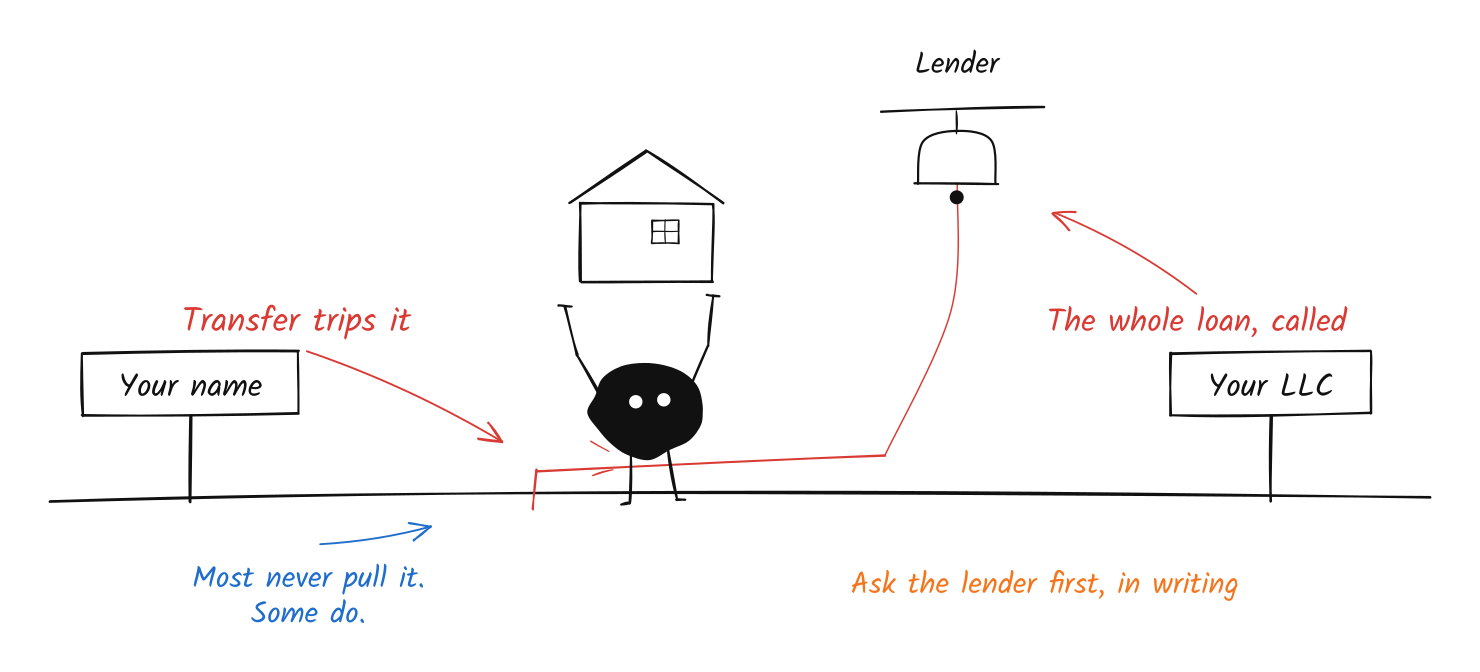
Almost every residential mortgage contains a due-on-sale clause. It says the lender can demand immediate full repayment of the loan if you transfer ownership without the lender's consent. The Garn-St. Germain Act (12 U.S.C. § 1701j-3) preempts these clauses for certain types of transfers on residential properties with fewer than five dwelling units.
The Act lists nine specific exemptions. Transfers into a living trust where the borrower remains the beneficiary are protected under exemption number 8. Transfers to a spouse or children are protected under exemption number 6. Transfers to an LLC are not listed. This is the part that every content-farm article glosses over: Congress protected trust transfers but did not extend the same protection to LLC transfers.
In practice, most lenders do not enforce the due-on-sale clause against borrowers who transfer to their own single-member LLCs. There are several reasons for this. Fannie Mae's Servicing Guide (section D1-4.1-02) explicitly permits servicers to allow transfers to LLCs controlled by the original borrower. Freddie Mac has virtually identical guidance. Since Fannie and Freddie own or guarantee the majority of residential mortgages in the country, most servicers follow their lead.
The risk is real, though, for portfolio loans. Credit unions, community banks, and private lenders that hold loans on their own balance sheets are not bound by Fannie/Freddie guidance. I have had clients receive demand letters from portfolio lenders after recording a deed transfer. The lender eventually backed down in each case, but only after attorney involvement.
I go deeper on the Garn-St. Germain Act, the nine exemptions, and due-on-sale risk management in my guide to subject-to acquisitions. If you're an investor buying properties subject-to existing financing, the due-on-sale analysis is the same legal framework, just with higher stakes.
Transfer Tax Exemptions in Illinois
Illinois imposes transfer taxes when real property changes hands. The state rate is $0.50 per $500 of consideration under 35 ILCS 200/31-10. Counties add $0.25 per $500 under 55 ILCS 5/5-1031. On a $300,000 property, that would be $450 in combined transfer taxes.
You don't pay that. Under 35 ILCS 200/31-45(e), transfers where the actual consideration is less than $100 are exempt from both state and county transfer tax. When you transfer a property you already own into your own LLC, the consideration is nominal. I draft these deeds with a stated consideration of $10, which is standard practice and clearly falls within the exemption.
Plan on filing the declaration anyway. Section 31-25 requires one for every deed "[e]xcept as provided in Section 31-45," and Section 31-45 is the list of exempt transfers. Your nominal-consideration transfer sits in subsection (e). Three of the exempt subsections, (b), (k) and (m), are singled out as deeds that "shall not be exempt from filing the declaration," meaning those still have to file one even though no tax is owed. Subsection (e) is not among them, so the statute alone does not compel a PTAX-203 on a sub-$100-consideration deed. County practice is what actually governs. Recorders want an exemption statement on the face of the deed, and Cook and the other MyDec counties process exempt transfers through MyDec. That is why I prepare and file the declaration on every transfer, including the ones the statute would let you skip: the recorder is the office that decides whether your deed gets accepted.
One more provision to flag: 35 ILCS 200/31-5 defines a "controlling interest" in a real estate entity. If you later sell more than 50% of your LLC's membership interests, that sale may trigger transfer tax on the property's full fair market value, even though no deed changes hands. This matters for multi-member LLCs and for anyone planning to sell the LLC rather than the property. I cover the implications of selling LLC interests on the LLC formation page.
County Recording Fees
Recording fees vary by county. These are the current fees for the counties I handle most frequently.
| County | Recording Fee | Notes |
|---|---|---|
| DuPage | $76 | Includes GIS ($31), RHSP ($18), document storage ($10) |
| Cook (suburban) | $88 - $107 | Varies by RHSP applicability |
| Cook (Chicago) | $88 - $107 | Plus city transfer tax on non-exempt transfers |
| Will | $72 | Standard document recording |
| Kane | $68 | Standard document recording |
| Lake | $74 | Standard document recording |
| McHenry | $66 | Standard document recording |
These fees cover the deed recording only. The PTAX-203 is filed alongside the deed at no additional charge. If your transfer is exempt from transfer tax (which it should be for a self-to-LLC transfer with nominal consideration), no tax payment is required at the recorder's window.
To put it plainly: a DuPage County transfer costs $100 (my fee) + $76 (recording) = $176 total. I transferred four rental properties into an investor's Series LLC last month across DuPage and Will counties. The entire project cost $400 for my time plus $296 in recording fees. All four deeds were recorded within a week.
Deed Transfer: Your Options
- Cheap
- Gives the title company an argument that coverage ended
- Claims denied on that basis ($40,000+ out of pocket)
- Refinancing complications
- Exemption missed or misstated on the deed, so the recorder collects transfer tax
- Warranty deed (not quit claim)
- Title insurance stays intact
- PTAX-203 exemption filed (saves $450+ in transfer tax)
- County recording handled
- Title company coordination included
- Properly drafted deed
- May or may not file PTAX-203
- No LLC operating agreement review
- No veil-piercing compliance context
- 2.5x to 7.5x the cost
What this costs without an attorney:
A quit claim deed hands the title company a clean argument that your coverage ended. I have seen a $35,000 garage teardown claim denied after a transfer. If you already quitclaimed, call the insurer before you assume you are bare, because some will still endorse. A new policy runs $2,000+.
What this costs with us:
$100 per deed. Warranty deed, PTAX-203 exemption (saves $450+ in transfer tax), plus county recording fees. Title insurance stays intact.
$100 Per Deed. Recording Fees Extra, at Cost.
I draft the warranty deed, prepare the PTAX-203, and record it at your county. About 20 minutes of my time per property. DuPage, Cook, Will, Kane, Lake, McHenry, and Kendall counties.
The Transfer Process
Confirm Your LLC Is in Good Standing
Before recording a deed in the LLC's name, I check that the LLC is active and in good standing with the Illinois Secretary of State. That includes confirming the LLC has a valid registered agent on file. If your annual report is overdue, the LLC may be administratively dissolved, and a deed recorded in the name of a dissolved entity creates title problems. Filing a late annual report costs $175 ($75 fee + $100 penalty) and takes about a week to process.
Review Your Mortgage and Title Insurance
I pull the loan details to determine if the mortgage is a Fannie Mae or Freddie Mac loan. If it is, I proceed with the transfer and note the agency ownership in the file. If it's a portfolio loan, I contact the lender to get written consent before recording anything. I also contact the title company to confirm how they want to handle the endorsement.
Draft the Warranty Deed and PTAX-203
The deed names you as grantor and your LLC (using the exact legal name from the Articles of Organization) as grantee. It includes the legal description from your existing deed, the PIN, and language establishing that the transfer is for organizational purposes with no change in beneficial ownership. I prepare the PTAX-203 with the correct exemption checked and the $10 nominal consideration stated.
Sign, Notarize, and Record
You sign the deed in front of a notary. I record the deed and PTAX-203 at your county recorder's office and pay the recording fee. Once recorded, the county returns the original deed with a recording stamp, which becomes your proof of transfer.
Update Insurance, Leases, and Bank Accounts
After recording, your landlord or property insurance policy needs to be updated to name the LLC as the insured. Your leases should be amended (or re-executed at next renewal) to name the LLC as the landlord. If the property generates rental income, that income should flow through the LLC's bank account, not your personal account. This step is critical for maintaining the liability shield the LLC is supposed to provide.
Title Insurance: Don't Lose Your Coverage
Title insurance protects the owner against claims, liens, or defects in title that weren't discovered at closing. When you transfer your property to an LLC, the insured entity changes. If the title company decides the transfer voided the policy, you lose that protection entirely, and you won't find out until someone files a lien or claim against the property.
For single-member LLCs, most title companies will issue an endorsement adding the LLC as the named insured, as long as the transfer did not change beneficial ownership. Some companies do this at no charge. Others charge a small endorsement fee. The key is to contact them before recording the deed, not after.
If you formed a multi-member LLC, or if the LLC has members who are not the current property owner, the title company will treat this as a genuine change in ownership. That means a new title policy, not an endorsement. A new owner's policy on a $300,000 property runs roughly $1,500 to $2,500 depending on the underwriter and county. This is a cost that catches multi-member LLC owners by surprise because nobody mentioned it during formation. If you plan to add or remove LLC members after transferring the property, the title insurance implications are something you need to address upfront.
Update Your Insurance Policy
This is the step people skip, and it is the most expensive mistake on this entire page.
Your property insurance policy names you as the insured. After the transfer, the LLC owns the property. If there's a fire, a tenant injury, or any covered loss, the insurance company will look at who owns the property (the LLC) and who is named on the policy (you). If those don't match, the claim gets denied.
I have seen this happen to a client in Naperville who transferred a duplex into an LLC and never updated the policy. A pipe burst eight months later and caused $40,000 in water damage. The insurance company denied the claim because the named insured (the client personally) no longer owned the property. The LLC owned it, and the LLC was not on the policy. The client paid for the repairs out of pocket.
Call your insurance agent the same week you record the deed. You need a landlord or commercial property policy issued in the LLC's name. Premiums may increase slightly because commercial policies are typically priced differently than personal policies, but the alternative is carrying insurance that will not pay a claim.
Chicago: You Must Identify Yourself to Tenants
If your property is in Chicago, transferring it into an LLC creates an additional obligation that most landlords don't know about until a tenant's attorney raises it in court.
Chicago Municipal Code Section 5-12-090, "Identification of owner and agents," requires a landlord or anyone authorized to enter into a rental agreement on the landlord's behalf to disclose to the tenant in writing at or before the commencement of the tenancy the name, address, and telephone number of "(a) the owner or person authorized to manage the premises; and (b) a person authorized to act for and on behalf of the owner for the purpose of service of process and for the purpose of receiving and receipting for notices and demands." Note the word person in subsection (b). Naming only the LLC and its registered agent address does not identify a person authorized to accept service and receipt for notices, so name a human being with a street address and a phone number.
The City strengthened this requirement to address the specific problem of landlords using LLCs (and nested LLCs owned by other LLCs) to make themselves unreachable. If your LLC is owned by another LLC, you have to disclose up the chain until you get to an actual human being with a real street address and phone number.
For Chicago landlords, I draft the 5-12-090 disclosure language directly into the lease when I prepare the LLC transfer. It identifies the LLC as the owner, names the managing member as the person authorized to accept service and receipt for notices, and provides a street address and phone number. Getting this right at the time of transfer prevents it from becoming a liability later. For a deeper look at Chicago-specific landlord obligations, see my RLTO defense guide.
Homestead Exemption
If you are transferring a rental or investment property into your LLC, this section does not apply to you. The homestead exemption under 35 ILCS 200/15-175 only applies to property you occupy as your primary residence.
For the rare client who wants to transfer a primary residence into an LLC for asset protection: you will lose the homestead exemption. In DuPage County and the other counties contiguous to Cook, the general homestead exemption reduces your equalized assessed value by up to $8,000 (since tax year 2023), which translates to a property tax increase of roughly $500 to $800 per year depending on local tax rates. Cook County offers a higher exemption of $10,000 EAV, and counties elsewhere in the state get $6,000. Losing it is meaningful.
I generally recommend against transferring your primary residence into an LLC. The homestead exemption loss, combined with the due-on-sale risk on your home mortgage and the insurance complications, makes it a poor trade-off for most homeowners. A personal umbrella policy is usually a better asset protection strategy for your primary residence. For the rentals themselves, see how the two shields compare: LLC vs umbrella insurance.
$100 Per Deed. Get It Done Right the First Time.
Warranty deed, PTAX-203, and county recording for $100 per property plus recording fees at cost. Title insurance coordination included.
The Land Trust Alternative
Illinois is one of a handful of states with a robust land trust statute. A land trust holds title to real property, with the trustee (typically a title company or law firm) named on the deed and the beneficial interest held privately.
The due-on-sale advantage is the whole reason this strategy exists. The Garn-St. Germain exemption at 12 U.S.C. 1701j-3(d)(8) covers "a transfer into an inter vivos trust in which the borrower is and remains a beneficiary and which does not relate to a transfer of rights of occupancy in the property," and subsection (d) applies only to a loan secured by a lien on residential real property "containing less than five dwelling units." Both halves matter, and the occupancy clause is the one people drop. A properly structured Illinois land trust is generally treated as an inter vivos trust for this purpose, provided you remain the beneficiary and the transfer does not shift rights of occupancy, but no Illinois case squarely holds it. Treat this as a strong argument, not a guarantee. Once the property is in the land trust, you can assign the beneficial interest to your LLC.
The argument for this two-step approach is that the deed transfer (the triggering event for due-on-sale) is protected, and the subsequent assignment of beneficial interest does not involve a new deed or recording. Some legal commentators debate whether lenders could argue the beneficial interest assignment is itself a "transfer" that triggers due-on-sale. In practice, I have not seen a lender pursue this argument in Illinois.
The land trust adds complexity and annual trustee fees (typically $300 to $500 per year). I recommend it primarily for clients with portfolio loans where the lender has explicitly declined to consent to a direct LLC transfer. For Fannie/Freddie loans, the direct transfer is simpler and the due-on-sale risk is already manageable.
Frequently Asked Questions
Further Reading
External resources: 35 ILCS 200/31-45 (Transfer Tax Exemptions) · 12 U.S.C. § 1701j-3 (Garn-St. Germain Act) · PTAX-203 Instructions (IL Dept. of Revenue)
$100. Warranty Deed. Recorded at Your County.
Deed drafting, PTAX-203, county recording, and title insurance coordination. $100 per property plus recording fees at cost. Multiple properties? Same rate per deed.