Real Estate Services / Multi-Board 8.0 Guide

The Complete Multi-Board 8.0 Guide: Every Clause of the Illinois Real Estate Contract Explained

If you're buying or selling a home in Illinois, you're almost certainly signing a Multi-Board Residential Real Estate Contract. Version 8.0 dropped in February 2025, and it's the most significant update in years. This guide walks through all 38 paragraphs.

Just need the contract?

Download the Multi-Board 8.0 Residential Real Estate Contract and get started.

Download Multi-Board 8.0 Contract (PDF)

Justin Abdilla, Illinois real estate attorney at Abdilla and Associates
Justin Abdilla Managing Attorney, Abdilla & Associates

Justin Abdilla has closed tens of millions of dollars in Illinois real estate transactions since founding Abdilla & Associates in 2014. He has personally handled over 400 matters spanning closings, evictions, short sales, foreclosure defense, zoning applications, and creative investor transactions across Cook, DuPage, Kane, Will, and the collar counties. He is a Super Lawyers Rising Stars honoree from 2021 through 2026 and holds 90+ five-star client reviews on Google and Avvo. Last updated: April 2026.

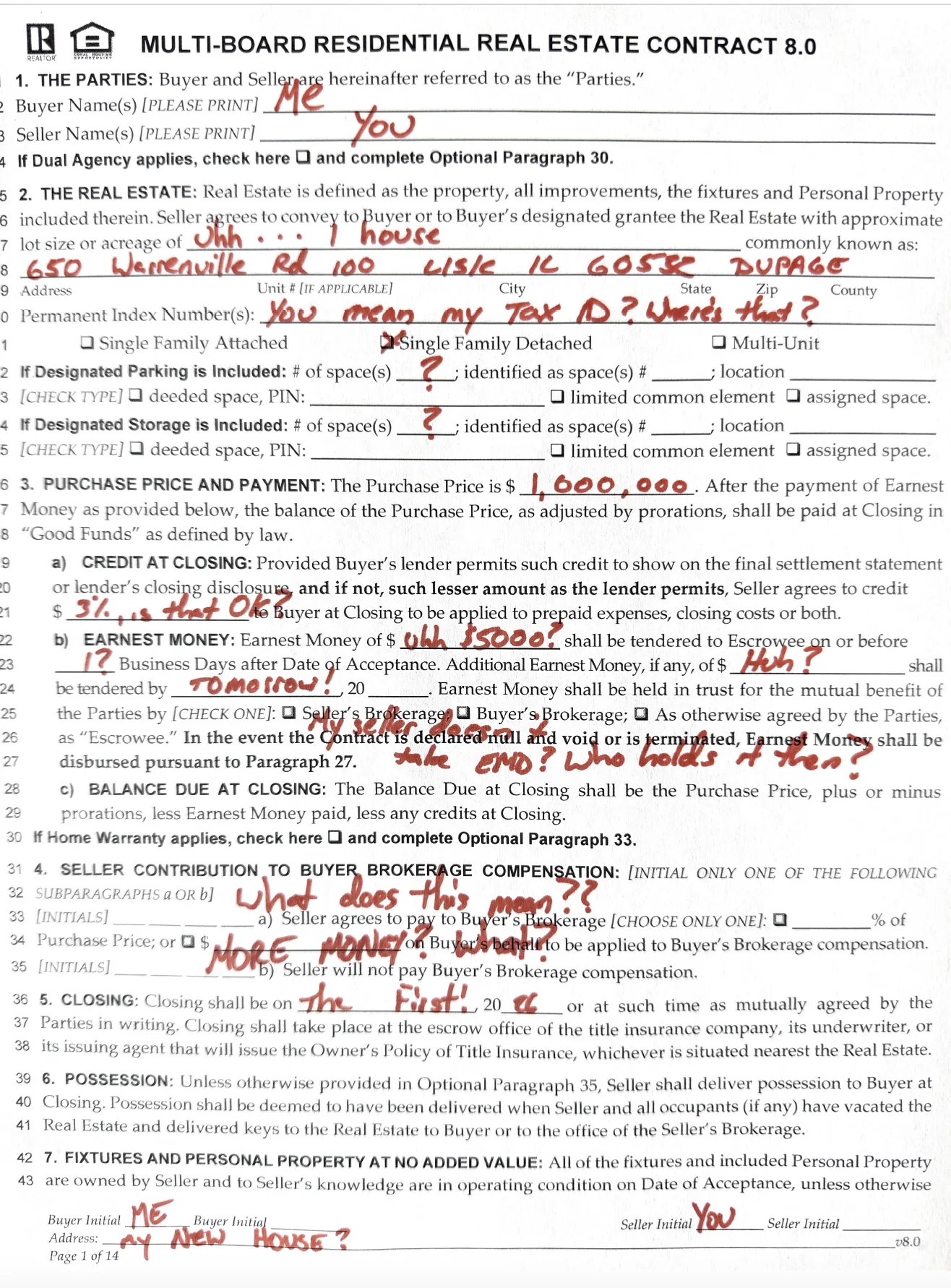
Page 1 of the Multi-Board 8.0 contract with handwritten annotations showing common buyer questions: What is a Tax ID? How much earnest money? Who holds the EMD? What does buyer brokerage compensation mean?
The Multi-Board 8.0 contract, page 1. These are the questions we hear from buyers every single day.

What Is the Multi-Board Contract?

The Multi-Board Residential Real Estate Contract is the standard purchase agreement for residential real estate transactions across metropolitan Chicago and most of Illinois. It's approved by over 20 REALTOR associations and bar associations, including the Chicago Association of REALTORS, the Illinois Real Estate Lawyers Association, and bar associations from Cook County to Will County.

If your agent hands you a contract for a house, condo, or townhome in Illinois, this is almost certainly the form you're signing.

Download the Multi-Board 8.0 Contract (PDF)

What Changed from 7.0 to 8.0?

The headline change is Paragraph 4, a brand-new section on buyer brokerage compensation driven by the NAR settlement. Under the old rules, the seller's listing agreement typically covered both agents' commissions. Now, buyer brokerage compensation must be addressed separately.

Other notable changes in 8.0:

  • Paragraph 13(d): A new "non-counteroffer proposal" mechanism that lets attorneys make proposals that don't kill the contract if rejected
  • Updated fixtures checklist: Electric vehicle charging systems, video doorbells, and surveillance systems added
  • Clarified financing alternatives: The three-tier financing structure (contingency, cash-no-financing, cash-financing-allowed) is more clearly delineated
  • Copyright date: 2025 Multi-Board Joint Venture

Let's go paragraph by paragraph.

Paragraphs 1-2: The Parties and the Property

Paragraph 1 identifies the buyer and seller. Simple enough, but watch for trusts, LLCs, and estate situations where the wrong entity name can torpedo a closing.

Paragraph 2 defines the "Real Estate," the property itself, all improvements, fixtures, and personal property included in the sale. You'll specify the address, PIN, property type (single family attached, detached, or multi-unit), and any designated parking or storage spaces.

The checkbox for dual agency (referencing Optional Paragraph 30) is right here at the top. If the same brokerage represents both sides, this must be initialed.

Attorney tip: Always verify the PIN against the legal description on the title commitment. Mismatches happen more often than you'd think.

Paragraph 3: Purchase Price and Payment

This paragraph does three things:

3(a): Credit at Closing

The seller can agree to credit the buyer a dollar amount toward prepaid expenses, closing costs, or both. The critical language new in 8.0: "and if not, such lesser amount as the lender permits." This means if the lender caps seller credits at 3% and the contract says $15,000, the credit automatically reduces to whatever the lender allows. No amendment needed.

3(b): Earnest Money

The deposit that shows the buyer is serious. Typically $5,000-$10,000 in the Chicago market, though it varies. Earnest money is held in trust by the escrowee (usually the seller's brokerage) and applied to the purchase price at closing.

The bolded language is crucial: "In the event the Contract is declared null and void or is terminated, Earnest Money shall be disbursed pursuant to Paragraph 27." This means every termination provision in the contract funnels back to Paragraph 27's disbursement mechanics.

3(c): Balance Due at Closing

Purchase price, plus or minus prorations, minus earnest money, minus credits. Paid in "Good Funds," which means wire transfer or cashier's check.

Attorney tip: The earnest money deadline is a real deadline. Under Illinois case law, if the buyer fails to deposit earnest money timely, the seller may have grounds to argue no binding contract was formed. See Catholic Charities v. Thorpe, 396 Ill.App.3d 77 (2009).

Paragraph 4: Seller Contribution to Buyer Brokerage Compensation (NEW)

This is the NAR settlement paragraph. One of two subparagraphs must be initialed:

(a) Seller agrees to pay a percentage of the purchase price OR a flat dollar amount toward the buyer's brokerage compensation.

(b) Seller will not pay buyer brokerage compensation.

This is the biggest structural change from 7.0. Previously, the listing agreement handled agent compensation on both sides. Now it's explicitly addressed in the purchase contract. If you're a buyer's attorney, make sure your client understands how their agent is getting paid before they sign.

"I should have called before I signed."

Have Me Review Your Multi-Board 8.0 Contract

The NAR settlement changed everything about how agents get paid. If you're signing an 8.0 contract, a 15-minute call could save you thousands. Flat fee, no surprises.

(630) 839-9195
โ˜…โ˜…โ˜…โ˜…โ˜… 90+ Five-Star Reviews on Google & Avvo

Paragraphs 5-6: Closing and Possession

Paragraph 5 (Closing): Closing occurs at the escrow office of the title insurance company, its underwriter, or the issuing agent nearest the property. The date is filled in on the form. If it falls on a non-business day, it bumps to the next business day.

Paragraph 6 (Possession): Possession transfers at closing unless the parties initial Optional Paragraph 35 (post-closing possession). Possession is "deemed to have been delivered" when the seller has vacated and delivered keys to the buyer or to the seller's brokerage office.

Attorney tip: If your seller needs to stay past closing, always use Paragraph 35 with a meaningful escrow holdback, 2% of the purchase price if left blank. The treble-penalty provision for overstaying the possession date has teeth.

Paragraph 7: Fixtures and Personal Property

The fixtures checklist has grown to about 60 items in 8.0. New additions include electric vehicle charging systems, video doorbells, smart thermostats, and surveillance systems, reflecting what modern homes actually have.

The key warranty: seller warrants all fixtures and included personal property are in operating condition at possession. "Operating condition" means the item "performs the function for which it is intended, regardless of age, and does not constitute a threat to health or safety." A 20-year-old furnace that still heats the house? Operating condition. The same furnace with a cracked heat exchanger? Not operating condition.

Paragraph 8: Financing

This is where deals live or die. Three alternatives; initial only one:

8(a): Financing Contingency

The buyer has until the Financing Contingency Date (45 days after acceptance OR 5 business days before closing, whichever is earlier) to provide written evidence of financing approval subject only to "at close" conditions.

Key deadlines:

  • 10 business days: Buyer must apply for financing and pay all application fees, or seller can terminate
  • Financing Contingency Date: Buyer must show approval or provide notice of rejection/non-approval
  • Delay penalty: A party causing delay in the financing process loses the right to terminate

If the buyer gets a written rejection, the contract is null and void upon notice to the seller. If the buyer simply hasn't gotten approval yet, the contract becomes voidable at either party's election, a critical distinction.

Illinois courts take the good-faith obligation seriously here. In Osten v. Shah, 104 Ill.App.3d 784 (1982), the court recognized an implied duty of good faith in pursuing financing. And in Djomlija v. Urban, 107 Ill.App.3d 960 (1982), the court held that failure to provide timely notice of financing status creates a conclusive presumption that financing was obtained or waived.

8(b): Cash Transaction, No Financing

All cash, no contingency. Buyer represents sufficient funds and authorizes seller to verify. This Contract shall NOT be contingent upon Buyer obtaining financing.

8(c): Cash Transaction, Financing Allowed

A hybrid: the buyer commits to closing in cash but reserves the right to obtain a mortgage. The contract is not contingent on financing. If the loan falls through, the buyer still must close with cash. Seller must cooperate with the buyer's lender (access for appraisal, etc.).

Attorney tip: 8(c) is increasingly common in competitive markets. It gives the seller the security of a cash deal while letting the buyer finance. But make sure your buyer actually has the cash to close if the loan doesn't materialize.

Paragraphs 9-10: Insurance Contingencies

Paragraph 9 (Homeowner Insurance): Buyer has 10 business days to obtain evidence of insurability for an HO-3 policy at standard rates. If the property is uninsurable (flood zone, claims history, etc.), the buyer can void the contract.

Paragraph 10 (Flood Insurance): If the property is in a special flood hazard area, buyer can void the contract within 10 business days or by the Financing Contingency Date, whichever is later.

Both contingencies operate on a waiver-by-silence mechanic: if notice is not served within the deadline, the contingency is waived.

Paragraph 11: Statutory Disclosures

A checklist confirming whether the buyer has received five mandatory disclosures. We've linked every one of them below so you can download them right now:

  1. Illinois Residential Real Property Disclosure (765 ILCS 77)
  2. EPA Lead Pamphlet: "Protect Your Family From Lead In Your Home"
  3. Lead-Based Paint Disclosure (Seller's Form)
  4. IEMA Radon Testing Guidelines for Real Estate
  5. Disclosure of Information on Radon Hazards

The Residential Real Property Disclosure Act is one of the most litigated areas of Illinois real estate law. The key holding from Hogan v. Adams, 333 Ill.App.3d 141 (2002): sellers are liable for knowing violations, no bad faith required, and buyers are not required to investigate the seller's disclosures. If the seller checks "no" on basement flooding and the basement floods, the buyer has a claim even without proving the seller acted in bad faith.

Paragraph 12: Prorations

Prorations survive the closing. Items prorated include: real estate taxes, rents, utilities, water/sewer, HOA fees, and special service area taxes.

The Tax Proration Trap

The percentage fill-in is critical. If the form says 100%, taxes are prorated based on last year's bill. If it says 105%, the parties assume taxes will increase. With Illinois's unique system, where you're always paying last year's taxes, getting this wrong can mean a four-figure swing at closing.

New Improvement Escrow

If the property has been improved but not yet fully taxed as improved (new construction, major addition), 3% of the purchase price goes into escrow for future tax adjustment. This protects the buyer from a massive supplemental tax bill.

HOA fees: Seller represents the current assessment amount. Accumulated reserves of the association are not a proratable item, a common point of confusion.

Seller Net Sheet Calculator

Use this calculator to estimate what you'll walk away with after Illinois closing costs, transfer taxes, prorations, and broker fees. Enter your property details and see the full breakdown.

Seller Profit Estimate

Paragraph 13: Attorney Review

This is Illinois's signature provision. Within five business days after the Date of Acceptance, either party's attorney may:

(a) Approve the contract; or

(b) Disapprove the contract (which cannot be based solely on the purchase price); or

(c) Propose modifications (which are conclusively deemed NOT a counteroffer); or

(d) Offer proposals specifically referencing this subparagraph, which are also not counteroffers. If these proposals are not agreed upon, neither party may declare the contract null and void. The contract continues in full force.

The distinction between (c) and (d) is new in 8.0 and enormously significant. Under (c), if modifications aren't resolved within 10 business days, either party can terminate. Under (d), unresolved proposals just stay unresolved, and the contract continues without them. This lets attorneys propose wish-list items without risking the deal.

If no notice of disapproval or modifications is served within five business days, the attorney review period is waived and the contract remains in full force.

Key case law: In Patel v. McGrath, 374 Ill.App.3d 378 (2007), the court held that the attorney-approval clause is a condition subsequent, the contract is formed when both parties sign, and the attorney review period allows termination of an existing contract. Proposed modifications are therefore not counteroffers. This is the leading case on this provision.

Attorney tip: Calendar the five-day deadline the moment you receive the contract. Missing this window is the most common preventable error in Illinois residential real estate practice. See Gruse v. Belline, 138 Ill.App.3d 689 (1985) (attorney malpractice for failure to advise on contingency).

For a full walkthrough of the attorney review process, see our Illinois Attorney Review Guide.

Paragraph 14: As-Is Condition

Optional. If initialed, the buyer acknowledges:

  • No representations or warranties on property condition (except known defects disclosed by seller and Paragraph 24 representations)
  • The Paragraph 7 fixture warranty does not apply
  • Buyer waives inspections unless Paragraph 15(b) or (c) is initialed

Critical limitation: "As is" does NOT bar fraud claims. In Bauer v. Giannis, 359 Ill.App.3d 75 (2005), the court held that an as-is clause does not bar fraud claims under the Disclosure Act. And in Napcor Corp. v. JP Morgan Chase, 406 Ill.App.3d 146 (2010), the court allowed a $1.2 million claim for roof misrepresentation despite an as-is clause. Sellers cannot use "as is" to hide known defects.

Paragraph 15: Inspections

Three alternatives; initial only one. If none is initialed, subparagraph (a) applies (waiver):

15(a): Waiver

Buyer waives all inspection rights.

15(b): Inspection with Requests

The most common choice. The buyer can inspect and request repairs to major components only: HVAC, plumbing, electrical, roof, walls, windows, doors, ceilings, floors, appliances, and structural/mechanical components. "Minor repairs, routine maintenance items and painting, decorating or other items of a cosmetic nature... do not constitute defects."

The buyer has 5 business days to serve notice of defects. If the parties can't agree on resolution within 10 business days, either party can terminate.

The trap: "A request by Buyer for credits or repairs in violation of the terms of this subparagraph shall allow Seller to declare this Contract terminated and direct the return of Buyer's Earnest Money." If the buyer asks for cosmetic repairs under 15(b), the seller gets to terminate.

15(c): Inspection, No Requests

Buyer inspects and either accepts the property or terminates within 5 business days. No repair requests allowed. Same trap applies: requesting credits or repairs under 15(c) gives the seller a termination right.

Important: Under all three alternatives, the buyer SHALL NOT send any portion of the inspection report unless specifically requested in writing by the seller or seller's attorney. This protects the seller from having the inspection report used against them later.

"He caught something in paragraph 15 that would have cost me $12,000."

Every Checkbox Matters. Every Deadline Is Real.

I review Multi-Board 8.0 contracts every day. If you've got one in front of you, let's talk before you sign it.

(630) 839-9195
โ˜…โ˜…โ˜…โ˜…โ˜… 90+ Five-Star Reviews on Google & Avvo

Paragraphs 16-17: Additional Inspections & Condominiums

Paragraph 16: Additional Inspections

Separate from Paragraph 15 and not subject to the as-is clause:

16(a) Termite Inspection: Seller provides a clean termite report within 15 business days. If active infestation or structural damage is found, buyer has 5 business days to proceed or void.

16(b) Well/Septic Inspection: Seller obtains a well water test and/or septic report. If remediation costs exceed $5,000, either party may terminate.

Paragraph 17: Condominium/Common Interest Associations

If the property is a condo or governed by an HOA, this paragraph supersedes any conflicting terms in the rest of the contract. Key provisions:

  • Title is merchantable subject to the declaration/CCRs
  • Seller pays all regular assessments due before closing and all special assessments confirmed before the Date of Acceptance
  • Seller must apply for disclosure documents within 10 business days
  • Buyer has 5 business days to review and terminate if the documents are unacceptable
  • Seller must notify buyer of any proposed special assessments (3 business days to agree on allocation)

The right of first refusal is addressed here too: the contract is contingent on the seller obtaining a release or waiver.

Under the Condominium Property Act (765 ILCS 605/22.1), the seller must make certain documents available to the buyer in any resale. In D'Attomo v. Baumbeck, 2015 IL App (2d) 140865, the court recognized an implied private right of action for failure to provide these documents.

For more on HOA documents at closing, see our Paid Assessment Letter Guide.

Paragraphs 18-21: Deed, Municipal Compliance, Title, and Survey

Paragraph 18 (The Deed): Seller conveys by recordable Warranty Deed with release of homestead rights. Title when conveyed must be good and merchantable, subject only to standard exceptions (recorded covenants that don't interfere with use, general taxes not yet due).

Paragraph 19 (Municipal Compliance): Reminds the parties about pre-closing inspections, transfer taxes, and FIRPTA compliance. The party designated in the local ordinance pays for municipal requirements unless otherwise agreed.

Paragraph 20 (Title): Seller provides an ALTA title commitment with extended coverage at seller's expense. If the commitment discloses unpermitted exceptions, or the survey shows encroachments, the seller must cure: remove the exception, get the title insurer to insure over it, or the buyer can deduct ascertainable amounts from the purchase price.

Paragraph 21 (Plat of Survey): Not required for condos. For all other properties, seller provides a boundary survey (not a mortgage inspection) dated within 6 months, with corners staked or flagged.

Attorney tip: The survey is where encroachments, fence-line disputes, and easement conflicts surface. Review it carefully against the title commitment. In Nelson v. Anderson, 286 Ill.App.3d 706 (1997), the court held that a restrictive covenant violation renders title unmerchantable, and title insurance doesn't cure it.

Paragraphs 22-24: Risk, Condition, and Seller Representations

Paragraph 22 (Casualty/Condemnation): If the property is damaged or condemned before closing, the buyer can terminate (with earnest money returned) or proceed and receive the insurance/condemnation proceeds.

Paragraph 23 (Broom Clean Condition): Seller leaves the property in broom clean condition. The buyer has the right to inspect before possession to verify substantially the same condition as the Date of Acceptance, normal wear and tear excepted.

Paragraph 24 (Seller Representations): This is one of the most important paragraphs in the contract. The seller represents no knowledge of 12 specific issues, from code violations to hazardous waste to unpermitted improvements. These representations survive closing and are deemed re-made as of closing. If the seller discovers something after signing but before closing, the seller must promptly notify the buyer.

Paragraphs 25-29: General Provisions

Paragraph 25 (Business Days): Monday through Friday, excluding Federal holidays. Business hours: 8 AM to 6 PM Chicago time.

Paragraph 26 (Electronic Signatures): Digital signatures are valid. Scanned originals, qualified digital signatures, and PDF transmission are all acceptable.

Paragraph 27 (Direction to Escrowee): When the contract terminates, this paragraph governs earnest money disbursement. If the escrowee is a brokerage, it can give 14 days' notice of intended disbursement. If neither party objects in writing, the escrowee distributes the funds. Otherwise, the escrowee can file an interpleader action and retain its costs from the deposit.

Paragraph 28 (Notice): Seven methods of proper notice: personal delivery, regular + certified mail, fax, email, commercial overnight delivery, service on designated agent, and courtesy copies. Notice by certified mail is effective on the date of mailing. Email and fax notices sent during non-business hours are effective at the start of the next business day.

Paragraph 29 (Performance): Two critical provisions in one short paragraph:

  1. Time is of the essence. Every deadline in this contract is a real deadline. Miss it and you may lose your rights, though Illinois courts recognize waiver by conduct (Watson v. White, 152 Ill. 364 (1894)).
  2. Prevailing party attorney fees. The prevailing party in any litigation arising from this contract can recover reasonable attorney fees and costs. This is not automatic; it requires a court order.

Optional Paragraphs 30-38

These paragraphs apply only if initialed by the parties:

Paragraph 30 (Dual Agency): Confirms both parties consented to the licensee acting as a dual agent. Required when one brokerage represents both sides.

Paragraph 31 (Sale of Buyer's Real Estate): The "kick-out clause." Buyer's purchase is contingent on selling their existing home. The seller can continue showing the property and issue a "kick-out notice" requiring the buyer to waive contingencies (with additional earnest money) within a specified number of hours or the contract dies.

Paragraph 32 (Cancellation of Prior Contract): Three alternatives for when the property is already under a prior contract.

Paragraph 33 (Home Warranty): Seller provides a home warranty policy at a specified cost.

Paragraph 34 (Alternative Energy): Solar panel provisions: ownership, financing agreements, rental agreements. Buyer has 3 business days to review documentation.

Paragraph 35 (Post-Closing Possession): If the seller stays past closing, this paragraph establishes the escrow holdback (default: 2% of purchase price), daily use and occupancy charge, and a treble penalty for each day past the Possession Date. If the seller refuses to leave entirely, that becomes an eviction, a separate legal process with its own timeline and requirements.

Paragraph 36 (Specified Party Approval): A 5-business-day approval contingency for a specified third party (parent, spouse, etc.).

Paragraph 37 (Contract Addendums): Checkboxes for standard addendums: Appraisal, Multi-Unit, Reverse Contingency, Short Sale.

Paragraph 38 (Miscellaneous Provisions): Checkboxes for Articles for Deed, Tax-Deferred Exchange (1031), Vacant Land, Purchase Money Mortgage, Interest Bearing Account, Lease Purchase, Assumption of Seller's Mortgage, Commercial/Investment, New Construction, Cooperative Apartment.

The Bottom Line

The Multi-Board 8.0 is a dense, carefully drafted document. The NAR settlement changes in Paragraph 4 are the headline, but the new Paragraph 13(d) non-counteroffer mechanism may be the more consequential change for how attorneys negotiate these deals day-to-day.

Every deadline is real. Every checkbox matters. And having an attorney who knows this contract inside and out, not just the black letter, but the 400+ Illinois cases interpreting it, is the difference between a smooth closing and a dispute.

If you're buying or selling residential real estate in Illinois and need an attorney who handles these transactions daily, see our full list of real estate services or contact our office for a free consultation.


This article updates our original Multi-Board 7.0 guide published in 2020. The Multi-Board Residential Real Estate Contract 8.0 was released in February 2025.

Last updated: April 2026

Justin Abdilla, Illinois real estate attorney at Abdilla and Associates
Justin Abdilla Managing Attorney, Abdilla & Associates

Justin Abdilla has closed tens of millions of dollars in Illinois real estate transactions since founding Abdilla & Associates in 2014. He has personally handled over 400 matters spanning closings, evictions, short sales, foreclosure defense, zoning applications, and creative investor transactions across Cook, DuPage, Kane, Will, and the collar counties. He is a Super Lawyers Rising Stars honoree from 2021 through 2026 and holds 90+ five-star client reviews on Google and Avvo. Last updated: April 2026.

"Mr. Abdilla was better than I could have asked for."

We Review Multi-Board Contracts Every Day. Flat Fee. Free Consultation.

Whether you're a first-time buyer or a seasoned investor, the 8.0 contract has traps. Let me walk you through yours before you sign.

(630) 839-9195
โ˜…โ˜…โ˜…โ˜…โ˜… 90+ Five-Star Reviews on Google & Avvo