

Illinois Eviction Process Explained: Step-by-Step Guide (2026)
The eviction process in Illinois begins before a landlord ever calls an attorney. It starts with a breakdown — a tenant who stops paying rent, violates the lease, or simply refuses to leave when their time is up. That’s when the phone rings.
I’m Justin Abdilla, and I handle 150+ evictions every year in Chicago, Cook County, DuPage County, and Kane County. Judges call me by my first name. I’m in eviction court at least four days a week. This guide walks you through exactly what happens from the moment your tenancy breaks down to the day the sheriff hands you back your keys.
If you’re wondering how long it takes to evict someone in Chicago, the short answer is about 150 days for a contested case — roughly 5 months. But that timeline varies dramatically based on where your property is located and whether your tenant fights back. I’ll break down every step so you know exactly what to expect.
Need help now? Get a free consultation about your eviction case.
Step 1: The Breakdown of the Tenancy
Every eviction starts the same way: something goes wrong with the landlord-tenant relationship. The tenant fails to meet their obligations under the lease. In my experience, this happens in one of four ways:
- Non-payment of rent — The most common reason. The tenant is behind on rent or paying partial amounts.
- Lease violations — Pets, unauthorized guests moving in, property damage, illegal activity, or being impossible to deal with.
- Overstaying the lease — The lease expires, and the tenant refuses to sign a new one or simply won’t leave.
- Squatters and unauthorized occupants — Someone is living in your property without any agreement at all.
Once you’ve identified the problem, it’s time to take legal action. But you can’t just file a lawsuit — Illinois law requires you to give the tenant proper notice first.
Step 2: Determining the Correct Notice
This is where landlords mess up most often. The type of notice you need — and how long that notice period lasts — depends on why you’re evicting and where your property is located.
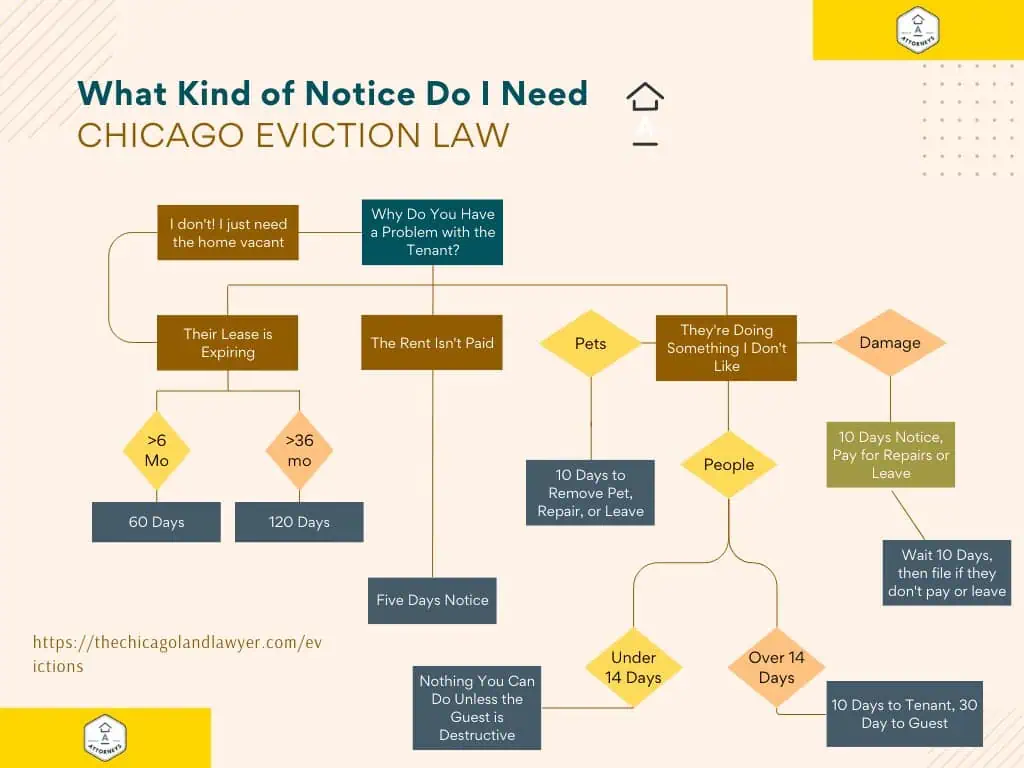
Chicago Notice Requirements (City of Chicago + Cook County)
In Chicago, notices are governed by both state statute and local ordinance. Here’s what you need:
| Reason for Eviction | Notice Type | Notice Period |
|---|---|---|
| Non-payment of rent | 5-Day Notice | 5 days to pay or vacate |
| Lease violation (pets, guests, damage) | 10-Day Notice | 10 days to cure or vacate |
| Lease termination (under 6 months) | 30-Day Notice | 30 days |
| Lease termination (6+ months residency) | 30-Day Notice | 60 days |
| Lease termination (3+ years residency) | 30-Day Notice | 120 days (Chicago Fair Notice Ordinance) |
Important: The 120-day notice requirement under Chicago’s Fair Notice Ordinance catches many landlords off guard. If your tenant has lived there more than 3 years, you’re looking at a 4-month notice period before you can even file the lawsuit.
Suburban Cook County
The rules are nearly identical to Chicago, except the 3+ year tenancy caps at 60 days — not 120 days.
DuPage County, Kane County, and the Rest of Illinois
Outside Cook County, Illinois law is simpler: 30 days notice for lease terminations, regardless of how long the tenant has lived there. This is one reason DuPage County evictions move significantly faster than Chicago.
📄 Download Notice Templates
For a deeper dive into notice requirements, see my full guide: What Kind of Notice Do I Need?
Step 3: Serving the Notice Properly
Here’s where my clients mess up most frequently. The notice must be properly served — not just written correctly. If you serve it wrong, your entire case can get thrown out.
Personal Service (The Best Method)
Hand the notice directly to the tenant. This is the preferred method because there’s no question they received it. The tenant does not need to sign anything. We get asked this constantly — your affidavit is sufficient even if the tenant claims they never got it.
Substitute Service
If the tenant isn’t available, you can give the notice to another adult (of suitable age and discretion) living in the unit. You must also mail a copy via first-class mail.
Certified Mail
You can send the notice via certified mail with return receipt requested. The green card showing the tenant signed for it becomes your proof. The risk: if the tenant refuses to sign or isn’t home, you don’t have valid service.
Can I Just Post the Notice on the Door?
Almost never. “Nail and mail” service is only appropriate when the property appears abandoned or you have unknown trespassers you’ve never contacted. If you know your tenant’s first name, you almost certainly cannot post.
This is the #1 mistake landlords make. Old-timer landlords will tell you posting is fine. It’s not. Your case will get dismissed.
📄 Download Affidavit of Service
Step 4: Filing the Eviction Lawsuit
Once the notice period expires and the tenant hasn’t complied, you can file the lawsuit. In legal terms, this is called a Forcible Entry and Detainer action.
Your filing must include:
- The termination notice you served
- The affidavit of service proving delivery
- The lease agreement (even if it’s expired)
- A complaint stating your grounds for eviction
The court assigns a date several weeks out. Then you must serve the tenant with a summons telling them to appear in court.
Serving the Summons
Until 2025, in Chicago, the first attempt would always be made by the Cook County Sheriff. Most landlords still believe this is mandatory. You may still use the sheriff, and they’re frankly much cheaper than private servers. However, the sheriff frequently fails (they’re overworked). About 5% of people will choose this path.
Instead, now you can just start with a special process server. It’s great to just skip the Sheriff entirely and go straight to a licensed private detective or agency. You still have the option of using the Sheriff, but it’s no longer a prerequisite. The private process server (or their employer) must remit $5.00 per service to the Cook County Sheriff, by law. However, in practice, usually we attorneys just prepay that for you. About 95% of people will do this path.
The court’s longstanding ability to appoint any person over 18 (who isn’t a party) to serve process remains unchange. Court-appointed servers don’t owe the $5 fee. The amendment only addresses the private detective route. About 1 out of 1000 people will choose this path.
The summons must be served at least 7 days before the court date. Once the tenant is served, you can proceed to the first hearing.
We often hear people ask about posting notices if you can’t find the Tenant. If you can’t get personal or substitute service on a tenant, you can fall back on constructive service by posting under 735 ILCS 5/9-107. You’ll need the summons returned unserved first, five attempts in the file, then file an affidavit explaining why the tenant can’t be found. The Sheriff posts notice in three public places at least 10 days before the court date and mails a copy to the tenant’s last known address. You won’t be able to get any money in your judgment this way, but you can still get the keys. This adds about a month to your timeline.
Wondering about costs? See my complete breakdown: How Much Does an Eviction Lawyer Cost?
Step 5: The Early Resolution Program (ERP) and Mediation
Here’s something competitors don’t tell you about: in Chicago, your first court date isn’t a trial. It’s an Early Resolution Program (ERP) compliance date.
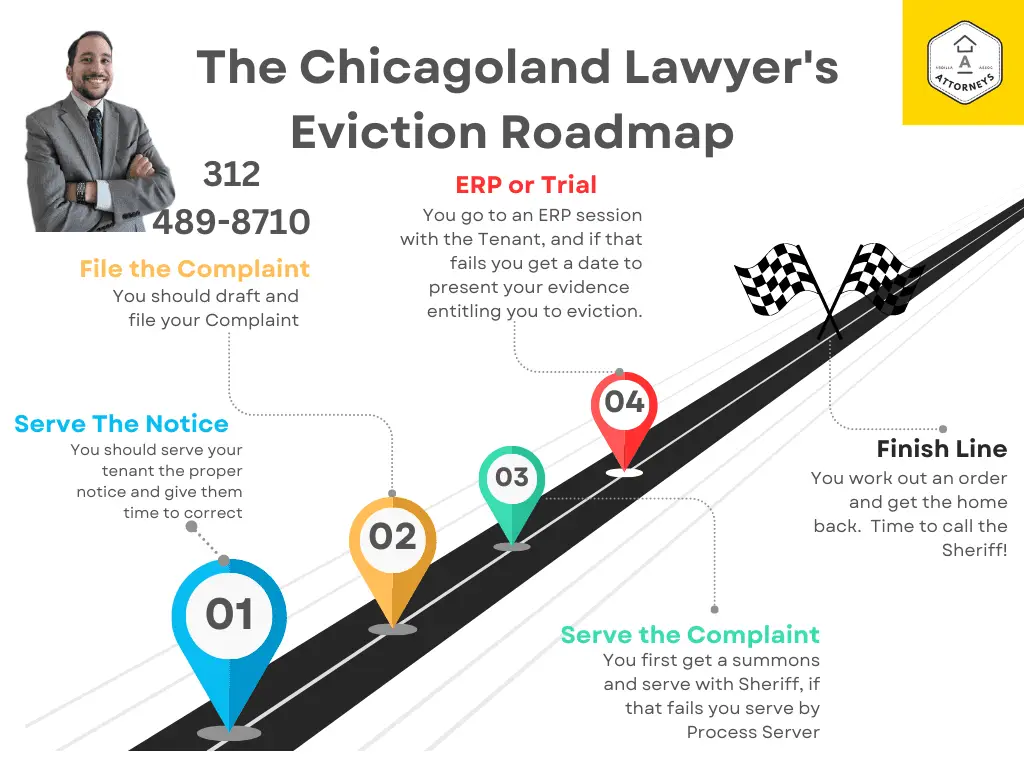
What is the Early Resolution Program?
The ERP is a court-mandated mediation program designed to resolve eviction disputes before trial. Both landlord and tenant attend a counseling appointment where mediators try to help you reach an agreement.
Participation is “voluntary” — but you must attend the meeting even if you don’t want to settle.
What Happens at ERP?
A neutral mediator facilitates a conversation. The goal is for the tenant to agree to move out voluntarily by a certain date — no eviction trial needed. Many responsible tenants agree to leave once they understand the process.
The ERP also connects eligible tenants with rental assistance programs. This actually benefits landlords: if the tenant qualifies, you may get paid the back rent they owe. I’ve had cases where landlords received thousands in rental assistance through this process.
What If Mediation Fails?
If the tenant doesn’t show up, the court typically gives you a two-week continuance to notify them again. If they still don’t appear, you can get a default judgment.
If the tenant shows but you can’t reach an agreement, the case proceeds to a trial setting.
For more details, see: The Chicago Early Resolution Program Explained
Step 6: The Eviction Trial
If mediation fails, the next hearing sets a trial date. This is the only in-person hearing in the entire process where both landlord and tenant must appear at the courthouse, along with any relevant witnesses.
What Happens at Trial
The trial is straightforward if you’ve prepared properly. I put the landlord on the witness stand, they get sworn in, and I prove four simple things:
- You own the property (or have authority to manage it)
- You had a lease with the tenant
- The lease required an obligation (like paying rent)
- The tenant failed to meet that obligation
Then we prove proper notice was given. We present the notice and affidavit of service showing the tenant received it.
If you’ve done everything correctly, the court almost always grants the eviction.
Step 7: Judgment and the Stay Period
When the court grants your eviction, two things happen:
- Possession judgment — The court orders the tenant to vacate
- Money judgment — If you filed a joint action, the court awards you the back rent owed
The court sets a stay date — typically 7 to 14 days — giving the tenant time to move out voluntarily. If they leave by that date, you’re done.
If they don’t leave, you proceed to sheriff enforcement.
Step 8: Sheriff Enforcement
If the tenant refuses to vacate after the stay period, you hire the sheriff to physically remove them.
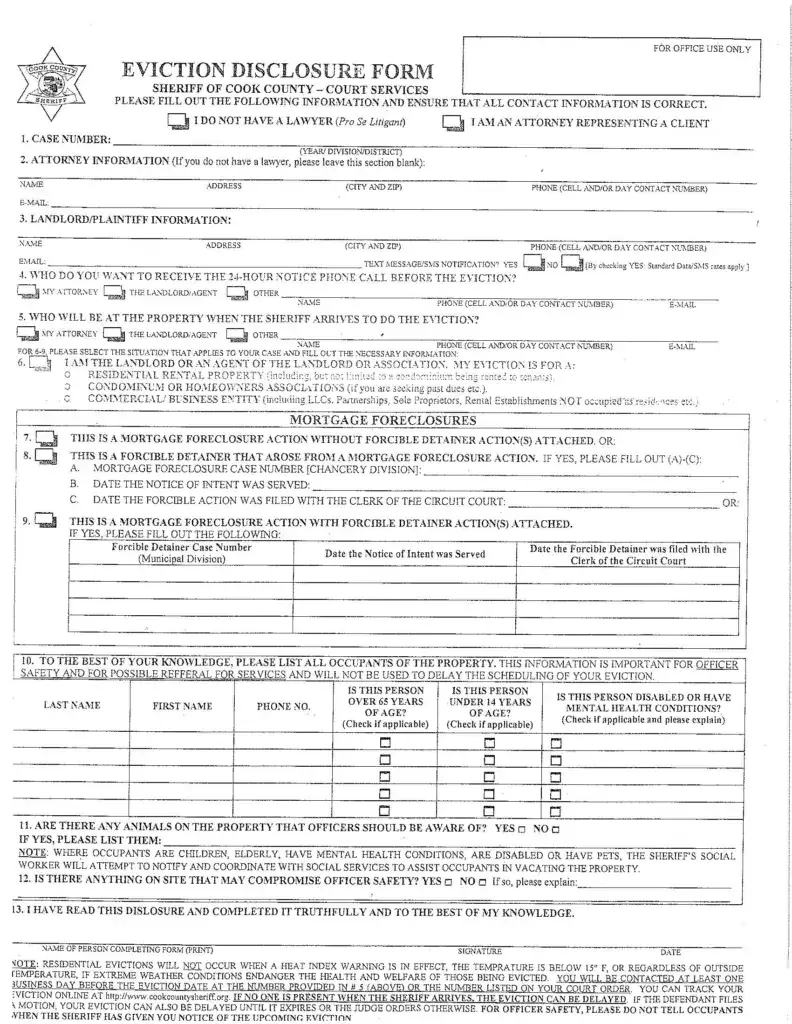
Here’s the process:
- File the proper form with the Sheriff’s office (see image above)
- Pay the fee (approximately $200)
- Get 2 certified copies of your judgment
- Wait for the sheriff to schedule an appointment
The wait time varies dramatically. Sometimes the sheriff comes in 2 weeks. Sometimes it takes 2 months. They come at their next available slot.
You must be present at the property to let the sheriffs in and oversee the removal. At that point, the eviction is complete — your property is back.
📄 Download Sheriff Forms
How Long Does a Chicago Eviction Actually Take?
This is the question everyone asks. Here’s the realistic timeline:
| Stage | Chicago / Cook County | DuPage County |
|---|---|---|
| Notice period | 5-120 days | 5-30 days |
| Filing to first court date | ~6 weeks | ~3 weeks |
| ERP / Mediation | 3-4 weeks | 1-2 weeks |
| Trial (if contested) | 1-8 weeks | 1-4 weeks |
| Stay period | 7-14 days | 7-14 days |
| Sheriff enforcement | 2-8 weeks | 1-2 weeks |
| TOTAL (contested) | ~150 days (5 months) | ~10 weeks |
Key insight: DuPage County evictions are dramatically faster than Chicago. If you own property in the suburbs, you’re looking at roughly 10 weeks instead of 5 months.
Some cases settle much faster. Through aggressive negotiation — leveraging eviction records and credit damage as pressure — I’ve resolved cases in as little as 8 weeks.
Post-Judgment Collections: Getting Your Back Rent
Many cases include a money judgment for back rent. Here’s the reality: tenants almost never pay voluntarily.
To collect, you need post-judgment enforcement — typically wage garnishment. This requires knowing two things:
- Where the tenant currently lives (after they move out)
- Where the tenant works
If you have both pieces of information, we bring the tenant back to court and impose a garnishment. Their wages get docked until the judgment is paid — or they face contempt of court.
I secure about $500,000 in back rent judgments for clients every year. While collection isn’t guaranteed, having the judgment gives you legal recourse for years to come.
Why You Need an Eviction Lawyer
To put it simply: this process is hard. Everything from giving notices to filing the case is technical. The Illinois legislature has tried for years to make it simpler, and they haven’t succeeded.
Common failure points I see from DIY landlords:
- Wrong notice type
- Improper service (posting when you shouldn’t)
- Missing the Fair Notice Ordinance 120-day requirement
- RLTO compliance failures
- Forgetting to attach required documents
Each mistake can mean starting over from scratch — adding months to your timeline while your tenant lives rent-free.
My flat fee of $1,600 covers everything through trial. No hourly billing, no surprises. Whether your case takes 5 court appearances or 15, the price stays the same.
Ready to Get Your Property Back?
Free consultation. No obligation. I’ll tell you honestly if you have grounds for eviction.