

Can an LLC Represent Itself in Court in Illinois?
No. An Illinois LLC must appear in court through a licensed attorney. That rule holds even if you are the only member. It comes from 705 ILCS 220/1 and Downtown Disposal Services, Inc. v. City of Chicago, 2012 IL 112040. Supreme Court Rule 282(b) has one narrow exception. A corporation may defend a small claims case up to $10,000 without a lawyer. No exception lets an LLC file a case, such as an eviction, on its own. If you own the property in your own name, you may appear for yourself. My evictions start at $895 flat.
You formed your LLC. You own it 100%. You have a tenant who hasn't paid rent in two months, so you drive to the courthouse, fill out the eviction forms, and file the case. Six weeks later you're standing in front of a judge who asks one question: "Who is representing the LLC?" You say "I am, I'm the owner." The judge tells you the LLC needs a licensed attorney and dismisses your case. You just wasted two months and $500 in filing fees. The tenant is still in the building.
The Rule: 705 ILCS 220/1
Illinois statute is blunt about this. 705 ILCS 220/1 makes it "unlawful for a corporation to practice law or appear as an attorney at law for any reason in any court in this state." LLCs fall under the same rule. The Illinois Supreme Court confirmed this in Downtown Disposal Services, Inc. v. City of Chicago, 2012 IL 112040, writing that "courts in this country, including this court, unanimously agree that a corporation must be represented by counsel in legal proceedings."
The reasoning is straightforward. An LLC is a separate legal entity from its members. When you formed that LLC to hold your rental property, you created something that exists independently of you. You can manage it, you can make decisions for it, but when it walks into a courtroom, it needs its own lawyer. A non-attorney member appearing on behalf of the LLC is practicing law without a license, regardless of how much you own or how small the case is.
I explain this to landlords several times a month, usually after they've already tried and failed to file something on their own. The conversation always starts the same way: "But I'm the only member. It's my company. How can I not speak for my own company?" The answer is that you can speak for yourself, as an individual, all day long. But the moment you put property into an LLC, the LLC is the plaintiff or defendant, not you. And the LLC cannot speak for itself.

Why LLC Members Can't Speak for the Entity
The distinction trips people up because it feels wrong. You're the sole member. You're the sole manager. You signed the operating agreement, you pay the property taxes, you collect the rent. Why would a court treat you as a stranger to your own company?
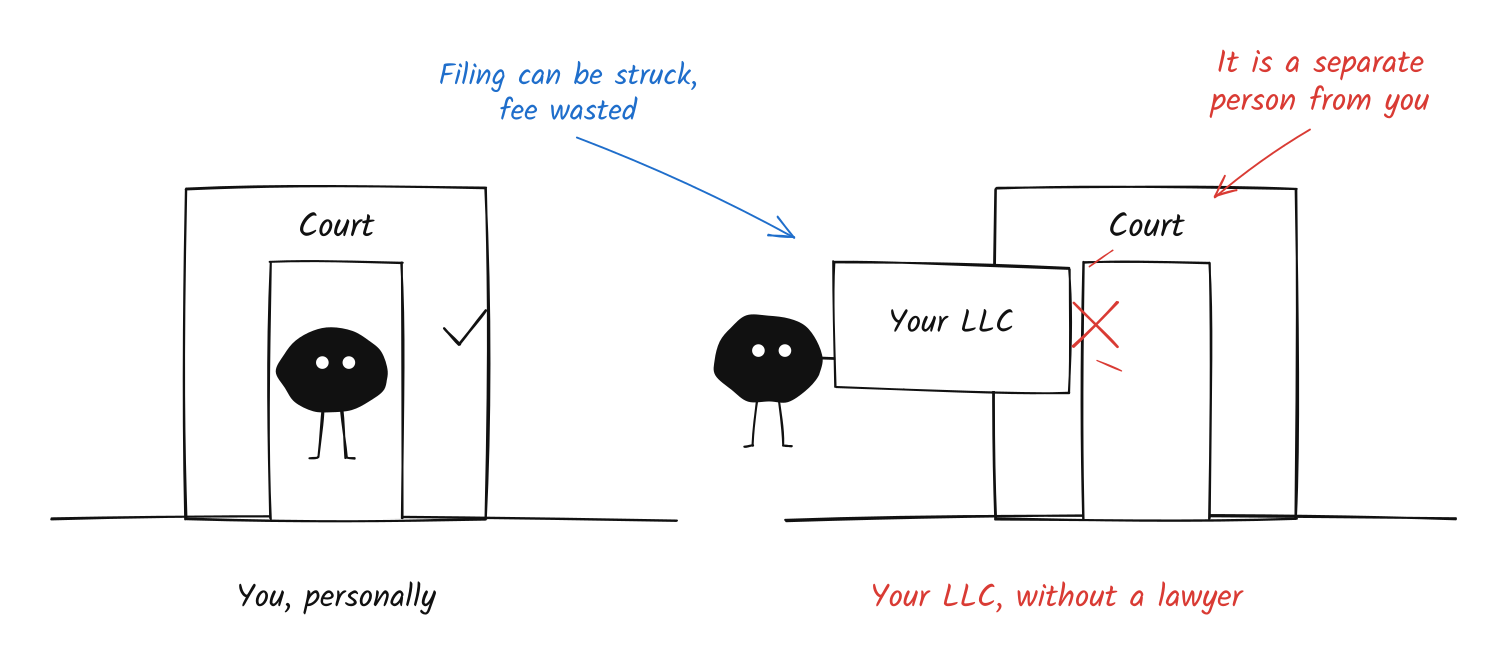
Because you told the court to. The entire point of forming an LLC is to create a legal barrier between you and the entity. That barrier is what protects your personal assets when a tenant sues. It's what keeps a judgment against the LLC from reaching your house, your car, and your personal bank account. You can't selectively remove that barrier when it's inconvenient. If the LLC is separate enough to shield your personal assets from a plaintiff, it's separate enough to need its own attorney in court.
The Illinois Attorney Act (705 ILCS 205/1) reinforces this by requiring that "no person shall be permitted to practice as an attorney or counselor at law within this State without having previously obtained a license for that purpose from the Supreme Court." When you draft legal documents, file pleadings, or argue motions on behalf of your LLC, you are practicing law. Unless you passed the Illinois bar exam, that's unauthorized practice and the court will stop you.
The $500 Mistake
I call this the $500 mistake because that's roughly what it costs a landlord who tries to file an eviction through their LLC without an attorney. The money breaks down like this:
| Expense | Cost | What Happens |
|---|---|---|
| Filing fee (Cook County) | $237 | Non-refundable. Gone when case is dismissed. |
| Service of process | $65-95 | Sheriff or process server. Paid again on refiling. |
| Half a day at the courthouse | Your time | Drive, park, wait, get told to come back with a lawyer. |
| 6-8 weeks wasted | $3,000+ | Two months of lost rent on a $1,500/mo unit. Tenant stays. |
When the case gets dismissed, you start over. New filing, new service, new court date. The filing fees from the first attempt are gone. The process server fees are gone. And the tenant has been living rent-free for two extra months while you figured out that your LLC needs a lawyer.
I had a landlord in Lombard come to me after exactly this scenario. He owned a three-flat through his LLC, filed the eviction himself in DuPage County, waited five weeks for his court date, and got bounced in under three minutes. The judge didn't even let him explain. He then hired me, we refiled, re-served the tenant, and waited another four weeks for the new court date. Total time from first notice to possession: four and a half months. If he'd hired me from the start, it would have been about six weeks.
LLC Court Representation: Your Options
- Case dismissed (LLC can't self-represent)
- Filing fees non-refundable ($237+)
- Service of process paid twice ($65-$95)
- 6-8 weeks lost rent ($3,000+ on $1,500/mo unit)
- Tenant's attorney uses the rule against you
- DuPage eviction: $895 flat
- Chicago eviction: $1,600 flat
- Commercial disputes: quoted on free call
- Case filed correctly the first time
- Average resolution: 6 weeks (not 4.5 months)
- Properly filed and represented
- No fixed price
- Every continuance adds cost
- May not specialize in landlord-tenant
What this costs without an attorney:
You drive to the courthouse, file the eviction, and the judge dismisses it in under three minutes. $389.25 in non-refundable filing fees. $150 in service of process. 6-8 weeks of lost rent ($3,000+ on a $1,500/mo unit). Total wasted: $4,200+.
What this costs with us:
DuPage eviction: $895 flat. Chicago eviction: $1,600 flat. Filed correctly the first time. Average resolution: 6 weeks.
Skip the $500 Lesson. Call Me First.
Evictions from $895. Commercial disputes, code violations, and member litigation quoted on a free call. Flat fee when possible, no surprises either way.
What Actually Happens in Court
I've sat in DuPage and Cook County eviction courtrooms and watched this play out dozens of times. The landlord walks in with a folder full of lease documents, photos of property damage, and a stack of unpaid rent receipts. The judge calls the case. The landlord stands up and says "I'm here for Smith Properties LLC." The judge asks if the landlord is a licensed attorney. The landlord says no, I'm the owner. The judge explains that the LLC needs an attorney, and the case is either dismissed without prejudice or continued so the landlord can retain counsel.
That's the best-case scenario. The worst case is when the tenant has an attorney (which is increasingly common in Cook County, where several legal aid organizations represent tenants for free). The tenant's attorney will file a motion to dismiss for unauthorized practice of law, which creates a written record of the deficiency. If the landlord has already filed pleadings, conducted any discovery, or made any arguments, the tenant's attorney will argue those actions are void because they were performed by a non-lawyer on behalf of the entity.
The Illinois Supreme Court in Downtown Disposal did soften the old rule slightly. Before that 2012 decision, any pleading filed by a non-attorney on behalf of a corporation was automatically void. The court replaced that with a four-factor test: did the non-attorney know the conduct was unauthorized, did the corporation move quickly to get a lawyer, was the non-attorney's participation minimal, and was the other side prejudiced? But relying on this is a gamble, not a strategy. The tenant's attorney will argue prejudice, and the court has full discretion to dismiss anyway.
The Small Claims Trap
When landlords learn the rule, the next question is always: "Can I at least file in small claims court without a lawyer?" The answer is almost certainly no.
Illinois Supreme Court Rule 282(b) does allow a corporation to appear without an attorney in small claims, but only as a defendant, and only when the amount claimed does not exceed the small claims jurisdictional limit, currently $10,000 (Ill. S. Ct. R. 281). An LLC filing a lawsuit, which includes filing an eviction, is a plaintiff, not a defendant. Rule 282 does not help you. The rule also uses the word "corporation" specifically and doesn't mention LLCs, though courts generally apply the same treatment.
And eviction cases are not small claims cases anyway. Forcible entry and detainer is a separate case type in Illinois. Even if Rule 282 allowed LLC plaintiffs to appear pro se in small claims (it doesn't), it wouldn't apply to your eviction.
The Illinois legislature tried to expand the exception through 735 ILCS 5/2-416, which purported to let corporations appear in small claims through officers. But when a statute conflicts with an Illinois Supreme Court rule on matters within the court's authority (like regulating the practice of law), the Supreme Court rule wins. Rule 282(b) trumps Section 2-416, and the narrow exception stands as written: defending only, and only up to the small claims jurisdictional limit. Rule 282(b) also bars a corporation from appearing as claimant, assignee, subrogee, or counterclaimant, so an LLC that is sued and wants to counterclaim still needs counsel.
The DIY Math
If you want to handle your LLC's legal matters without an attorney, nobody is going to stop you from trying. But I want you to see the math before you decide.
Filing fees (twice): $474
Service of process (twice): $130-190
Lost rent (4+ months): $3,000-6,000
Your time: 3 courthouse trips
Then you hire an attorney anyway.
Attorney fee (DuPage flat fee): $895
Filing fee: $300, paid to the clerk
Process server: $155+
Lost rent (6 weeks): $1,500
One courthouse trip. Done.
The DuPage County comparison is the clearest because the numbers are straightforward. My flat fee for a DuPage eviction is $895. That covers the filing work, the court appearance, and the order of possession. The $300 filing fee and the process server are paid on top. A landlord who tries to DIY it first, gets bounced, and then hires me has spent $895 plus roughly $500 in wasted fees from the first attempt, plus two to three months of additional lost rent. The "savings" from not hiring an attorney cost more than the attorney.
Chicago evictions start at $1,600 because Cook County procedures are more involved. The math is even more lopsided there because Cook County filing fees are higher and the court calendar is slower.
Not Just Evictions
I've focused on evictions because that's where I see this problem most often, but the representation rule covers every type of court proceeding your LLC might face. Here are real examples from my practice.
I represented a property management LLC in a dispute over a shared driveway easement in DuPage County. The opposing party's attorney moved to strike the LLC's initial filings because the managing member had signed and filed them without counsel. The court granted the motion. We had to refile and re-serve, which added six weeks to a case that was already contentious. If the LLC had hired me from day one, those filings would have been valid and the case would have resolved a full quarter earlier.
I've handled corporate turnover disputes where the dollar amounts are well into the millions. When an LLC member sues to compel an accounting or force the disgorgement of improperly distributed profits, the LLC itself is a party to that litigation. The member who controls the LLC cannot stand up in court and speak for the entity, even if they hold a 99% interest. These cases get complex fast, and a judge will not entertain arguments from a non-lawyer on behalf of the entity no matter how well-prepared they are.
Municipal code enforcement is another area that trips up LLC owners. When the City of Chicago or a DuPage municipality issues building code violations, the citation names the LLC as the property owner. If the LLC wants to contest those violations at an administrative hearing or in court, it needs a licensed attorney. I have represented LLCs facing tens of thousands of dollars in accumulated municipal fines where the owner's failure to retain counsel early turned a $2,000 problem into a $40,000 judgment.
The only situation where you can represent yourself is when you are personally a party to the case in your individual capacity. If you own a rental property in your own name (not through an LLC) and you're filing an eviction, you can appear pro se. But the moment that property sits inside an entity, the entity is the landlord, the entity is the plaintiff, and the entity needs a lawyer. And that entity needs to exist: an LLC that has been administratively dissolved for missing its annual report cannot file a lawsuit at all, because it no longer has legal standing.
Your LLC Needs a Lawyer. I Do This Every Day.
Evictions, easement disputes, code violations, member litigation. Flat-fee options for most matters. Free consultation to scope yours.
Frequently Asked Questions
Eviction attorneys in Cook County typically charge $1,000 to $3,000 depending on complexity and billing model. Many bill hourly after the first court date, which means every continuance, motion, and court appearance adds cost. My bench-trial DuPage eviction fee is $895 flat. Chicago is $1,600 flat. No hourly surprises.
Further Reading
External resources: Downtown Disposal Services v. City of Chicago (IL Supreme Court 2012) · 705 ILCS 220: Corporation Practice of Law Prohibition Act · Illinois Supreme Court Rule 282
Your LLC Has a Legal Problem. I'll Handle It.
Evictions from $895. Commercial disputes, code violations, and member litigation scoped on a free call.