

Key Facts
- Abdilla and Associates forms Illinois LLCs for landlords for a $750 flat fee, attorney filed, with the Illinois Secretary of State filing fee included.
- An Illinois series LLC for rental property starts at $1,050, and a deed transfer into the LLC is $100 per deed.
- The office drafts the operating agreement, obtains the EIN, and serves as registered agent as part of the formation work.
- Illinois amended its LLC Act in 2025; the change and what it means for a single-owner rental LLC are explained on this page.
- Justin Abdilla, ARDC #6308444, has handled more than 1,000 files across twelve years of practice in nine Illinois counties.
Fees verified September 21, 2026.
Why Should an Illinois Landlord Hold Rentals in an LLC?
If you own rental property in Illinois and you're still holding it in your personal name, you're one bad tenant or slip-and-fall away from losing everything you've built. An LLC is the single most important piece of legal infrastructure a landlord can put in place.

Chicago-area rental properties like these should be held in an LLC
Rental property is one of the best wealth-building tools available, and it comes with real risk. A tenant gets injured. A contractor files a lien. A former tenant sues over a security deposit. Without an LLC, every one of those claims reaches straight into your personal bank account, your home equity, and your retirement savings.
Forming a limited liability company for your rental properties puts a legal wall between your investment properties and your personal assets. It's the structure that gives you the best combination of liability protection, tax flexibility, and operational simplicity. Wondering whether an umbrella policy could do the job instead? Read LLC vs umbrella insurance. The short answer: they protect against different failures.
One more note for business owners: the SBA rewrote its acquisition-lending rules effective October 1, 2026. If you may sell a business, read what changes and why the date matters.
Launching an app instead of buying a building? Read how to start a vibecoded business in Illinois, which covers the LLC, the platform agreements, and the eight privacy requirements a weekend build usually misses.
I've been forming LLCs for Illinois landlords and real estate investors for years. This guide is what I actually tell my clients, not the generic overview you'll find on every other law blog. I'll walk you through every step, the actual costs, and the major law change in 2025 that every LLC owner needs to understand.
⚠ What Changed in the Illinois LLC Act in 2025?
For decades, Illinois case law actually made it harder to hold LLC members personally liable compared to corporate shareholders. Two key appellate decisions, Puleo v. Topel (2006) and Dass v. Yale (2013), essentially said that LLC members couldn't be pierced the way corporate shareholders could, even in cases involving fraud.
The 2025 amendment supersedes that reading. The new language in Section 10-10 reads:
Read the rest of the section before you panic about paperwork. Subsection (c) survived the amendment and still says failure to observe the usual company formalities is not a ground for personal liability, and (a-5) is expressly subject to (c). A stale Operating Agreement or a missed annual report is not, on its own, a route to your personal assets. What does build a piercing claim are the judge-made factors Illinois courts have long applied that subsection (c) does not disclaim: inadequate capitalization, commingling of funds, diversion of company assets, and running the company as a mere facade (see Fontana v. TLD Builders, 362 Ill. App. 3d 491 (2005)). Treat your LLC like a personal piggy bank and the LLC Act no longer stands between you and a veil-piercing claim, and a court can use those factors to hold you personally responsible for the company's debts and lawsuits.
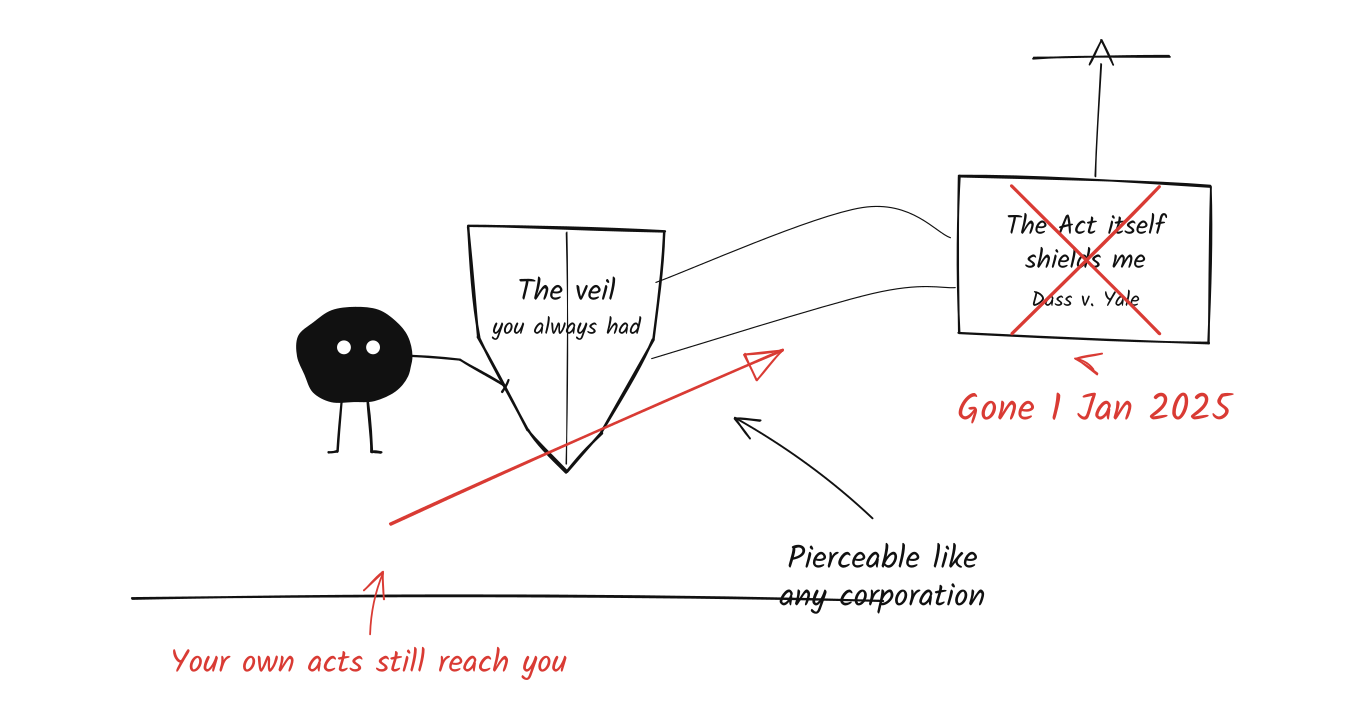
Keep the two categories straight, because they get blurred constantly. Missed paperwork alone will not pierce your LLC, and clean paperwork alone will not save it. What courts weigh is money and conduct: a separate bank account you never dip into, enough capital in the company to meet its foreseeable obligations, no company funds paying personal bills, and leases signed in the LLC's name rather than yours. A proper Operating Agreement and annual reports filed on time matter because they are the evidence that you did those things, not because a lapse is liability by itself.
If you already have an LLC and you are not sure the money side would hold up under discovery, talk to an attorney now instead of in front of a judge later.
Is an LLC or a Corporation Better for Rental Property?
When my clients ask "should I form an LLC or a corporation for my rental properties?" the answer is almost always an LLC.
Limited Liability Protection
This is the whole point. When your rental property is held inside an LLC, the LLC owns the property, not you. If a tenant sues over a mold issue, if someone slips on an icy walkway, or if you end up in an eviction dispute that goes sideways, the claims are against the LLC, not your personal assets. Your house, your savings, your other investments stay protected.
This protection only holds if you maintain the LLC properly, especially after the 2025 law change. Commingling personal and business funds is the number-one way landlords blow through their own liability shield.
Pass-Through Taxation on Your Rental Income
Unlike a C-corporation, an LLC doesn't pay taxes at the entity level. Your rental income (or loss) passes through directly to your personal tax return. This avoids the double-taxation problem that corporations create, where the business pays corporate income tax and then you pay personal income tax on distributions.
For most landlords, this pass-through structure saves roughly 3 to 3.5% annually compared to a corporate structure. That's real money, especially across multiple properties.
Management Flexibility
Corporations require a board of directors, corporate officers, formal meeting minutes, and a stack of paperwork. An LLC lets you manage things however you want. You can manage the properties yourself, bring in a property management company, or split responsibilities with partners. It's all governed by your Operating Agreement, not rigid corporate bylaws.
You can also structure ownership however makes sense: equal splits, unequal percentages, different classes of membership interests. It's built to be flexible.
Simplified Compliance
LLCs in Illinois have far fewer ongoing requirements than corporations. No mandatory board meetings, no formal minutes, no annual shareholder votes. You file your annual report, keep your records clean, and you're in good standing. Illinois also recently reduced LLC filing fees significantly, making them even more accessible for rental property investors.
LLC Formation: Your Options
- State filing fee ($150)
- Generic template operating agreement (3-5 pages)
- No veil-piercing compliance review
- No real estate authorization provisions
- No death/buyback or exit provisions
- No registered agent setup
- State filing fee included
- Custom operating agreement (12-20 pages)
- 2025 veil-piercing factors addressed
- Real estate authorization articles
- Death/buyback, transfer restrictions, tax withholding
- CT Corporation registered agent setup
- Custom operating agreement
- Full legal review
- No fixed price until you get the bill
- Hourly billing incentivizes complexity
- May or may not include EIN/agent setup
- Average 5-10 hours at $300/hr
What this costs without an attorney:
Average slip-and-fall settlement in Cook County: $47,000. Average cost to defend without an LLC: $15,000 - $25,000. Personal assets exposed: everything.
What this costs with us:
$750 flat fee. Operating agreement, EIN, and registered agent included. Filed the same week.
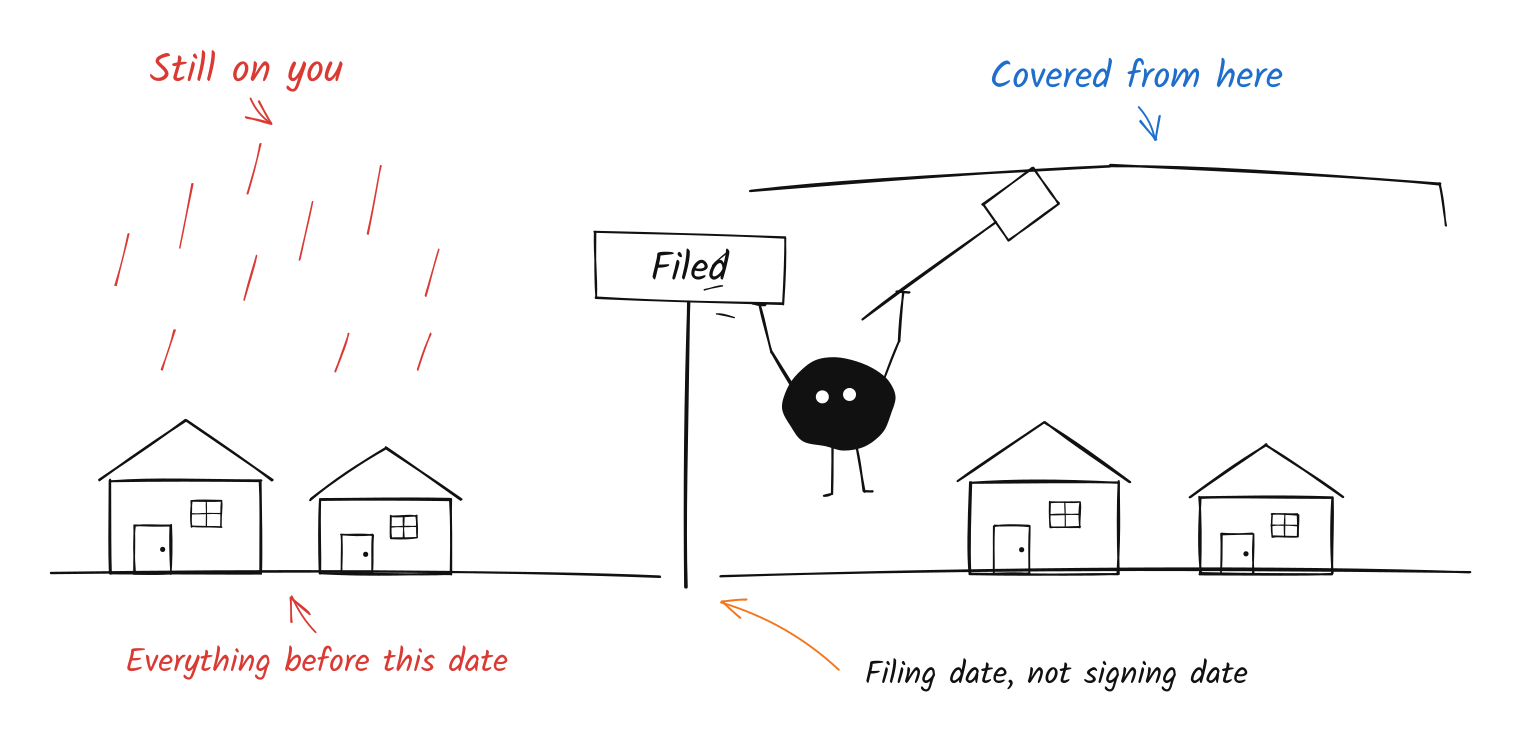
Your Rental Properties Are Unprotected Until the LLC Is Filed
Every day without an LLC is a day your personal assets are exposed. I file with the Secretary of State the same week. $750 flat fee, operating agreement included.
How Do You Form an LLC for Rental Property in Illinois?
Forming an Illinois rental property LLC takes eight steps, from choosing a name to filing annual reports.
Most people can form an LLC themselves. We do them for clients at a flat fee, and I'm going to walk you through every step so you understand what's actually happening and where the landmines are.
Prefer the guided version first? Walk through your first LLC stage by stage, then come back here for the full detail.
Search IL Secretary of State. Must include "LLC."
$150 fee. Creates your LLC as a legal entity.
Physical IL address required. Can be you or a service.
Not required by law. Required by banks, lenders, and courts.
Business license for your municipality. Chicago requires online registration.
Free. Online. 15 minutes. Do not skip this.
IBT number from Dept of Revenue. Most guides skip this.
$75/year. Due before your anniversary month. $100 late penalty each year.
Choose a Name for Your Rental Property LLC
Your LLC name must be unique in Illinois and not already registered with the Secretary of State. You can search the Illinois Secretary of State's business database to check availability.
A few rules: your name must include "LLC," "L.L.C.," or "Limited Liability Company" somewhere in it. You can't use restricted words like "Bank," "Insurance," or "Lawyer" without special licensing. Most of my investor clients go with something like "[Street Address] Properties LLC" or "[Last Name] Holdings LLC." Keep it clean and professional.
File Articles of Organization
This is the document that officially creates your LLC. You file it with the Illinois Secretary of State, pay the $150 filing fee, and once it's approved, your LLC exists as a legal entity.
The Articles of Organization include your LLC's name, registered agent information, principal office address, and whether the LLC is member-managed or manager-managed. This document also encompasses your LLC's fundamental rules and property regulations.
Appoint a Registered Agent
Every Illinois LLC must have a registered agent, a person or company authorized to receive legal documents (like lawsuits) on your behalf. The agent must have a physical Illinois address and be available during normal business hours.
You can be your own registered agent, but there's a practical downside: your personal address ends up on the public record, and you have to be physically available to accept service. Many landlords prefer to use a registered agent service for the privacy and reliability. We offer registered agent services for $250/year.
Your registered agent is also critical if you end up in an eviction case. They're almost always needed for court proceedings.
Create an Operating Agreement

Your Operating Agreement is the backbone of your LLC
Illinois law doesn't technically require an Operating Agreement, but going without one is like driving without insurance. Especially after the 2025 veil-piercing amendment, having a solid Operating Agreement is one of the strongest pieces of evidence that your LLC is a real, separate business entity.
Your Operating Agreement outlines ownership percentages, how profits and losses are distributed, management responsibilities, and what happens if a member wants to leave or the LLC needs to dissolve.
Practically speaking, you need an Operating Agreement to open a business bank account for your LLC. You'll also need it to take out loans, get a rental property mortgage, pay off debts, or sell a property held by the LLC. The one thing you don't need it for is buying a property, though I'd still recommend having it in place first.
Obtain Required Permits and Licenses
Assume you need a business license to collect rental income through your LLC. In most Illinois municipalities, it's as simple as submitting a form and paying a fee. In Chicago specifically, you can apply for your rental LLC permit online.
If you're renting property in Chicago, pay close attention to the Chicago RLTO requirements. Non-compliance with the Residential Landlord and Tenant Ordinance can cost you more than most landlords realize. We also handle Zoning Certificates if your property needs one.
Get Your FEIN (Federal Employer Identification Number)
Your FEIN is essentially a Social Security number for your LLC. You need one to open a business bank account, file taxes, and (if applicable) hire employees. The good news: it's free, and the entire application is online. It takes about 15 minutes.
If you're a single-member LLC with no employees, you could technically use your personal Social Security number instead. I'd only recommend that if you have one property and no plans to grow. For everyone building a portfolio, get the FEIN. It keeps your personal SSN off business documents.
Step 6B: Consider Filing Form 8832
By default, a single-member LLC is treated as a "disregarded entity" for tax purposes, meaning all income reports on your personal return. A multi-member LLC defaults to partnership treatment. In most cases, these defaults work fine for rental property investors.
An 8832 election can make sense for other reasons, so talk to your CPA about whether it fits your situation. Find Form 8832 and the instructions here.
FIRPTA is a separate question and it is widely misdescribed. Withholding under 26 U.S.C. 1445 is triggered when a foreign person disposes of a U.S. real property interest. If every member of your LLC is a U.S. person, FIRPTA does not reach your sale, and filing or not filing Form 8832 is neither what turns it on nor what turns it off. Where a foreign person sits somewhere in the ownership chain, how the LLC is classified for tax purposes affects who is treated as the transferor and how the withholding is computed, which is a conversation to have before you list the property.
Most landlords assume that once they form an LLC, they can get a mortgage in the LLC's name and keep their personal credit out of it. That's the dream. The reality is that most lenders still require a personal guarantee from the LLC's members, especially on residential investment loans. Your name is still on the hook if the LLC defaults.
There are exceptions. DSCR loans (Debt Service Coverage Ratio) underwrite based on the property's rental income rather than your personal income, and some portfolio lenders will lend directly to the entity. These products exist, but the rates are higher and the down payments are steeper (usually 20 to 25%).
If financing inside an LLC is part of your strategy, read our full guide to LLC mortgages for real estate investors before you commit to a structure.
Set Up Illinois State Taxes (The Step Nobody Mentions)
Most DIY guides skip this step entirely. In Illinois, you may need an Illinois Business Tax (IBT) number for your rental property LLC. You'll definitely need one if you have employees, rent commercial property, or operate short-term rentals in Chicago.
Register through the MyTax Illinois website, or submit Form REG-1. You'll need your LLC name, FEIN, business address, and a description of your business activities. Processing takes about 7 to 10 business days.
Without this registration, you won't be able to legally rent commercial property, and you'll run into licensing problems in Chicago and many other Illinois municipalities. If you're unsure whether you need it, call the Illinois Department of Revenue at 1-800-732-8866.
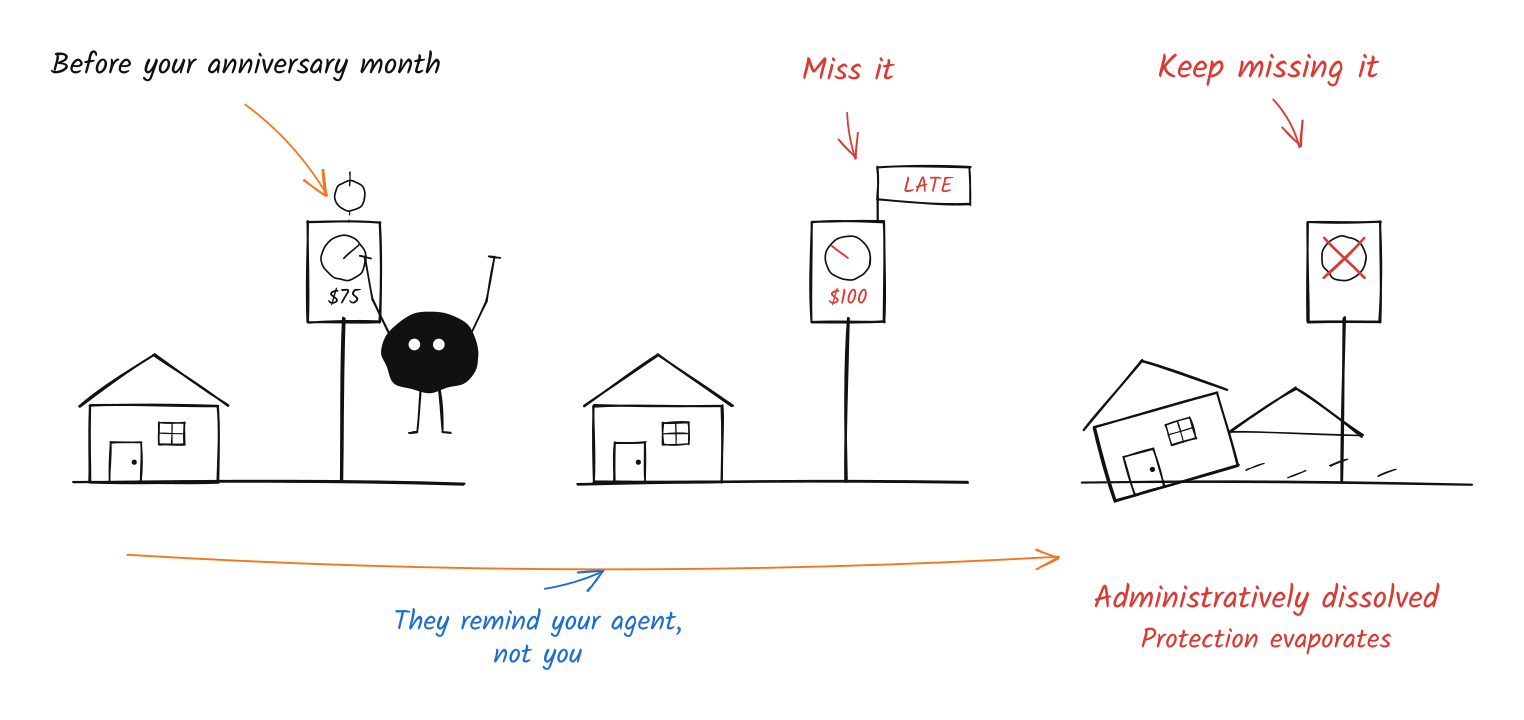
Every Illinois LLC must file an Annual Report with the Secretary of State. It's a straightforward form confirming your LLC's address, registered agent, and member/manager information. The fee is $75 per year (the state filing fee). We can file it for you ($200 flat fee), or our $149/yr compliance plan adds deadline tracking (registered-agent service is $249/yr).
Your report is due before the first day of your LLC's anniversary month (the month your Articles of Organization were approved). Miss the deadline and you're looking at a $100 late penalty. Keep missing it and the state will administratively dissolve your LLC, which means your liability protection evaporates.
FinCEN's Residential Real Estate Rule took effect March 1, 2026, requiring federal reporting on non-financed residential real estate transfers to LLCs and trusts. It lasted less than three weeks. On March 19, 2026, a federal court vacated the rule nationwide in Flowers Title Companies, LLC v. Bessent (E.D. Tex.), and FinCEN has confirmed that no Real Estate Reports are required while the vacatur stands.
Bottom line: no filing is currently required when you buy rental property through your LLC with cash, seller financing, or private lending. But the government has appealed, and the rule could come back, penalties and all (negligent violations started at $1,430 per transaction; willful violations could hit $71,545 or the full transaction amount, whichever is higher, plus potential criminal charges).
The good news: if you're already working with us on your LLC formation, we monitor the appeal and will handle FinCEN compliance as part of your closing if the rule comes back. Your Operating Agreement and ownership structure will already be documented correctly, which makes any reporting straightforward.
Read our full breakdown of the FinCEN Residential Real Estate Rule here.
Don't Want to Do This Yourself?
We handle the entire LLC formation process for a flat $750. Articles, Operating Agreement, FEIN, all of it.
Should You Make a Series LLC?
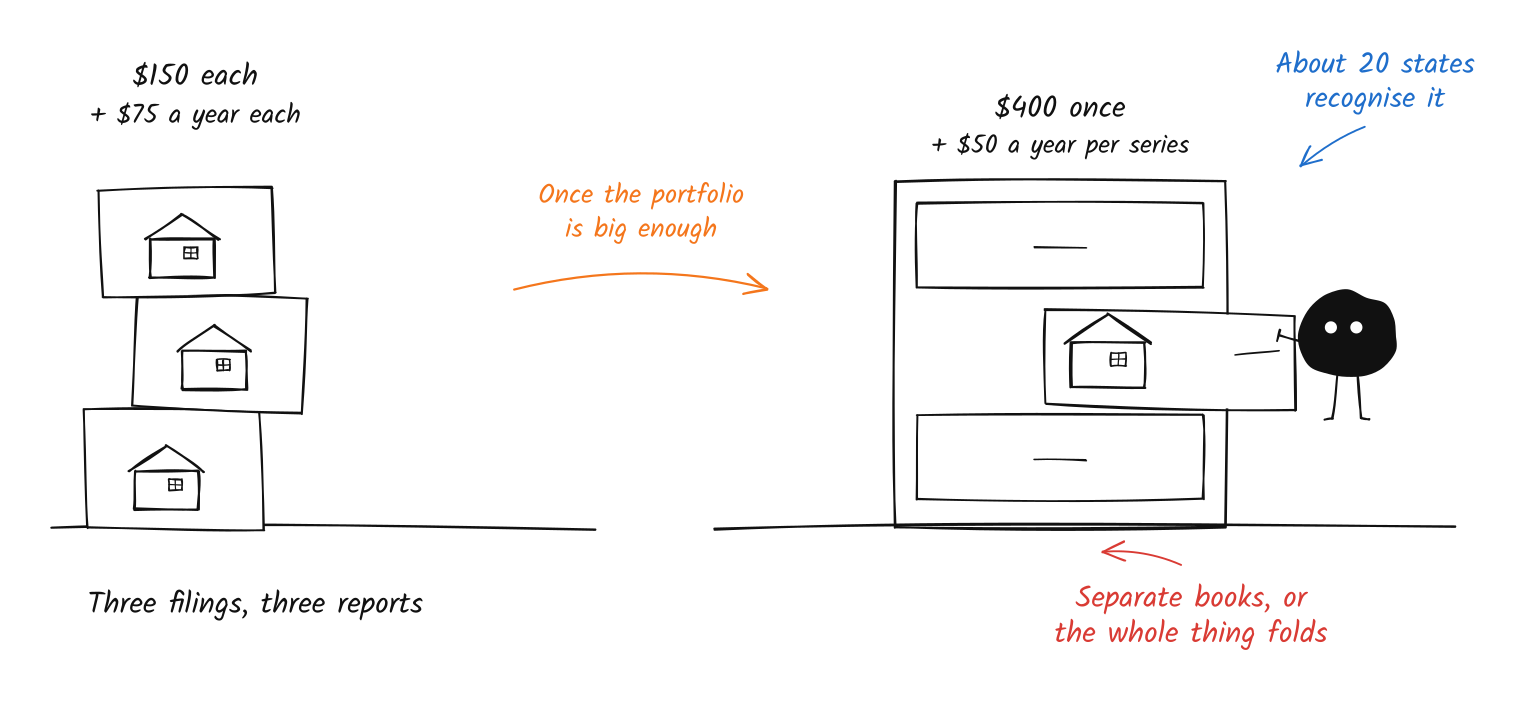
A Series LLC lets you create separate "series" under one umbrella LLC, each with its own assets, liabilities, and members. If Series A gets sued, the assets in Series B and C are protected. Think of it as internal firewalls within a single entity.

When a Series LLC Makes Sense
If you own multiple rental properties and your portfolio is worth over a million dollars, a Series LLC starts to pencil out. Instead of forming a separate $150 LLC for each property (plus $75/year each in annual reports), you form one Series LLC for $400 and add individual series at $50/year each. The savings compound as your portfolio grows.
When a Standard LLC Is the Better Move
If you own one or two rental properties, a standard LLC is simpler and cheaper. The Series LLC adds complexity to your Operating Agreement, your tax filings, and your record-keeping. You'll need to maintain completely separate books, bank accounts, and contracts for each series. Any commingling and the whole structure falls apart in court.
The Interstate Problem
Illinois is one of roughly twenty states that recognize Series LLCs. If you own property in a state that doesn't recognize them, or if a tenant from another state sues your series, the liability separation may not hold up. There's very little case law on this and zero federal bankruptcy precedent addressing how courts should treat individual series.
Tax Complexity
Each series may need to be treated as a separate entity for tax purposes, potentially requiring individual tax filings per series. Your CPA needs to be comfortable with this structure, and many aren't. It's still cheaper than maintaining fully independent LLCs for each property, and the liability isolation is worth it for larger portfolios.
Talk to an attorney before deciding. I'll tell you straight whether a Series LLC makes sense for your specific situation or whether a standard LLC is the better move. Schedule a free call here.
How Much Does an LLC Cost in Illinois?
Here are the real numbers, not the inflated quotes you'll get from online formation services:
| Expense | Cost | Notes |
|---|---|---|
| Articles of Organization filing fee | $150 | One-time, paid to Secretary of State |
| Series LLC filing fee | $400 | One-time, if forming a Series LLC instead |
| Expedited processing (optional) | $100 | 24-hour processing instead of 1 to 2 weeks |
| Annual Report | $75/year | Due before your LLC's anniversary month |
| Late filing penalty | $100 | On top of the $75 fee. Avoid this one. |
| Registered Agent service (optional) | $250/year | Our rate. You can also serve as your own. |
| Attorney LLC formation (optional) | $750 | Our flat fee. Includes Operating Agreement and the state filing fee. |
| Name Reservation (optional) | $25 | Holds your name for 90 days |
At the absolute minimum, you're looking at $150 to form and $75/year to maintain. If you have us handle the whole thing (Articles, Operating Agreement, FEIN, registered agent), the first-year total is around $900 and $325/year after that. Compare that to the cost of one lawsuit hitting your personal assets, and the math is obvious.
Can an LLC Get a Mortgage on Rental Property?
Yes, you can get a mortgage in an LLC's name, but it works differently from the residential mortgage you used to buy your own home. Here's what Illinois investors need to know about LLC mortgage lenders, qualification, rates, and the due-on-sale clause.
Can You Get a Mortgage in an LLC's Name?
Yes. When an LLC borrows to buy rental property, the loan is a commercial mortgage (also called a non-owner-occupied investment property loan). The LLC is the borrower; the property is the collateral. This is different from a conventional residential mortgage in three key ways: the lender evaluates the property's cash flow (not just your personal income), the rates are typically 0.5 to 1.5% higher, and most LLC mortgages require a personal guarantee from the LLC member(s).
Who Lends to LLCs? (LLC Mortgage Lenders)
Not every lender writes mortgages for LLCs. Here are the five types of lenders that do, ranked by how investor-friendly they are:
| Lender Type | Best For | Typical Terms |
|---|---|---|
| DSCR lenders | Investors with strong rental income | 20-25% down, 6-8% rate, 30-yr amortization, no personal income verification |
| Portfolio / community banks | Local investors, relationship banking | 20-25% down, 5-7% rate, 5/1 or 7/1 ARM, flexible underwriting |
| Agency lenders (Freddie/Fannie) | 1-4 unit residential rentals | 15-25% down, lowest rates, but LLC must be single-member and entity approved |
| Hard money lenders | Fix-and-flip, bridge, time-sensitive deals | 65-75% LTV, 8-15% rate, 6-18 month terms, 1-5% origination |
| Seller financing | Off-market deals, flexible terms | Negotiable: rate, down payment, and term all set by agreement |
How to Qualify for an LLC Mortgage
LLC mortgage lenders evaluate four things:
- The property's cash flow: DSCR lenders want rent to cover 120%+ of the monthly payment (principal, interest, taxes, insurance, and HOA). Portfolio lenders want to see a profitable operating history.
- Your personal credit: most LLC mortgages still pull the guarantor's credit. A 680+ FICO opens the best rates; below 640 limits you to hard money.
- Real estate experience: lenders favor investors with 2+ years of landlord experience and existing portfolios. A strong track record can waive reserve requirements.
- Reserves: expect to show 6 months of PITIA in liquid reserves per property. Some DSCR lenders waive this above a 1.35 DSCR.
LLC Mortgage Rates & Terms (2026)
LLC mortgage rates run higher than owner-occupied residential rates because the lender takes on investment risk. Here's what to expect in 2026:
- Down payment: 20-25% for DSCR and portfolio loans; 15-20% for agency loans on 1-4 unit residential.
- Interest rate: 0.5-1.5% above comparable owner-occupied rates. DSCR loans: 6-8%. Hard money: 8-15%.
- Amortization: 30-year amortization is common, but many LLC loans have 5- or 7-year balloons (the payment is calculated on 30 years, but the loan comes due sooner and must be refinanced).
- Personal guarantee: Nearly all LLC mortgages require a personal guarantee from the member(s). This means if the LLC defaults, the lender can go after your personal assets; the LLC shield does not protect you from a guarantee you signed.
Transferring a Mortgaged Property to an LLC (The Due-on-Sale Clause)
If you already own rental property in your personal name and want to move it into an LLC, you'll face the due-on-sale clause in your existing mortgage. This clause gives the lender the right to call the entire loan due if the property is transferred without their consent.
Here's the reality: transferring property to your own LLC does technically trigger the due-on-sale clause under most mortgage contracts. However, under the federal Garn-St. Germain Act (12 U.S.C. § 1701j-3), a lender cannot enforce a due-on-sale clause when a property is transferred into an inter vivos trust (like a land trust), but the Act does not exempt transfers to an LLC. This means:
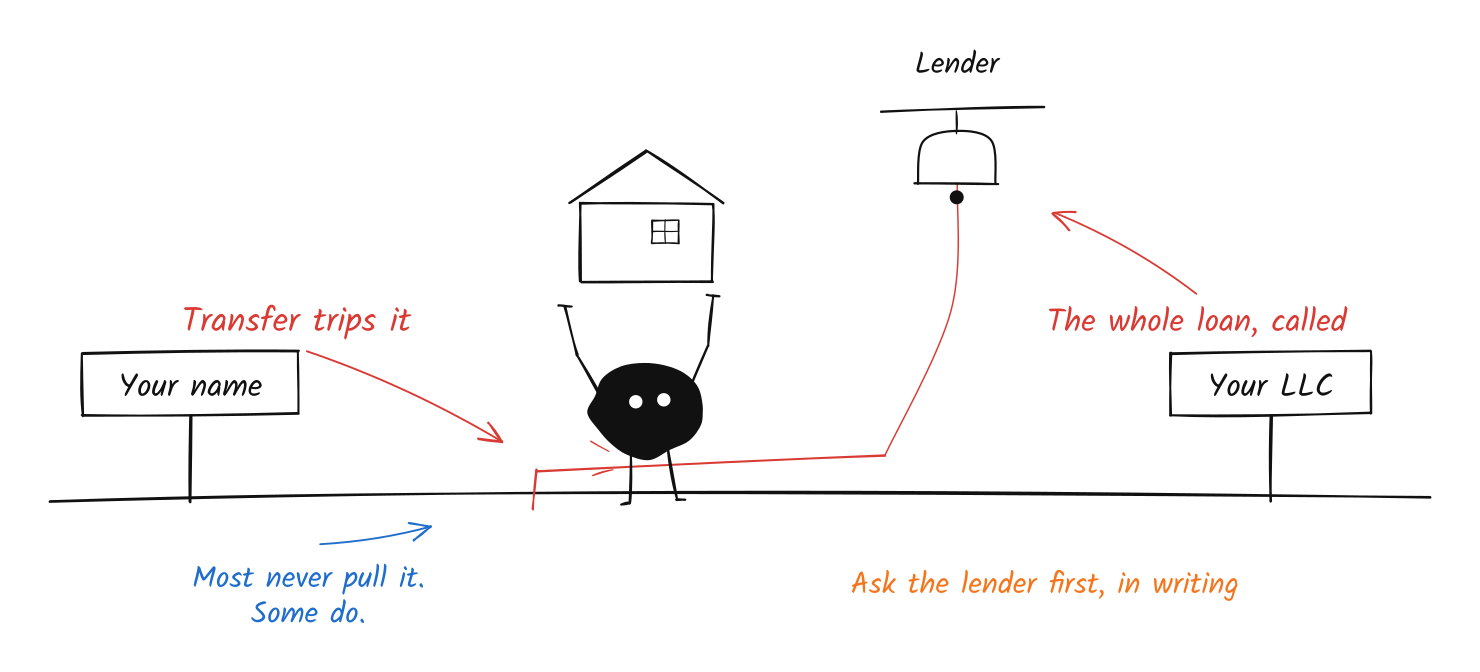
- Most lenders don't enforce it for owner-to-own-LLC transfers as long as payments continue on time, but they can, and occasionally do.
- The safe path: call your lender first. Some will consent in writing. Others will require you to refinance into a commercial loan.
- The land trust workaround: some Illinois investors transfer the property to a land trust first (which is exempt under Garn-St. Germain), then assign the beneficial interest to the LLC. This is a common Illinois strategy but requires an attorney to execute properly.
- Title insurance: your title company should be informed. Some title insurers will not insure a transfer to an LLC without a lender consent letter.
We handle property-to-LLC transfers for $100 per deed and can advise on the due-on-sale strategy for your specific lender. Schedule a free call to discuss your situation.
Alternatives to LLC Mortgages
If a traditional LLC mortgage doesn't fit, Illinois investors have alternatives:
- Seller financing (contract for deed): the seller carries the note. No bank, no due-on-sale issue, fully negotiable terms. Must comply with Illinois' contract-for-deed disclosure requirements under the Installment Sales Contract Act (765 ILCS 67).
- Subject-to existing financing: you take title to the property subject to the seller's existing mortgage. The loan stays in the seller's name; you make the payments. High risk for both parties: the lender can call the loan, and the seller remains liable. Read our subject-to guide.
- Partnership / equity raise: bring in a capital partner who funds the purchase in exchange for a membership interest in the LLC. Governed by your Operating Agreement's capital contribution and distribution provisions.
- Cash-out refinance on a different property: if you have equity in another rental, refinance it and use the proceeds to buy the next property in the LLC's name. No new LLC mortgage needed.
Frequently Asked Questions About LLCs for Rental Properties
No. You can hold multiple rental properties in a single LLC. If you want liability isolation between properties, consider a Series LLC rather than forming multiple independent LLCs. It's more cost-effective for portfolios of three or more properties.
Yes. The property gets transferred into the LLC by deed. Our fee is $100 per deed and county recording runs another $100 to $300, so budget $200 to $400 all in. Some mortgage lenders have "due on sale" clauses that could be triggered by the transfer, so check with your lender first. Read more about that in our LLC mortgages & due-on-sale clause section below.
Absolutely. Most landlord LLCs are member-managed, meaning the owners handle the day-to-day operations. You can also appoint a manager (like a property management company) if you prefer a more hands-off approach.
Legally, no. Practically, I'd strongly recommend it, especially after the 2025 law change. An improperly formed LLC (wrong tax elections, missing Operating Agreement, sloppy Articles) can cost you 4% or more of your margins over time, and a court may not respect your liability protection if the fundamentals aren't right.
It's typically a 9 to 15 page legal document that lays out all the business rules for your LLC: who owns what, how decisions are made, how profits are split, and what happens if a member leaves or the LLC dissolves. A good business attorney drafts this for you as part of the LLC formation process.
The 2025 amendment to the Illinois LLC Act doesn't eliminate LLC protection, and it does not make paperwork the thing that saves you. Subsection (c) still says formality lapses alone are not a ground for personal liability. What the amendment confirms is that you can be liable for your own wrongful acts under law outside the Act, and that a court can still apply the judge-made piercing factors: commingling funds, undercapitalizing the company, and treating its assets as your own. Keep separate bank accounts, fund the company properly, and sign all contracts and leases in the LLC's name. Do those things and your protection remains solid.
An LLC is a pass-through entity by default, meaning the LLC itself doesn't pay income tax. Your rental income and deductions flow through to your personal tax return. Illinois does not impose a separate franchise tax on LLCs, but you will owe Illinois personal income tax on your rental profits. Consult with a CPA familiar with rental property taxation for your specific situation.
LegalZoom's LLC formation is $259 plus a $159/year registered agent fee, and you get a 3-page template operating agreement with no real estate provisions, no death/buyback clause, and no veil-piercing compliance review. Northwest Registered Agent charges $39 for filing plus $125/year for their agent service. My $750 flat fee includes a 12-20 page custom operating agreement, CT Corporation registered agent setup, EIN, and Articles of Organization with the state filing fee.
Yes. LLC mortgages (also called commercial or non-owner-occupied investment property loans) are available from DSCR lenders, portfolio banks, agency lenders, and hard money lenders. The LLC is the borrower and the property is collateral. Expect 20-25% down, rates 0.5-1.5% above residential, and a personal guarantee. See our LLC mortgages section above for the full breakdown of lender types, rates, and qualification.
Technically yes: most mortgages have a due-on-sale clause that is triggered by transferring the property to an LLC. However, most lenders don't enforce it as long as payments stay current. The Garn-St. Germain Act exempts transfers to land trusts but not to LLCs. The safe approach is to call your lender first, or use an Illinois land trust as an intermediary step. We handle these transfers for $100/deed and can advise on your specific lender.
For a landlord with one or two rentals, a standard (non-Series) LLC is the right structure, simpler and cheaper than a Series LLC. The best service is one that gives you a custom operating agreement with real estate provisions, veil-piercing compliance, and a flat fee, not a $39 online template. Our $750 flat fee includes everything: Articles of Organization, a 12-20 page custom operating agreement, EIN, and registered agent setup. Book a free call and we'll have your LLC formed in days.
Further Reading
External resources: Illinois Secretary of State: LLC Publications and Forms · SBA: Limited Liability Company Guide
Justin made the process incredibly easy and straightforward. He was always available to answer my questions and provided excellent guidance throughout.
Thank you Justin for taking your valuable time to go over the steps of a quit claim deed with me, and also educating me on the swiftest way to incorporate the process and save money! You are the best!
Ready to Protect Your Rental Properties?
Get your LLC set up right the first time. Free consultation. Flat-fee pricing. No surprises.