

If you own three or more rental properties in Illinois, someone at your local REI meetup or BiggerPockets forum has probably told you to look into a Series LLC. One entity, separate compartments for each property, liability walls between them. The pitch is mostly accurate. But I've reviewed enough botched Series LLCs from online formation services to know that the details are where protection lives or dies.
What Is a Series LLC?
A series LLC is one Illinois LLC that holds separate compartments, called series. Each series has its own assets and liabilities. A lawsuit against one series cannot reach the others, if each keeps separate records and funds. Illinois authorizes the structure under 805 ILCS 180/37-40. It makes sense if you own three or more rentals, all in Illinois. If you own one or two, start with a standard LLC. If you own property in other states, use separate LLCs. My flat fee is $1,050, with the $400 state fee included. Each series adds a $50 state fee.
The structure works like a building with firewalls between units. The main LLC is the shell. Each series is a separate compartment inside it. A fire in one compartment doesn't spread to the others. The liability stays contained to the series where the problem happened.
I set these up for landlords with three or more properties across DuPage, Cook, Will, and Kane counties every month. The parent Series LLC sits at the top and holds no property directly. Each rental property goes into its own series. Last year I had a client with a tenant injury claim at one of his Berwyn buildings. Because that building was in its own series, the plaintiff's attorney couldn't touch the client's two Naperville properties held in separate series. That's the whole point of the structure.
The largest series I've structured was 22 properties for a single investor in 2022. Roughly $4.5 million in real estate across Chicagoland. That meant 22 deeds transferring each property into its own series, 22 individual operating agreements, and 22 first annual meetings to get the books right from day one. Most clients come in with three to five properties, but the structure scales. That's one of its advantages over forming separate LLCs, where each additional entity means starting the entire formation process over again.
Chicago, IL
Value: $285K
Naperville, IL
Value: $340K
Lisle, IL
Value: $195K

Series LLC vs. Separate LLCs
Every landlord with multiple buildings asks this. If you want each property protected individually, why not just form a separate LLC for each one? You absolutely can. I file plenty of those. But the annual costs add up once you're past three or four properties, and the comparison math is worth seeing.
- 5 formation filings at $750 each ($3,750)
- 5 annual reports per year for 5 yrs ($1,875)
- 5 operating agreements to maintain
- 5 EINs and 5 separate bank accounts
- 1 formation at $1,050 (state fee included)
- 5 series designations ($50 ea = $250)
- 1 parent + 5 series reports/yr for 5 yrs ($1,625)
- 1 master operating agreement covers all
- $400 state filing + $250 designations
- Same annual reports ($1,625 over 5 yrs)
- You draft your own operating agreement
- No veil-piercing compliance review
The savings are real, but notice the DIY column. You can save $750 by filing the Series LLC yourself and writing your own operating agreement. The reason most landlords don't is the same reason most people don't represent themselves in court: a 15-page operating agreement that never addresses how each series keeps separate records, assets and obligations is a document that exists only to be dismantled during litigation. The $750 difference buys you an attorney who knows which provisions Illinois courts actually look at.
Separate LLCs do have one genuine advantage: universal recognition. Every state, every court, every bank understands a standalone LLC. Series LLCs are newer. I'll get into the interstate recognition problem below, because if you own property outside Illinois, it changes the calculus entirely.
When a Series LLC Makes Sense
Most of the clients I form Series LLCs for look similar. They own three or more rentals, all in Illinois, with a combined portfolio value above $500K. Below three properties, the cost savings over separate LLCs aren't dramatic enough to justify the maintenance overhead. A landlord with a single $120K rental in Joliet doesn't need this structure.
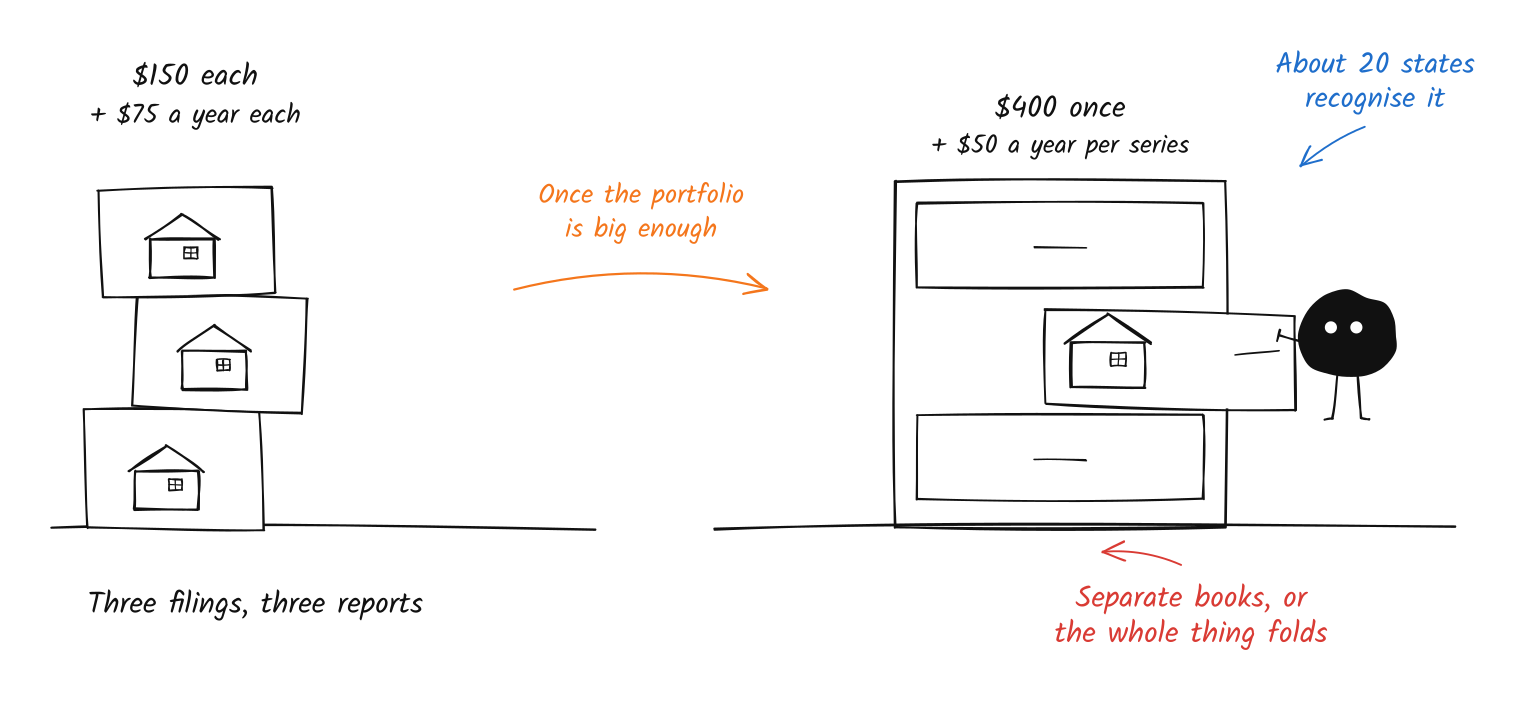
The structure is especially useful if you're still acquiring. I have a client in Wheaton who buys one property per year. Each new acquisition is a $50 Certificate of Designation instead of a $150 new LLC formation, a new operating agreement, and a new set of compliance obligations. Over five years and five properties, he's saved roughly $3,000 compared to the separate-LLC approach.
One requirement I'm firm on: all of your properties should be in Illinois. If you hold property across state lines, the interstate recognition problem I cover below could undermine the entire structure. I've turned clients away from Series LLCs when their portfolio spans two or three states.
When It Doesn't
Multi-state portfolios are the biggest disqualifier. Only roughly twenty states have Series LLC statutes, and the law varies on whether courts will respect another state's series liability walls. I had a client last year who owned two buildings in Illinois and one in Indiana. Indiana does have a Series LLC statute (Ind. Code art. 23-18.1, effective January 1, 2017), but having one is not the same as a court there enforcing your Illinois series walls. If a tenant in that Indiana building files suit, an Indiana court has no obligation to honor the series separation. I formed him separate LLCs instead.
Complex partnerships also push me toward separate LLCs. If different investors co-own different properties, each property benefits from its own operating agreement with customized allocations and management terms. A Series LLC can technically handle different members per series, but the master operating agreement becomes a 40-page document that nobody reads and everyone violates. And when a partner exits or a new investor comes in, changing LLC members in a Series LLC is more complicated than doing it in a standalone entity.
Selling individual properties out of a Series LLC is possible but adds friction. A standalone LLC can be sold cleanly as an entity transfer. Selling a single series out of a parent LLC requires careful legal work to ensure the buyer gets clean title and complete separation from the remaining series. If you plan to sell properties one at a time to different buyers over the next few years, separate LLCs will make each transaction simpler.
Series LLCs and Real Estate Financing
The practical headache nobody warns you about is banking. Most banks have no idea what a Series LLC is. I've had clients walk into a Chase branch in Naperville with their Certificate of Designation, their EIN letter from the IRS, and their operating agreement, and get told "we don't do that" by a banker who has never seen a series entity. Chase, Bank of America, Wells Fargo, the big nationals are generally not set up to open accounts for individual series. You'll have better luck with community banks and credit unions. I steer most clients toward Wintrust, Inland Bank, or Byline because their commercial banking teams understand Illinois entity structures.
Financing is the bigger issue. Conventional lenders (Fannie Mae, Freddie Mac) will not issue a residential mortgage to any LLC, series or otherwise. If you're buying a property in your LLC's name, you're looking at commercial loans or DSCR loans (debt-service coverage ratio loans, where the lender qualifies the property's income rather than your personal credit). DSCR rates run 1 to 2 points higher than conventional, and they typically require 20-25% down. That's the cost of holding property in an entity instead of your personal name.
Some landlords buy in their personal name with a conventional mortgage, then transfer the property into their Series LLC after closing. This triggers the due-on-sale clause question, which I cover in detail in my LLC formation guide. The short version: most lenders don't enforce the due-on-sale clause on self-to-LLC transfers for 1-4 unit residential properties, and the Garn-St. Germain Depository Institutions Act (12 U.S.C. § 1701j-3) provides federal protection for transfers where you remain the borrower. But "most lenders don't enforce" is not "no lender will ever enforce," and I've seen it happen once on a portfolio loan with a small regional bank.
The Series LLC actually helps with portfolio lenders once you get past the initial confusion. A landlord who walks in with a properly structured Series LLC, separate books per property, clean annual reports, and an attorney-drafted operating agreement signals to a commercial lender that this borrower is organized and knows how to manage assets. I've had clients get better terms on portfolio loans specifically because the lender could see that each property was compartmentalized with its own P&L. Compare that to the landlord who owns seven properties in his personal name with no entity structure and a shoebox full of receipts. The organized borrower gets the loan.
Umbrella Insurance vs. Series LLC
I get this question in almost every initial consult: "Do I really need a Series LLC, or can I just get umbrella insurance?" It's a fair question, and the honest answer is that a well-written umbrella policy does cover a lot of the same ground. A $2 million umbrella policy from a decent carrier runs $600 to $1,000 per year for most landlords (Mercury Insurance published customer data, August 2025 to January 2026). It sits on top of your underlying landlord insurance policies and kicks in when a claim exceeds those limits. If a tenant slips on an icy stairwell and the judgment comes back at $800K, the umbrella covers the overage that your base policy can't reach.
The problem with relying on umbrella insurance alone is that insurance only covers claims the policy was written to cover. A standard umbrella policy covers bodily injury and property damage. It does not cover intentional acts, breach of contract, fair housing violations, RLTO penalties, or fraud allegations. Say a tenant files a fair housing complaint with HUD and simultaneously sues for retaliatory eviction under the RLTO. A standard umbrella policy doesn't apply to either claim because neither is a covered peril. If that landlord owns three buildings in his own name with nothing but insurance, all three buildings are exposed to the judgment. If each building sits in its own series, only the one building is at risk. That's the gap umbrella insurance can't close.
The reverse is also true. A Series LLC with no insurance is a bad plan. The liability walls only protect your other properties. They don't pay the judgment. If a $400K verdict hits Series A and Series A holds a $285K building, the plaintiff takes the building. You've protected your other properties, but you still lost a $285K asset because there was no insurance to pay the claim before it reached the entity's assets.
The strongest position is both. A $2 million umbrella policy handles the claims insurance is designed to handle, which covers the vast majority of landlord litigation. The Series LLC handles everything the policy excludes and provides a second layer of asset segregation underneath. Insurance pays the claim. The series structure limits the blast radius if insurance doesn't apply or the judgment exceeds your coverage limits.
How to Form a Series LLC in Illinois
File Articles of Organization (Form LLC-5.5(S))
The Series LLC uses Form LLC-5.5(S), not the standard LLC-5.5. You file it with the Illinois Secretary of State and pay a $400 filing fee ($250 more than a standard LLC). The Articles must designate a registered agent in Illinois, which is a statutory requirement for all LLCs. The critical piece most people miss: the Articles must also include specific statutory language establishing the limitation on liability between series per 805 ILCS 180/37-40(b). Leave that language out and you've formed a standard LLC that can't create protected series.
Draft the Master Operating Agreement
The master operating agreement governs how the parent LLC and all its series operate. I draft these at 15 to 20 pages depending on the portfolio. They cover management structure, capital contributions, profit/loss allocations per series, and the procedures for creating new series down the road. A generic template off LegalZoom won't work because it won't address how each series maintains separate records, separate assets, and separate obligations. Under Illinois veil-piercing law, a weak or missing operating agreement is one of the factors a court can weigh in deciding whether to pierce the veil.
File Certificates of Designation for Each Series
Each individual series gets its own Certificate of Designation filed with the Secretary of State at $50 per series. I usually name them by street address ("123 Main Street Series") rather than generic labels ("Series A") because it makes bookkeeping and annual reports clearer. The certificate is what formally creates the compartment and establishes it as a distinct entity for liability purposes.
Get EINs and Open Bank Accounts
The parent LLC needs its own EIN from the IRS and its own bank account. Each series that will hold property also needs its own EIN and bank account. I walk clients through the EIN applications because the IRS online form doesn't have a "series" option, so you apply as a disregarded entity or partnership depending on your member count. The bank account piece is non-negotiable. Commingling funds between series is the single fastest way to lose your liability protection in court.
Transfer Properties Into Their Respective Series
Each property gets deeded into its designated series via a quit-claim deed. The grantee on the deed must be the specific series, not the parent LLC. I see this error constantly in structures set up without an attorney. A deed to "Smith Properties LLC" instead of "Smith Properties LLC, 123 Main Street Series" means the property belongs to the parent entity, and you've eliminated the compartmentalization you paid $1,050 for. The recording requirements vary by county. Cook County has different forms than DuPage or Will. I cover the full process, including transfer tax exemptions and county recording fees, in my guide to transferring property into an LLC.
The Interstate Problem
Most Series LLC content online either ignores this issue or buries it in a footnote. I put it in its own section because it's the single biggest limitation of the structure.
Illinois recognizes Series LLCs under 805 ILCS 180/37-40. Roughly twenty states in all, Illinois included, have adopted Series LLC statutes. Delaware pioneered the concept, and Texas, Nevada, Iowa, Tennessee, Utah, Kansas, and Oklahoma all have established frameworks. The rest have nothing on the books. The Uniform Law Commission published the Uniform Protected Series Act in 2017 to give states a standardized framework, but adoption has been slow. Until more states adopt it, an Illinois Series LLC's liability walls are only as strong as the law of the state where the lawsuit gets filed.
Say you own a property in Wisconsin through an Illinois Series LLC. Wisconsin has no Series LLC statute. If a tenant at that Wisconsin property sues you in Wisconsin state court, the judge has no obligation to honor the liability barriers between your series. That judge could treat every series as part of one entity, exposing your Illinois properties to a claim that originated in Wisconsin.
For clients with Illinois-only portfolios, this is not an issue. For clients with properties across state lines, I recommend separate LLCs formed in each state where property is located. The cost is higher, but the protection is certain.
How Series LLCs Are Taxed
The tax treatment of Series LLCs is genuinely unsettled at the federal level, and I bring this up during every consult because your CPA needs to know. The IRS issued proposed regulations in 2010 (Prop. Treas. Reg. Section 301.7701-1(a)(5)(x)) that would treat each series as a separate entity for federal income tax purposes. Those proposed regulations were never finalized. Sixteen years later, we're still operating under draft rules that everyone follows but nobody is technically required to follow.
For the typical landlord client I work with, who owns the Series LLC entirely on their own, the practical effect is straightforward. The IRS treats each single-member series as a disregarded entity, which means no separate federal tax return for each series. Rental income and expenses from all properties flow through to Schedule E on the owner's personal return, the same way they would with a standard LLC or direct ownership. The series structure doesn't change how a CPA handles the federal filing. Each property still gets its own line on Schedule E with its own income and expense figures.
If the Series LLC has multiple members, say you and a partner co-own all the properties, it's classified as a partnership by default. The parent LLC files Form 1065 and issues K-1s to each member. Each series can technically file its own return if it has different ownership than the other series, but for most of my clients where the same husband and wife own every series, a single partnership return covers the whole structure.
Individual series can even elect different tax classifications. One series could elect S-corp treatment by filing Form 2553, while another remains a disregarded entity. For rental property owners this almost never makes sense because rental income is already exempt from self-employment tax, which eliminates the main reason anyone elects S-corp status. But if you own a property management company inside one series and rental properties in the others, the option exists. That's a conversation for your CPA.
Illinois State Tax Treatment
Illinois adds a wrinkle that catches people off guard. The state requires each series to be treated as a separate entity for state tax purposes regardless of how you file federally. That means each series should be reported separately on your Illinois return. Your CPA needs to know you have a Series LLC specifically because Illinois doesn't let you lump everything together the way the IRS effectively does. Some states like Delaware and Nevada allow a single consolidated return for the entire Series LLC. Illinois is not one of them.
Default: Entire Series LLC as single entity
Single-member: Disregarded entity (Schedule E)
Multi-member: Partnership (Form 1065 + K-1s)
Status: 2010 proposed regs never finalized
Default: Each series is a separate entity
Filing: Each series reported individually
Consolidated: Not allowed (unlike DE, NV)
Status: Adopted, mandatory
Maintaining Your Series LLC
Forming the Series LLC is the easy part. I've reviewed structures set up by other attorneys and by online services like LegalZoom and Northwest where the formation paperwork was fine but nobody told the client what to do after that. Those clients are paying $400 in filing fees for protection that won't survive the first lawsuit.
The maintenance boils down to keeping each series genuinely separate in practice, not just on paper. Each series needs its own books showing income, expenses, and capital contributions. If you use QuickBooks, each series gets its own class or company file. Each series also needs its own bank account at a real bank (not a sub-account under the parent). Rent from 123 Main Street goes into Series A's account. You don't deposit it into Series B's account because you forgot which debit card was in your wallet. One wrong deposit and a plaintiff's attorney will argue commingling in discovery.
Contracts are where I see clients slip up most often. Every lease, contractor agreement, insurance policy, and purchase contract needs to name the specific series as the party. A lease that says "Smith Properties LLC" instead of "Smith Properties LLC, Series A" is a problem I catch during annual reviews at least twice a quarter. The tenant's attorney will argue they contracted with the parent entity, not the individual series, and suddenly every asset across every series is in play.
Annual reports are the easiest piece to forget and the most damaging to miss. The parent LLC files a $75 annual report with the Secretary of State. Each individual series files its own $50 report. Miss a series report and the state can dissolve that specific series, which eliminates the liability wall around that property. I handle these filings for clients as part of my annual report filing service.
2025 Veil-Piercing Law and Series LLCs
Before 2025, it was genuinely contested whether veil-piercing applied to Illinois LLCs at all; decisions like Dass v. Yale had been read to put LLC members beyond the doctrine's reach. P.A. 103-0920, effective January 1, 2025, amended 805 ILCS 180/10-10 to make clear the LLC Act does not bar liability imposed under other law, including common-law veil piercing. It did not create new piercing grounds or a statutory factor list, and it does not address series-by-series piercing. Read 10-10 as a whole before you take comfort from it. Subsection (a-5) confirms you stay liable for your own wrongful acts under law outside the Act, and subsection (c) says a failure to observe the usual company formalities is not, by itself, a ground for personal liability. That second half is narrower than it sounds. It stops a plaintiff from winning on missed minutes alone. It does nothing to stop that same plaintiff from using commingled accounts, thin capitalization, and leases naming the wrong entity as proof the series was never separate in the first place. For Series LLC owners, the practical question is whether a plaintiff can pierce a single series without collapsing the entire structure. That turns on how well each series was maintained: a poorly maintained Series B can lose its protection while a properly maintained Series A and C remain intact.
The factors courts evaluate are the judge-made veil-piercing factors Illinois courts have applied for years (see Fontana v. TLD Builders); there is no statutory checklist. Inadequate capitalization leads the list, and courts look at it on an ongoing basis, not just at formation. A series that held a $285K property five years ago and now holds a $450K property needs to reflect that change. Record-keeping comes next: did each series maintain genuinely separate books from the parent and from sibling series? Courts also scrutinize entity formalities, which means documented resolutions, proper meeting minutes, and current compliance filings. Fund commingling between series or between a series and the parent LLC will sink you faster than anything else on this list. The last factor is third-party notice. Were tenants, contractors, and lenders given clear notice of which entity they were dealing with? This is why I insist the correct series name appears on every lease, insurance policy, and contractor agreement. A Series LLC where funds commingle and leases name the wrong entity is worse than having no LLC at all. You paid for a structure that a judge will dismantle during discovery, and the plaintiff's attorney will use your own formation documents to show the jury you knew what you were supposed to do and didn't do it.
What It Costs
| Service | Fee | Details |
|---|---|---|
| Series LLC Formation | $1,050 flat fee | Includes $400 state filing fee, Articles of Organization (Form LLC-5.5(S)), master operating agreement, EIN application for parent LLC |
| Certificate of Designation (per series) | $50 | State fee per series. Filed when you add a new property to the structure. |
| Annual Report (parent LLC) | $75/year | Due each year on the anniversary of formation |
| Annual Report (per series) | $50/year | Each active series files its own annual report |
| Deed Transfer (per property) | $100/deed + recording | Quit-claim deed from you to the specific series. County recording fees range $66-$107. |
The $1,050 covers everything on my end: drafting the Articles of Organization, the master operating agreement, the EIN application, and the $400 state filing fee. You'll pay $50 per Certificate of Designation when we add each series. So a client coming in with three properties walks out paying $1,200 total ($1,050 + three $50 designations). I've had clients add a fourth or fifth property months later, and it's just another $50 filing with a quick amendment to the operating agreement.
What this costs without an attorney:
Five separate LLCs: $5,625 over 5 years. A Series LLC with commingled funds and wrong lease names is worse than no LLC at all. Don't let them use your own docs against you.
What this costs with us:
$1,050 flat fee. State filing included. $50 per additional series. Built around the 2025 veil-piercing factors.
Every Property You Add Without Protection Is a Risk You're Choosing to Carry
I'll review your portfolio, confirm a Series LLC is the right fit, and build the structure around the 2025 veil-piercing factors.
His knowledge and experience is extensive and he's able to explain complex issues in simple understandable terms. Justin has a knack for creativity and out of the box thinking that helped place me in the best possible situation. The value he offers far exceeds Justin's already reasonable fees.
Frequently Asked Questions
Further Reading
External resources: Illinois Secretary of State: LLC Division · 805 ILCS 180/37-40: Series LLC Statute · IRS Proposed Regulations: Series LLCs and Cell Companies (75 FR 55699) · Uniform Protected Series Act (Uniform Law Commission)
$1,050. State Fee Included. Three Weeks Start to Finish.
I'll form the Series LLC, draft the operating agreement, file every Certificate of Designation, and walk you through the banking setup.