
If you own rental property in Chicago or the collar counties, your lease is the single most important document protecting your investment. A good lease prevents disputes before they start. A bad lease will cost you money you did not know you owed until you are standing in front of a judge trying to explain why your security deposit clause violates the RLTO.
This guide walks through every clause that matters in a 2026 Chicago lease agreement, including two major changes that take effect this year. I have drafted hundreds of these leases for landlords across Cook, DuPage, Kane, Will, and Lake counties, and I can tell you that nearly every lease I review from a non-attorney source has at least one clause that would cost the landlord money in court.
Need a compliant lease? $350 flat fee.
New lease within 24 hours. HB 3564 compliant.

UPDATE YOUR LEASE FOR JULY 1, 2026
Illinois HB 3564 takes effect on July 1, 2026 and rewrites the rules on what fees landlords can charge tenants. If your lease contains any of the prohibited fees listed below, you need to rewrite it before that date or you will be exposed to civil liability. Any lease signed after July 1, 2026 must comply or you are liable.
Does not apply to owner-occupied buildings with 6 units or fewer.
Table of Contents
What This Guide Covers
- HB 3564: The Junk Fee Ban (July 1, 2026)
- Safer Homes Act / VAWA Disclosure (January 1, 2026)
- Fair Housing Compliance and AI Screening
- Required Chicago Lease Disclosures
- Rent Payment and Late Fee Clauses
- Security Deposit Rules
- Pets, Service Animals, and Therapy Animals
- Maintenance and Repair Obligations
- Termination and Renewal
- Additional Clauses Worth Including
- What a Bad Lease Costs You
- Printable Compliance Checklists
HB 3564: Illinois Junk Fee Ban for Landlords (Effective July 1, 2026)
HB 3564 was amended in October 2025. If you manage residential property in Illinois, this bill rewrites the rules on what you can charge your tenants and what fees are now illegal.
Fee Transparency on Page 1
All non-optional fees, whether one-time or recurring, must be explicitly listed on the first page of the lease agreement. If a fee is not disclosed on the first page, the tenant is not liable for it. If you have been burying fees on page 14 of your lease, that stops working on July 1.
This also extends to your property listing. You must disclose all non-optional fees and whether utilities are included in the rent in a “clear and conspicuous manner” before the tenant ever signs anything.
Application Fee Cap: $50 Maximum
Under HB 3564, the landlord cannot charge a rental application fee (including background checks) in excess of $50, unless the actual cost of a third-party background check exceeds that amount. If the cost is higher, the landlord may charge the excess only if all three conditions are met:
- The cost of the third-party background check genuinely exceeds $50.
- The landlord pays the upfront cost of the service.
- The landlord bills the applicant within 14 days and provides the receipts.
If the landlord fails to send the bill and receipts within 14 days, the fee is waived entirely. Under no circumstance may this fee be used as a basis for eviction within the first year of the lease.
Fees and Fines That Are Now Prohibited
This is the part that will catch most property management companies off guard. HB 3564 explicitly prohibits the following charges:
- Any fee ancillary to the application fee at the time of application
- Any fee for modification or renewal of a lease
- Any fee for an eviction notice or filing prior to the court granting an eviction order (you can still recover court costs and filing fees after the order)
- Any fee for after-hours maintenance requests
- Any fee for contacting the landlord or property manager about maintenance, lease questions, or anything related to the tenancy
- Any fee for travel required to complete maintenance work or safety repairs
- Any fee for a maintenance hotline or calls to that service
- Any fee for routine maintenance and upkeep of the unit, so long as the tenant did not contribute to the condition
- Any fee for pest abatement or removal where the tenant did not contribute to the infestation
- Any fee for an in-person walk-through at move-in or move-out
If your lease currently charges any of these fees, remove them before July 1, 2026. A person alleging a violation may bring a civil action in any court of competent jurisdiction. The court may order injunctive relief, monetary relief, and attorney’s fees and costs.
Who Is Exempt
This section applies to all residential leases signed after July 1, 2026. It does not apply to owner-occupied buildings with 6 units or fewer. Home-rule municipalities can impose stricter regulations but cannot be less protective than HB 3564.
Need your lease rewritten for HB 3564? We draft attorney-reviewed Chicago lease agreements for $350 flat fee with 24-hour turnaround. Every lease we draft after April 2026 is fully compliant. (630) 839-9195 or schedule a free consultation.
Safer Homes Act Disclosure (VAWA) — Required Since January 1, 2026
As of January 1, 2026, every Illinois landlord must attach a “Summary of Rights for Safer Homes” as the first page of every written residential lease, whether new or renewed. This comes from the Summary of Rights for Safer Homes Act (765 ILCS 752), which implements protections under the Safe Homes Act (765 ILCS 750) for tenants who are victims of domestic violence, sexual violence, or stalking.
The disclosure is a four-page document published by the Illinois Department of Human Rights. Each page requires a tenant acknowledgment signature confirming receipt.
What You Need to Do
- Download the official form from the IDHR website.
- Attach it as the first page of every new or renewed residential lease.
- Get the tenant’s signature on all four pages.
Penalties
Landlords who fail to provide the Summary of Rights face liability for the greater of actual damages (not exceeding $2,000) or $100 per violation. This is a per-lease penalty. If you have 20 units and none of them got the disclosure, you are looking at $2,000 in exposure on each one.
Every lease we draft includes the Safer Homes Act disclosure. If you are handling your own leases, download the form and attach it before page 1. Do not skip this.
Illinois Fair Housing Compliance and AI Tenant Screening
The Illinois Human Rights Act (775 ILCS 5, Article 3) protects tenants from discrimination in housing. If you are a landlord in Illinois, this is not optional and it is not negotiable. The penalties start at $16,000 for a first violation and go up to $70,000 for a third offense, plus attorney’s fees.
Source of Income Discrimination
Since January 1, 2023, Illinois law prohibits landlords from discriminating based on a tenant’s source of income. This means you cannot reject an applicant because they receive Housing Choice Vouchers (Section 8), SSI, SSDI, veterans benefits, spousal maintenance, child support, or any other lawful income source.
You cannot advertise “No Section 8” or “market rate tenants only.” You cannot screen out applicants for lacking W-2s or paystubs if they have non-employment income documentation. You must evaluate only the tenant’s portion of rent (excluding the subsidy amount) when assessing ability to pay.
Despite the law, a WBEZ Chicago investigation in 2025 found roughly one in three Chicago-area landlords still refuse Section 8 vouchers. In January 2025 alone, 176 complaints were filed with IDHR from that investigation. If you are still doing this, the IDHR is going to find you.
Protected Classes in Illinois Housing
Illinois protects more classes in housing than the federal Fair Housing Act does. The full list under 775 ILCS 5:
AI Tenant Screening: You Are Still Liable
If you use algorithmic or AI-powered tenant screening tools (RentPrep, TransUnion SmartMove, Naborly, or similar), you need to understand that using a third-party tool does not transfer your liability. HUD issued guidance in May 2024 making it clear that the Fair Housing Act applies regardless of what technology you use to make housing decisions.
If an AI screening tool disproportionately rejects applicants of a protected class, you bear the liability, not the screening company. HUD specifically identified three high-risk areas where overbroad algorithmic screening is “especially likely to have an unjustified discriminatory effect”:
- Credit history screening that does not account for individual circumstances
- Eviction history screening that treats all eviction filings equally (many filings are dismissed or resolved)
- Criminal records screening that fails to consider the nature, severity, and recency of the offense
Illinois HB 3773, which took effect January 1, 2026, regulates AI in employment decisions and explicitly prohibits using zip codes as a proxy for protected classes. While this law applies to employment only right now, the Illinois legislature has introduced SB 2203 (the Preventing Algorithmic Discrimination Act) which would extend similar requirements to housing. It is a matter of when, not if.
Bottom line: If your screening tool auto-rejects applicants without giving you the ability to review individual circumstances, you have a problem. Review your screening criteria and make sure they are applied uniformly and narrowly tailored to tenancy compliance.
Required Chicago Lease Disclosures
A Chicago lease agreement is not just the lease itself. Illinois and Chicago law require you to attach several disclosure documents. Missing any one of them puts you on the wrong side of a lawsuit. Here is the full list for 2026:
- Safer Homes Act Summary of Rights (765 ILCS 752) as first page of lease, all four pages signed by tenant. Required since January 1, 2026.
- Summary of the Chicago RLTO (Chicago Municipal Code 5-12-170). Required for all Chicago residential units.
- Lead-based paint disclosure for all buildings constructed before 1978.
- Bed bug disclosure regarding any known history of bed bug infestation.
- Mold disclosure regarding any known mold conditions.
- Radon disclosure (Illinois Radon Awareness Act, 420 ILCS 46).
- Heating cost disclosure showing the previous year’s heating costs for the unit.
- Security deposit receipt with the institution name, address, and account details.
Failing to provide the RLTO summary alone can result in the tenant recovering one month’s rent plus attorney’s fees. Nearly all RLTO violations carry an attorney’s fee provision, which means a $100 violation can become a $10,000 problem once a tenant’s lawyer gets involved.
Rent Payment and Late Fee Clauses
Every lease needs a clear rent payment clause that specifies the monthly amount, the due date, and the accepted payment methods. If this sounds obvious, you would be surprised how many leases I review that leave the payment method ambiguous or fail to specify what happens when a payment date falls on a weekend or holiday.
Late Fee Rules Under the RLTO
Chicago caps late fees under the RLTO. For monthly rent under $500, the maximum late fee is $10 per month. For rent over $500, the maximum is $10 plus 5% of the amount exceeding $500. You cannot send a five-day notice for non-payment of late fees alone. Late fees are not rent.
Are your late fee provisions RLTO-compliant? If you copied your lease from the internet, they probably are not. We review and fix existing leases for a flat fee. (630) 839-9195
Security Deposit Rules in Chicago
Security deposits in Chicago are heavily regulated by the RLTO. If you get this wrong, the penalty is returning the entire deposit plus two times the deposit as damages, plus attorney’s fees. I have seen landlords lose $6,000 on a $1,500 deposit because they did not follow the rules.
Key requirements you cannot skip:
- The deposit must be held in a federally insured interest-bearing account.
- You must provide a receipt with the institution name, date, and unit description within the time frame set by the RLTO.
- Interest must be paid to the tenant annually or applied as a credit.
- Within 30 days of the tenant vacating, you must return the deposit with an itemized statement of any deductions, or the tenant can sue for double damages plus fees.
Pets, Service Animals, and Therapy Animals
Since 2021, blanket pet prohibitions have become legally problematic in Chicago. The Americans with Disabilities Act requires landlords to make reasonable accommodations for service animals and emotional support animals, and you cannot charge pet fees or deposits for them.
That said, you can still regulate pet ownership in your lease. You can require pet deposits (separate from the security deposit), set weight and breed restrictions for non-service animals, and require proof of vaccinations and renter’s insurance covering the animal.
Maintenance and Repair Obligations
The RLTO requires landlords to maintain properties in compliance with all applicable building, health, and safety codes. Tenants must keep their units clean and in good condition. Your lease should spell out exactly what each party is responsible for.
What Tenants Can Do If You Fail to Maintain
Under the RLTO, if a landlord fails to maintain the property in code compliance, tenants have four remedies available to them:
- Rent withholding: The tenant requests repairs in writing, gives you 14 days to respond, and if you do not complete the repairs, the tenant may withhold rent reflecting the reduced value of the unit.
- Repair and deduct: The tenant requests repairs, and if you fail to act, the tenant may deduct up to $500 or half of one month’s rent (whichever is greater, but not exceeding one month’s rent) to make the repair themselves.
- Lawsuit: The tenant may file suit for damages and injunctive relief.
- Lease termination: If the failures render the premises uninhabitable, the tenant may terminate the lease immediately.
A well-drafted maintenance clause protects you from these remedies by setting a clear process for reporting and resolving issues before they escalate. It also protects you by documenting the tenant’s own obligations. If a maintenance dispute turns into an eviction, your lease language is the first thing the judge reads.
Remember: under HB 3564, you cannot charge fees for after-hours maintenance requests, maintenance travel, or routine upkeep. Make sure your lease reflects this starting July 1, 2026.
Lease Termination and Renewal
The RLTO has specific notice requirements that override whatever your lease says. If your lease requires 30 days’ notice but the RLTO requires 60, the RLTO wins. If you are a Chicago landlord who has not read the RLTO’s termination provisions, start here:
- 6 months to 3 years of tenancy: 60 days’ written notice to terminate or raise rent.
- 3+ years of tenancy: 120 days’ written notice to terminate or raise rent.
These rules apply regardless of whether the tenancy is formalized in a written lease or is an informal arrangement. If a tenant stays past the lease term and you accept rent, a month-to-month tenancy forms under the original lease terms.
Chicago leases do not automatically renew. If you want the lease to renew, you need to execute a new agreement. Otherwise, the tenancy converts to month-to-month and the RLTO notice requirements above govern termination.
New for 2026: No Lease Renewal Fees
Under HB 3564, you can no longer charge a fee for lease renewal or modification. If your current lease includes a renewal fee, remove it.
Additional Clauses Worth Including
Renter’s Insurance
Requiring renter’s insurance protects both you and the tenant. Your landlord policy does not cover the tenant’s personal property. A standard renter’s policy is $15 to $25 per month and covers theft, fire, water damage, and personal liability.
No Alterations
Tenants cannot alter the building or construct improvements without written consent. Any approved alterations become the landlord’s property upon installation unless otherwise agreed in writing.
Subletting
Under Chicago Municipal Code 05-12-120, you cannot unreasonably withhold consent to a sublease. Your lease should specify the criteria for sublet approval so that any denial is based on documented, objective standards.
Entry and Inspection
You have the right to enter the unit at reasonable times for maintenance, repairs, or to show the unit to prospective tenants within 45 days of lease expiration. You should provide at least 48 hours’ notice except in emergencies. Your lease needs to spell this out clearly to avoid disputes about when and how you can access the unit.
Utility Payment
Specify exactly which utilities the tenant is responsible for and which are included in rent. Under HB 3564, this must also be disclosed in any property listing.
Guest and Occupancy Limits
Your lease should define what constitutes a guest versus an unauthorized occupant. A reasonable approach: overnight guests are permitted for up to 2 nights per week and no more than 5 nights in any 14-day period. No consecutive stays exceeding 14 days without written landlord approval.
What a Bad Lease Costs You
I want to be direct about this because I see it constantly. Landlords download a lease template from the internet, change the rent amount, and think they are covered. Then one of these things happens:
You lose an eviction because your lease clause is unenforceable. Courts in Cook County and DuPage County will throw out eviction cases where the landlord’s lease violates the RLTO. The judge does not care that you found the clause on a real estate investor forum. If your five-day notice was based on a fee that the RLTO does not allow, the case gets dismissed and your tenant stays.
You owe double the security deposit. You held the deposit in a non-interest-bearing account, or you missed the 30-day return window, or you did not provide an itemized statement. The tenant’s attorney sues for double damages plus fees. I have seen landlords pay $6,000 on a $1,500 deposit.
You get hit with a fair housing complaint. Your screening criteria excluded a protected class. Your listing said something it should not have. Your AI screening tool auto-rejected applicants in a way that has disparate impact. IDHR’s first-offense penalty is $16,000 and it goes up from there.
Nearly all RLTO violations carry an attorney’s fee provision. That means a $100 violation can turn into a $10,000 problem once a tenant’s lawyer gets involved. The economics of landlord-tenant litigation in Chicago are stacked against landlords who do not have compliant leases.
$350 FOR A LEASE THAT ACTUALLY PROTECTS YOU
We draft attorney-reviewed Chicago lease agreements for a flat fee of $350, delivered within 24 hours. Every lease includes the Safer Homes Act disclosure, compliant security deposit language, RLTO-compliant terms and conditions, and as of April 2026, full HB 3564 compliance. We also review and fix existing leases.
Printable Compliance Checklists
I put together two printable checklists you can use to audit your lease before July 1, 2026. Save them, print them, and go through your lease line by line.
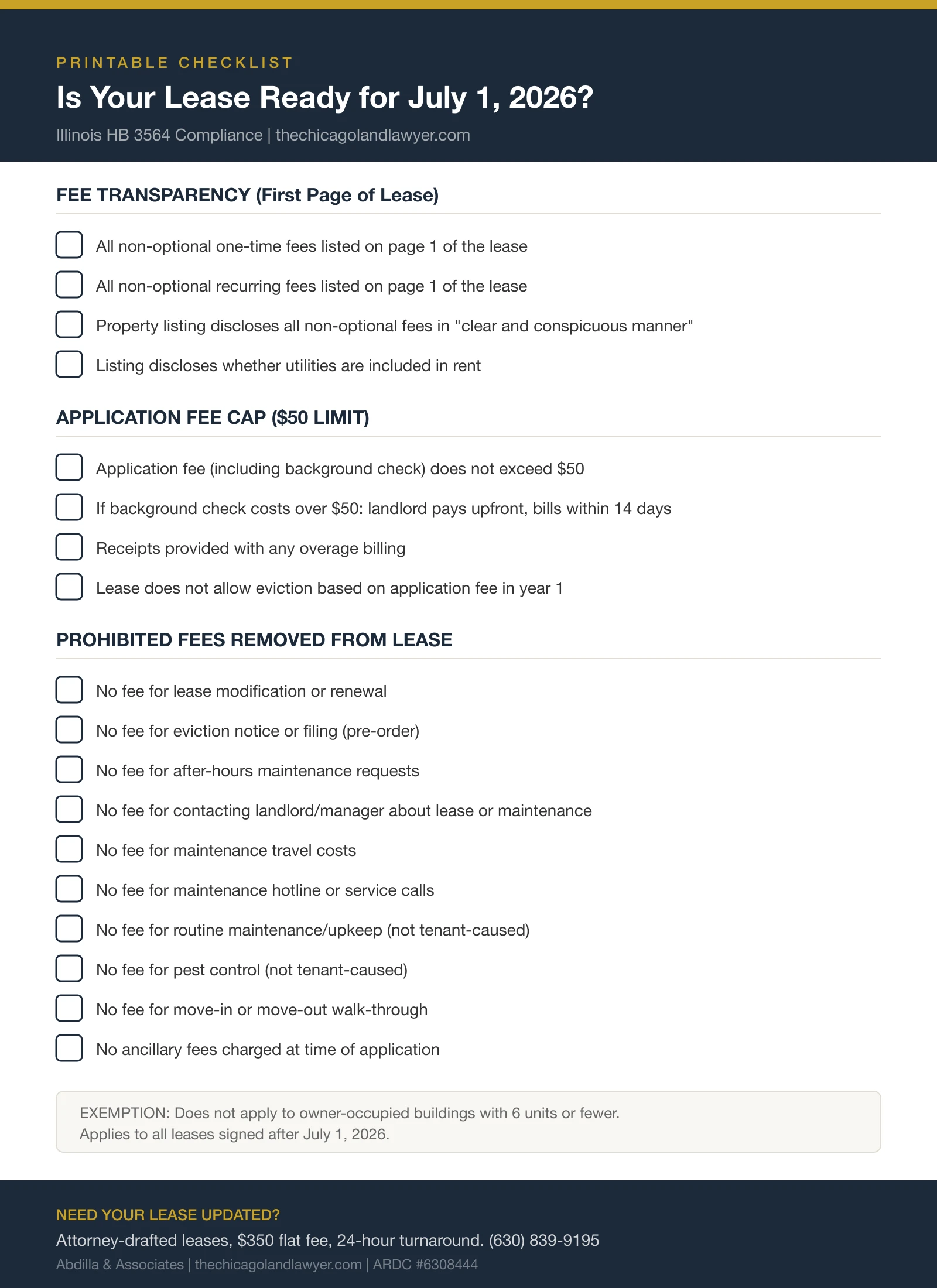
HB 3564 Compliance Checklist
Use this checklist to verify your lease does not contain any of the fees prohibited by HB 3564 and that your fee disclosures comply with the new transparency requirements.
Illinois Fair Housing Compliance Checklist
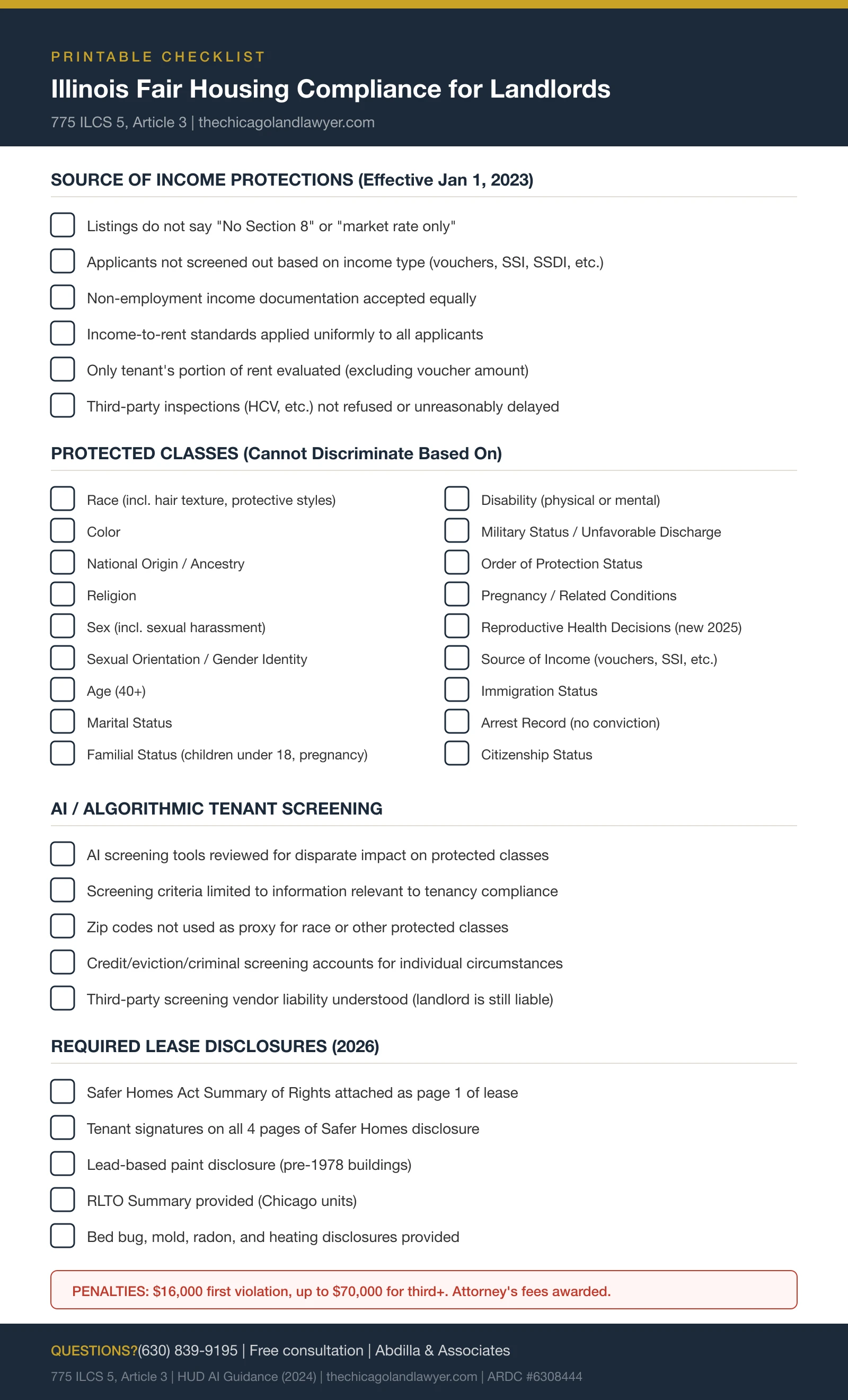
Use this checklist to verify your screening criteria, lease language, and advertising comply with the Illinois Human Rights Act. Pay special attention to the AI screening section if you use any algorithmic tenant screening tools.

Justin Abdilla has drafted hundreds of Chicago lease agreements for landlords across Cook, DuPage, Kane, Will, and Lake counties since founding Abdilla & Associates in 2014. He handles closings, evictions, construction disputes, and zoning applications. Super Lawyers Rising Stars 2021 through 2026. Last updated: April 2026.