
75+ Chicago Eviction Statistics 2026: Costs, Lost Rent and Landlord Risk

Part of the guide: Illinois Eviction Process, Step by Step.
Illinois law requires a written nonpayment notice giving the tenant at least five days to pay before the landlord may terminate the lease and file an eviction action. If the court enters an eviction order, possession is returned through the Sheriff’s enforcement process, not by the landlord acting alone.
For Chicago landlords, an eviction can involve notice requirements, court proceedings, an order of possession and Sheriff enforcement. Those stages create separate timing and cost considerations. In this guide we separate those stages so owners can evaluate the evidence, costs and timing associated with each one.
Abdilla and Associates advises Chicago landlords on notices, filings, court proceedings and enforcement.
Key Takeaways
- Cook County: 30,675 eviction filings in 2024, 30,492 in 2025. Illinois statewide: 64,126 and 61,217. The category combines residential and commercial cases. (Administrative Office of the Illinois Courts, Circuit Court Statistical Dashboard, refreshed July 2026)
- Cook County courts issued nearly 12,000 eviction orders in 2023. Because these were orders sent to the Sheriff for enforcement, the figure does not represent completed physical evictions. (Cook County Sheriff, February 2024)
- Abdilla and Associates' current Chicago example eviction totals about $2,185. That is $1,600 in attorney fees, $389.25 in court filing fees and about $195 for private service. (Abdilla and Associates, August 2026)
- Chicago's median gross rent was $1,486 in the 2024 one-year American Community Survey. (U.S. Census Bureau, August 2026)
- Chicago-area rent prices increased 5.2% from April 2025 to April 2026. This metro CPI figure tracks the rate of price change. It does not report the typical monthly rent inside the city. (U.S. Bureau of Labor Statistics, May 2026)
- Chicago’s stabilized apartment properties recorded 95.9% occupancy in Yardi Matrix’s September 2026 report. The metro’s occupancy rate stood 1.8 percentage points above the national average. (Yardi Matrix, September 2026)
- Chicago recorded 3,500 residential foreclosure filings in 2024. That is an increase from 2,849 in 2023. (DePaul University Institute for Housing Studies, August 2026)
- Illinois recorded 1,192 foreclosure starts in August 2026. ATTOM’s statewide count covers properties where lenders initiated the foreclosure process during the month. (ATTOM, September 2026)
- Chicago landlords generally have 30 days after a tenant vacates to give an itemized statement of damages. They have 45 days to return the remaining security deposit. (City of Chicago, August 2026)
Chicago and Cook County Eviction Statistics
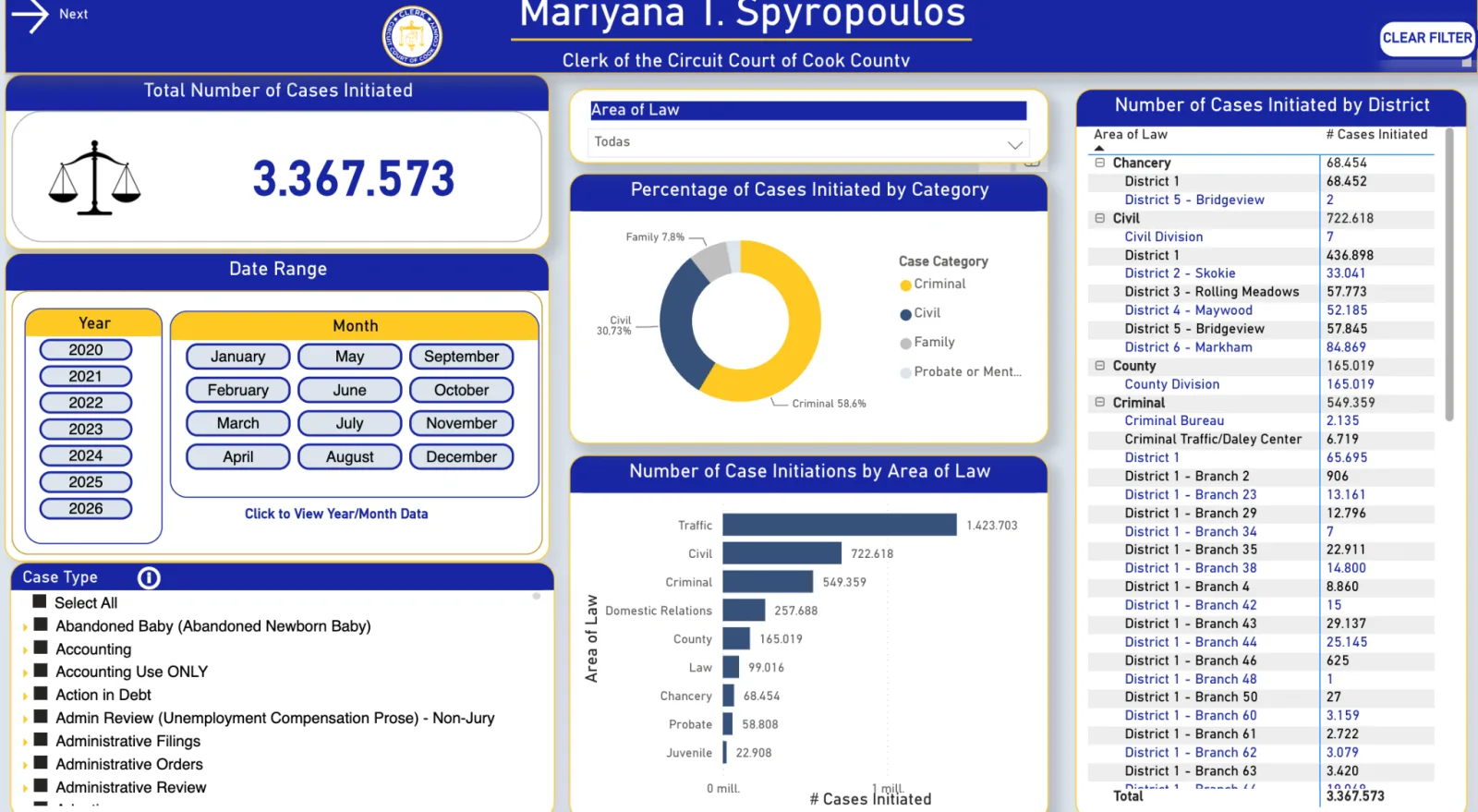
Cook County’s court dashboard tracks case initiation, while the Sheriff’s report tracks eviction orders sent for enforcement. This section keeps those measures separate because a filing, a court order and a completed physical eviction are not the same event.
Eviction filings by county
Filing counts below are from the Administrative Office of the Illinois Courts. The category begins in 2022 and combines commercial and residential cases.
| Jurisdiction | 2024 filings | 2025 filings |
|---|---|---|
| Cook | 30,675 | 30,492 |
| DuPage | 4,317 | 3,866 |
| Will | 3,094 | 2,644 |
| Lake | 2,156 | 2,122 |
| Kane | 1,749 | 1,585 |
| McHenry | 628 | 642 |
| Illinois statewide | 64,126 | 61,217 |
Source: Administrative Office of the Illinois Courts, Circuit Court Statistical Dashboard, 2022 to 2025. Refreshed July 2026. 2025 figures subject to revision.
Show the full 2022 to 2025 series
| Jurisdiction | 2022 | 2023 | 2024 | 2025 |
|---|---|---|---|---|
| Cook | 29,574 | 30,130 | 30,675 | 30,492 |
| DuPage | 4,096 | 4,714 | 4,317 | 3,866 |
| Will | 2,694 | 2,935 | 3,094 | 2,644 |
| Lake | 1,851 | 2,065 | 2,156 | 2,122 |
| Kane | 1,672 | 1,715 | 1,749 | 1,585 |
| McHenry | 625 | 664 | 628 | 642 |
| Statewide | 62,665 | 64,313 | 64,126 | 61,217 |
Source: Administrative Office of the Illinois Courts, Circuit Court Statistical Dashboard, 2022 to 2025.
From filing to enforcement: the Cook County funnel
Sources: Administrative Office of the Illinois Courts, Circuit Court Statistical Dashboard (filings); Cook County Sheriff, 2023 Annual Evictions Report (orders).
- Cook County courts issued nearly 12,000 eviction orders for Sheriff enforcement in 2023. The report does not show how many cases also included monetary judgments or resulted in completed physical evictions. (Cook County Sheriff, February 2024)
- Abdilla and Associates handles more than 150 eviction matters per year, according to the firm. That figure reflects the firm's own caseload. It is not a share of Cook County filings. (Abdilla and Associates, August 2026)
Judgments and possession orders
- Illinois eviction orders generally remain enforceable for up to 120 days after entry. The court may grant an extension. (Illinois General Assembly, 735 ILCS 5/9-117, August 2026)
- Cook County courts issued nearly 12,000 eviction orders for Sheriff enforcement in 2023. The report does not show how many cases also included monetary judgments or resulted in completed physical evictions. (Cook County Sheriff, February 2024)
- Abdilla and Associates reports obtaining approximately $500,000 in back-rent judgments for its clients each year. The amount reflects the firm's client portfolio. It measures amounts awarded, not money collected. (Abdilla and Associates, August 2026)
Sheriff-enforced evictions
- The Cook County Sheriff may enforce an eviction as soon as 24 hours after the order reaches the Evictions Office. This is the earliest possible timing. It is not the typical wait. (Cook County Sheriff, August 2026)
- Filing an eviction order with the Cook County Sheriff costs $65 electronically or $95 on paper. (Cook County Sheriff, August 2026)
- Abdilla and Associates' process guide estimates about 150 days from notice to lockout in Cook County. This is a firm practice estimate. It is not an official Sheriff service-time average, and it does not isolate the enforcement stage. (Abdilla and Associates, August 2026)
Eviction Timelines in Chicago
Illinois law sets minimum notice periods before filing. An eviction order generally expires after 120 days unless the court extends it. Sheriff procedures govern the separate enforcement stage after the order is delivered.
Stage intervals from Abdilla and Associates' own files
No official Illinois source publishes an eviction case duration. Abdilla and Associates records the procedural intervals instead. The tables below are the firm's stage timings, not an official statistic.
| Stage | Days |
|---|---|
| 5-day notice | 5 |
| Filing to first court date | 35 |
| First court date to Early Resolution Program date | 30 |
| ERP to trial transfer | 14 |
| Trial transfer to trial | 21 |
| Stay of eviction after judgment | 7 |
| Sheriff enforcement | 21 to 42 |
| Total | 133 to 154 |
| Stage | Days |
|---|---|
| 5-day notice | 5 |
| Filing to first court date | 35 |
| Default judgment | 14 |
| Stay of eviction after judgment | 7 |
| Sheriff enforcement | 21 to 42 |
| Total | 82 to 103 |
| Stage | Days |
|---|---|
| 5-day notice | 5 |
| Filing to hearing | 21 |
| Hearing to mediation | 28 |
| Mediation to trial | 21 |
| Stay of eviction after judgment | 7 |
| Sheriff enforcement | 14 to 21 |
| Total | 96 to 103 |
Source: Abdilla and Associates case files, August 2026. Totals are the sum of the stage intervals. These are firm practice figures and not an official court statistic. Abdilla and Associates' published typical-case estimates are about 150 days in Cook County, about 95 days in Kane County and about 65 days in DuPage County. The contested tables above run longer because they include every hearing stage.
Service by posting. If the Sheriff must post to obtain service, add approximately 35 days to the high end of each table. Posting applies only when the tenant cannot be served personally. It is not often required.
Time from notice to filing
- For nonpayment of rent, Illinois law generally requires at least five days' notice after service before an eviction case may be filed. (Illinois General Assembly, August 2026)
- Chicago landlords must generally give tenants at least 10 days to correct a material lease violation before filing for eviction. (City of Chicago, August 2026)
- Under Chicago's Fair Notice rules, landlords must give 30, 60 or 120 days' notice. The period depends on the length of occupancy. The tiers cover occupancy of less than six months, six months through three years, and more than three years. (City of Chicago, August 2026)
Time from judgment to Sheriff enforcement
- An Illinois eviction order generally remains enforceable for no more than 120 days after entry unless the court grants an extension. (Illinois General Assembly, August 2026)
- An extension requires court approval. The reviewed official source does not publish a typical time for scheduling an extension request. (Illinois General Assembly, August 2026)
- The Cook County Sheriff notifies the plaintiff by telephone one working day before the scheduled eviction. (Cook County Sheriff, August 2026)
How delay affects total landlord cost
Source: U.S. Census Bureau, 2024 ACS Table B25064. These calculations do not include collection expenses, vacancy losses or other carrying costs.
- At Chicago’s 2024 median gross rent of $1,486, 30 days without payment represents $1,486 in lost rent, or approximately $49.53 per day using a 30-day month. (U.S. Census Bureau, August 2026)
- Using the same median rent, 60 days without payment represents $2,972 in gross rent exposure, while 120 days represents $5,944. These calculations do not include collection expenses, vacancy losses or other carrying costs. (U.S. Census Bureau, August 2026)
- Abdilla and Associates estimates that an error in the eviction notice can extend a case by 30 to 60 days and add more than $2,000 in lost rent. The example reflects the firm's case experience. (Abdilla and Associates, January 2026)
Eviction Costs and Lost Rent
An eviction budget has five parts. Those parts are attorney fees, court filing fees, service charges, Sheriff enforcement fees and unpaid-rent exposure. This section keeps published government fees, firm-specific pricing and calculated rent benchmarks apart.
Attorney, court and service costs
Source: Abdilla and Associates, August 2026.
- Abdilla and Associates charges a $1,600 fixed fee for non-jury residential evictions in Chicago. (Abdilla and Associates, August 2026)
- Cook County Sheriff service of a summons costs $60 per service and defendant when filed electronically. It costs $95 when filed on paper or by mail. (Cook County Sheriff, August 2026)
- Abdilla and Associates estimates that a Chicago eviction generally costs $2,100 to $2,300, depending on complexity. The flat fee covers legal work through the stage immediately before the Sheriff lockout. (Abdilla and Associates, January 2026)
Eviction enforcement costs
- Filing an eviction order with the Cook County Sheriff costs $65 electronically or $95 on paper at the Daley Center. (Cook County Sheriff, August 2026)
- If an eviction is called off, or the landlord does not appear, rescheduling costs another $65 electronically or $95 on paper. (Cook County Sheriff, August 2026)
Lost rent and arrears
- Abdilla and Associates obtains approximately $500,000 in back-rent judgments across its client portfolio each year. This figure measures amounts awarded by courts. It does not measure money collected. (Abdilla and Associates, August 2026)
- At $1,486 per month, three months of unpaid rent equals $4,458. Five months equals $7,430. These calculations illustrate potential exposure. They do not represent typical arrears in an eviction case. (U.S. Census Bureau, August 2026)
- Based on Abdilla and Associates' case experience, a dismissed eviction case can add 30 to 60 days to the process and $2,000 to $4,000 in lost rent. (Abdilla and Associates, January 2026)
See also: rent loss calculator · wait it out or file the eviction.
Vacancy and carrying costs
- Chicago homeowners with a mortgage had median monthly ownership costs of $2,377 in the 2024 one-year ACS. Owners without a mortgage paid $846. These are homeowner figures. They do not measure the carrying costs of rental properties. (U.S. Census Bureau, August 2026)
- Nationally, one-unit rental properties had median operating expenses of $6,613 per unit in 2024, while the mean was $8,670. These federal benchmarks are not specific to Chicago rental properties. (U.S. Census Bureau, February 2026)
- Chicago-area housing prices increased 4.0% over the year ending April 2026. Energy prices increased 14.2%. These CPI figures measure regional price changes, not the costs borne by a typical landlord. (U.S. Bureau of Labor Statistics, May 2026)
Chicago Rental Profitability
Rental profitability depends on both income and expenses. The Chicago rent figures in this section come from the ACS and metropolitan CPI, while operating-cost and receipt benchmarks come from the national Rental Housing Finance Survey and should not be presented as Chicago margins.
Rents and vacancy rates
- Chicago's median gross rent was $1,486 in the 2024 one-year American Community Survey. (U.S. Census Bureau, August 2026)
- The Chicago-area rent CPI increased 5.2% over the year ending April 2026. (U.S. Bureau of Labor Statistics, May 2026)
- The same index increased 1.1% from February to April 2026 and 0.8% from March to April 2026. The index covers the metropolitan area. It measures regional rent-price changes, not rent levels inside the city alone. (U.S. Bureau of Labor Statistics, May 2026)
- Chicago’s stabilized apartment properties recorded 95.9% occupancy in Yardi Matrix’s September 2026 report. The metro’s occupancy rate stood 1.8 percentage points above the national average. (Yardi Matrix, September 2026)
Operating costs and margins
- Among one-unit rental properties nationwide, median operating expenses were $6,613 per unit in 2024. The mean was $8,670. (U.S. Census Bureau, February 2026)
- For the same national group, median annual rental receipts were $16,800 and mean receipts were $19,109. These are gross receipts before operating expenses. (U.S. Census Bureau, February 2026)
- Chicago-area housing prices increased 4.0% over the year ending April 2026. Shelter prices increased 4.7%. Both CPI figures measure metro-area consumer prices. (U.S. Bureau of Labor Statistics, May 2026)
- Chicago-area prices for household furnishings and operations increased 1.9% over the year ending April 2026. This is a consumer-price category. Do not treat it as an index of landlord expenses. (U.S. Bureau of Labor Statistics, May 2026)
Rent collection and delinquency risk
- Illinois landlords must give tenants at least five days to pay overdue rent before terminating the lease and filing an eviction action. (Illinois General Assembly, August 2026)
- Cook County courts issued nearly 12,000 eviction orders in 2023, although the Sheriff's report does not distinguish nonpayment cases from evictions filed on other grounds. (Cook County Sheriff, February 2024)
- At Chicago’s 2024 median gross rent of $1,486, one missed month represents $1,486 in unpaid rent and three missed months represent $4,458. These calculations illustrate financial exposure rather than typical delinquency amounts. (U.S. Census Bureau, August 2026)
Small-landlord economics
- The 2024 Rental Housing Finance Survey estimated that the United States had 15.714 million one-unit rental properties. (U.S. Census Bureau, February 2026)
- DePaul's portal estimates 1,146,111 Chicago households, with 54.5% renter occupancy and 45.5% owner occupancy. Applying the renter share yields approximately 624,600 renter-occupied households. This is a calculation, not a count of all rental units. (DePaul University Institute for Housing Studies, August 2026)
- Among one-unit rental properties nationwide, median annual rental receipts were $16,800 in 2024 and median operating expenses were $6,613 per unit. (U.S. Census Bureau, February 2026)
Tenant Property Damage Statistics
Available sources do not publish the probability or average cost of tenant-caused damage in Chicago. This section separates three different things. Those things are national capital-improvement data, renter-reported disputes, and verified tenant-caused damage. It then states the applicable security-deposit rules.
Likelihood and frequency of tenant damage
- The 2024 Rental Housing Finance Survey estimated 15.714 million one-unit rental properties nationwide. It does not identify whether tenants caused the capital work reported for those properties. (U.S. Census Bureau, February 2026)
- Chicago's ordinance allows deductions for tenant-caused damage but excludes reasonable wear and tear. It does not report how often tenants cause damage. (City of Chicago, August 2026)
- In Zillow's nationally representative 2024 renter study, 19% of recent renters who had moved reported a disagreement with a landlord or property manager about repairs, damage or maintenance. (Zillow, October 2024)
Repair and turnover costs
- For one-unit rental properties nationwide, the median value of capital improvements was $500 in 2024. The mean was $5,383. The figures include improvements unrelated to tenant damage. (U.S. Census Bureau, February 2026)
- The mean capital-improvement value exceeded the median by $4,883. A small number of expensive projects raises the average sharply. The table does not establish Chicago turnover costs, the share of zero-cost projects, or whether tenants caused the work. (U.S. Census Bureau, February 2026)
- Under certain conditions, Chicago tenants may address landlord noncompliance when the reasonable repair cost does not exceed the greater of $500 or half the monthly rent. This threshold applies to a tenant repair remedy. It is not a measure of tenant-caused damage. (City of Chicago, August 2026)
Security deposits and uncovered losses
- Chicago landlords generally have 30 days after a tenant vacates to give an itemized statement of damage. They have 45 days to return the remaining deposit balance. (City of Chicago, August 2026)
- For Illinois rental buildings or complexes with five or more units, landlords withholding any part of a deposit must give an itemized damage statement and paid receipts within 30 days. If they do not, they must return the full deposit within 45 days. (Illinois Attorney General, January 2024)
- Certain Chicago security-deposit violations may expose a landlord to damages equal to twice the deposit plus interest. Interest amounts are often less than $1 per year. The ordinance provides a cure route that requires an additional $50 payment within 14 days after notice. (City of Chicago, August 2026)
Foreclosures of Tenant-Occupied Properties
DePaul's portal reports Chicago foreclosure filings and outcomes by building size. Census tenure data describe the citywide mix of owner- and renter-occupied housing. Neither source identifies tenant occupancy or the cause of foreclosure for a given property.
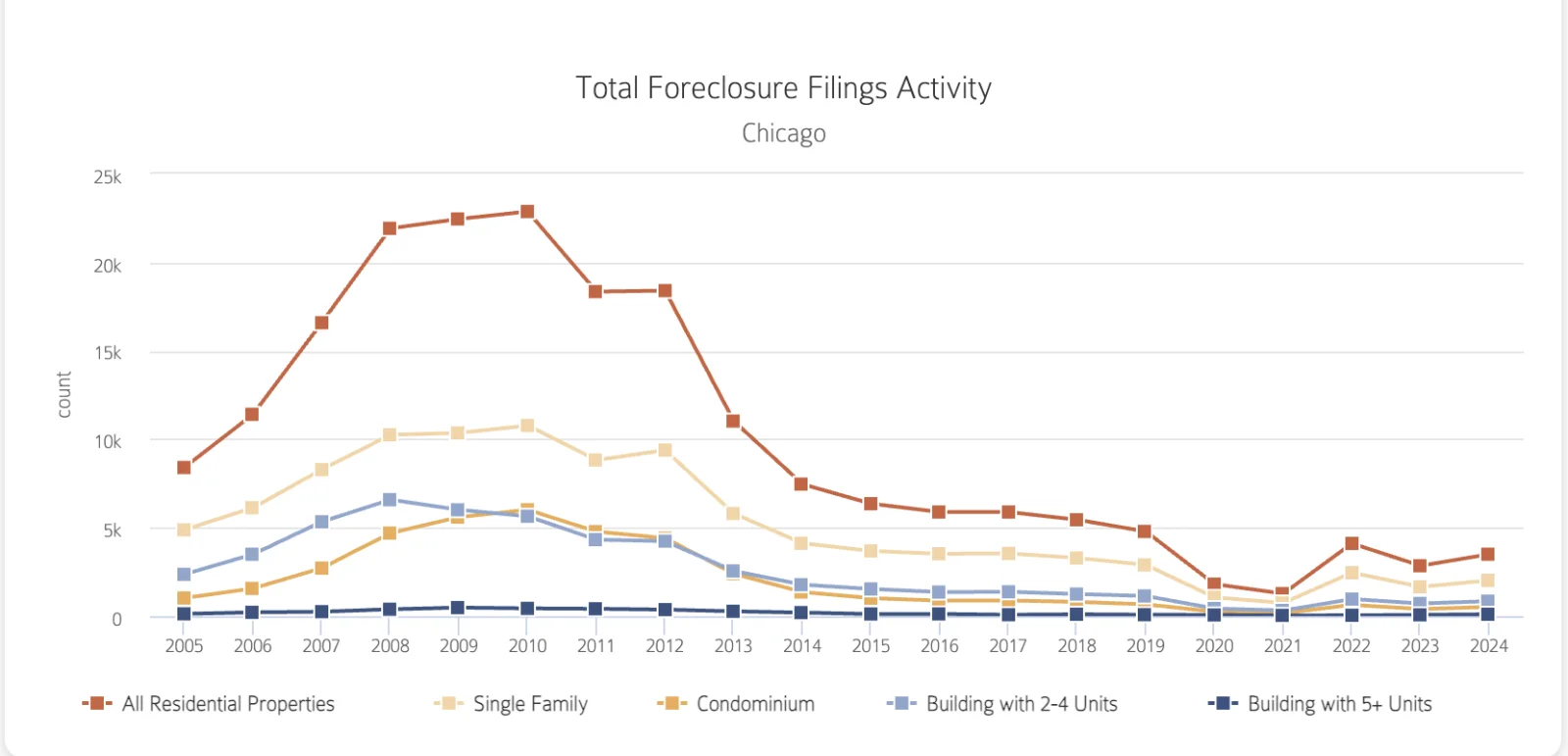
Source: DePaul University Institute for Housing Studies, Chicago Data Portal. The city recorded 651 more filings in 2024 than in 2023, an increase of 22.9%.
Foreclosure filings
- Chicago recorded 3,500 residential foreclosure filings in 2024, compared with 2,849 in 2023. (DePaul University Institute for Housing Studies, August 2026)
- The city recorded 651 more filings in 2024 than in 2023, an increase of 22.9%. (DePaul University Institute for Housing Studies, August 2026)
- Illinois recorded 1,192 foreclosure starts in August 2026. ATTOM’s statewide count covers properties where lenders initiated the foreclosure process during the month. The count covers all of Illinois. It does not isolate Chicago or rental buildings. (ATTOM, September 2026)
- Chicago's residential foreclosure filing rate increased from 0.4 per 100 parcels in 2023 to 0.5 per 100 parcels in 2024. (DePaul University Institute for Housing Studies, August 2026)
- Chicago's median owner-occupied home value was $341,200 in the 2024 one-year ACS. This citywide benchmark does not represent the value of homes in foreclosure. (U.S. Census Bureau, August 2026)
Tenant-occupied rental properties
- Of Chicago's 2024 foreclosure filings, 847 involved buildings with two to four units and 107 involved buildings with five or more units. (DePaul University Institute for Housing Studies, August 2026)
- Together the two multifamily categories accounted for 954 filings, or 27.3% of Chicago's 3,500 residential foreclosure filings in 2024. Building size alone does not establish whether tenants occupied those properties. (DePaul University Institute for Housing Studies, August 2026)
- Chicago's 2024 one-year ACS tenure counts indicate that 46.5% of occupied housing units were owner-occupied and 53.5% were renter-occupied. These citywide shares cannot determine occupancy inside properties facing foreclosure. (U.S. Census Bureau, August 2026)
Foreclosure outcomes and data gaps
- In 2024, 73.6% of completed foreclosure auctions resulted in bank-owned, or REO, status. The share was 75.1% for two-to-four-unit buildings and 100% for buildings with five or more units. (DePaul University Institute for Housing Studies, August 2026)
- The 884 foreclosure auctions completed in 2024 equaled 25.3% of the 3,500 filings recorded that year. This is not a case conversion rate. Auctions completed in 2024 may stem from filings made in earlier years. (DePaul University Institute for Housing Studies, August 2026)
- Chicago had an estimated 1,172,455 households in the 2024 one-year ACS. The Census table does not show how many households experienced foreclosure. (U.S. Census Bureau, August 2026)
Enforcement Actions Against Chicago Landlords
Chicago and Cook County rules set inspection and enforcement requirements for covered properties. The city's live datasets report violation records, dockets, dispositions and fines. These measures use different units. Do not combine them into a single landlord-violation rate.
Building violations and inspections
- Chicago requires annual inspections for certain buildings, including theaters, churches, schools and public-assembly units. Places of public amusement must be inspected within the 90 days before the annual license-renewal deadline. (City of Chicago, August 2026)
- HUD requires public-housing and covered multifamily properties to inspect every unit at least once per year. Life-threatening and severe deficiencies found during an NSPIRE inspection must be corrected within 24 hours. (U.S. Department of Housing and Urban Development, August 2026)
- Cook County requires each covered rental unit to be inspected at least once every four years. The county must notify the owner at least three business days before the inspection. The owner must give the tenant at least two calendar days' notice. (Cook County, August 2026)
Most common landlord violations
- Injustice Watch identified 149,758 Chicago buildings with recorded code violations. Of those, 78,889 had violations meeting the city's former criteria for its Problem Landlord List. The analysis covered about 1.9 million violation records across nearly two decades. These are not annual figures. (Injustice Watch, August 2024)
- Of more than 9,000 Chicago addresses tied to heat complaints between February 2019 and February 2024, fewer than 200 were found liable and fined. The fines ranged from $500 to $3,500. (WBEZ, March 2024)
- Illinois Answers identified 76 Chicago properties that received at least five complaint-driven inspections for insufficient heat or hot water beginning in November 2017. Buildings owned by one landlord were cited for heating-law violations at least 19 times. These findings cover multiple years. (Illinois Answers Project, June 2023)
Administrative and Housing Court actions
- For building matters with violation dates in 2025, Chicago's data contained 25,802 ordinance-violation records across 10,701 Administrative Hearings dockets and 10,703 notice numbers. (City of Chicago Data Portal, August 2026)
- At the time the data was accessed, docket dispositions included 4,391 non-suits, 3,875 findings of liability, 1,639 defaults and 616 continuances. (City of Chicago Data Portal, August 2026)
- An additional 179 dockets were marked not liable, 23 were categorized as "Adjudication Performance / Other," and 63 had no displayed disposition. These figures may change as cases proceed. (City of Chicago Data Portal, August 2026)
Frequency of fines and repeat violations
- Chicago's dataset showed fines greater than zero on 12,184 building-violation records spanning 5,544 dockets. A single docket may contain multiple violation records, so these are not 12,184 separate fines or cases. (City of Chicago Data Portal, August 2026)
- When accessed, the 2025 building-violation records included 36,777 open statuses, 12,744 compliant statuses and 80 records with no entry. Case statuses change, so this is a snapshot of records rather than a count of repeat-offending landlords. (City of Chicago Data Portal, August 2026)
- Chicago had an estimated 1,172,455 households in the 2024 one-year ACS. That household count cannot be meaningfully compared with the building-violation dataset's 10,309 property groups because the two datasets use different units of measurement. (U.S. Census Bureau, August 2026)
Methodology and Source Notes
The sources use different geographies, time periods and units of measurement. These notes distinguish city from county data, filings from court orders, reported figures from calculations, and live administrative records from fixed annual tables.
The evidence has material limits. The official court counts combine residential and commercial evictions. Chicago's foreclosure portal does not identify tenant occupancy for every parcel. No qualifying primary source publishes the probability that a Chicago tenant causes property damage. Rental Housing Finance Survey cost and income estimates are national benchmarks and are not Chicago margins. City administrative datasets are live and change between queries.
Frequently Asked Questions
How many eviction orders did Cook County issue in 2023?
Cook County courts issued nearly 12,000 eviction orders in 2023. Because these were orders sent to the Sheriff for enforcement, the figure does not represent completed physical evictions. Cook County’s court dashboard tracks case initiation, while the Sheriff’s report tracks eviction orders sent for enforcement. A filing, a court order and a completed physical eviction are not the same event.
How soon can the Sheriff enforce an eviction order in Cook County?
The Cook County Sheriff may enforce an eviction as soon as 24 hours after the order reaches the Evictions Office. This is the earliest possible timing, not the typical wait. The Cook County Sheriff notifies the plaintiff by telephone one working day before the scheduled eviction. At the enforcement stage, filing an eviction order with the Cook County Sheriff costs $65 electronically or $95 on paper.
How much does a Chicago eviction cost in 2026?
Abdilla and Associates’ current Chicago example eviction totals approximately $2,185: $1,600 in attorney fees, $389.25 in court filing fees and about $195 for private service. Abdilla and Associates charges a $1,600 fixed fee for non-jury residential evictions in Chicago. Abdilla and Associates estimates that a Chicago eviction generally costs $2,100 to $2,300, depending on complexity. Its flat fee covers legal work through the stage immediately before the Sheriff lockout.
How much rent does a Chicago landlord lose during an eviction?
Chicago’s median gross rent was $1,486 in the 2024 one-year American Community Survey. At Chicago’s 2024 median gross rent of $1,486, 30 days without payment represents $1,486 in lost rent, or approximately $49.53 per day using a 30-day month. Using the same median rent, 60 days without payment represents $2,972 in gross rent exposure, while 120 days represents $5,944. These calculations do not include collection expenses, vacancy losses or other carrying costs.
How long does a Chicago eviction take?
For nonpayment of rent, Illinois law generally requires at least five days’ notice after service before an eviction case may be filed. An Illinois eviction order generally remains enforceable for no more than 120 days after entry unless the court grants an extension. Abdilla and Associates’ current process guide estimates about 150 days from notice to lockout in Cook County. This is a firm-reported practice estimate, not an official Sheriff service-time average, and it does not isolate the enforcement stage.
How many Chicago foreclosure filings involve rental buildings?
Chicago recorded 3,500 residential foreclosure filings in 2024, compared with 2,849 in 2023. Of Chicago’s 2024 foreclosure filings, 847 involved buildings with two to four units and 107 involved buildings with five or more units. Together, the two multifamily categories accounted for 954 filings, or 27.3% of Chicago’s 3,500 residential foreclosure filings in 2024. Building size alone does not establish whether tenants occupied those properties.
How many foreclosure starts did Illinois record in August 2026?
Illinois recorded 1,192 foreclosure starts in August 2026, according to ATTOM. The statewide count covers properties where lenders initiated the foreclosure process during the month. It does not isolate Chicago or rental buildings.
What is the apartment occupancy rate in Chicago?
Chicago’s stabilized apartment properties recorded 95.9% occupancy in Yardi Matrix’s September 2026 report. The metro’s occupancy rate stood 1.8 percentage points above the national average.
"Illinois notice law and Cook County enforcement procedures make the applicable notice, filing stage and court order important to case planning."
$1,600 Flat Fee in Chicago. $895 in DuPage. Notice Through Judgment.
Chicago landlords can review Abdilla and Associates’ eviction service and schedule a confidential consultation about their facts, likely timeline and current fees. Statistics and general legal information are not legal advice.
All consultations are confidential.
Related reading
- The Illinois eviction process, stage by stage
- Chicago eviction attorney: flat fee, notice through judgment
- The Illinois 5-day notice, explained
- Rent loss calculator
- Suburban Cook County evictions and Kane County evictions
Full Source List
- Administrative Office of the Illinois Courts, Circuit Court Statistical Dashboard (2022 to 2025) and the printed 2022 and 2023 Annual Report Statistical Summaries, Civil Caseload by County, eviction column.
- Cook County Sheriff: 2023 Annual Evictions Report
- Cook County Sheriff: Eviction Procedure, Property Owner's Guide
- Cook County Sheriff: Eviction Procedure, Tenant's Guide
- Cook County Sheriff: Serving Process and Summons
- Cook County Clerk of the Circuit Court: Data Dashboard
- Illinois General Assembly: 735 ILCS 5/9-117, Expiration of Eviction Order
- Illinois General Assembly: Code of Civil Procedure, Article IX
- U.S. Census Bureau: 2024 ACS Table B25064, Median Gross Rent
- U.S. Census Bureau: 2024 ACS Table B25088, Selected Monthly Owner Costs
- U.S. Census Bureau: 2024 ACS Table B25077, Median Home Value
- U.S. Census Bureau: 2024 ACS Table B25003, Housing Tenure
- U.S. Census Bureau: 2024 ACS Table B11001, Households by Type
- U.S. Census Bureau: 2024 RHFS Table 3, Rental Receipts
- U.S. Census Bureau: 2024 RHFS Table 4, Operating Expenses
- U.S. Census Bureau: 2024 RHFS Table 6, Capital Improvements
- U.S. Bureau of Labor Statistics: Chicago Area CPI, April 2026
- DePaul University Institute for Housing Studies: Chicago Data Portal
- City of Chicago: Municipal Code 5-12-080, Security Deposits
- City of Chicago: Municipal Code 5-12-130, Landlord Remedies
- City of Chicago: Municipal Code 5-12-110, Tenant Remedies
- Cook County: Code of Ordinances, Residential Inspection Requirements
- Illinois Attorney General: Landlord and Tenant Rights and Laws
- U.S. Department of Housing and Urban Development: NSPIRE Standards
- Zillow: 2024 Consumer Housing Trends Report, Renters
- Injustice Watch: Tenant Trap, Housing Court Data Methodology
- WBEZ: Chicago Heat Complaints and Enforcement
- Illinois Answers Project: Repeat Heat Violations
- City of Chicago Data Portal: Building Violations dataset (22u3-xenr)
- City of Chicago Data Portal: Administrative Hearings dataset (6br9-quuz)
- Abdilla and Associates: How Much Does an Eviction Lawyer Cost in Illinois?
- Abdilla and Associates: The Illinois Eviction Process
- Abdilla and Associates: Chicago Evictions
- ATTOM: August 2026 U.S. Foreclosure Market Report
- Yardi Matrix: Chicago Multifamily Market Report, September 2026
Reuse is welcome with attribution and a link to this page. Cite as: Abdilla and Associates, "75+ Chicago Eviction Statistics 2026," thechicagolandlawyer.com, updated August 2026.