Part of the guide: Illinois Eviction Process, Step by Step.
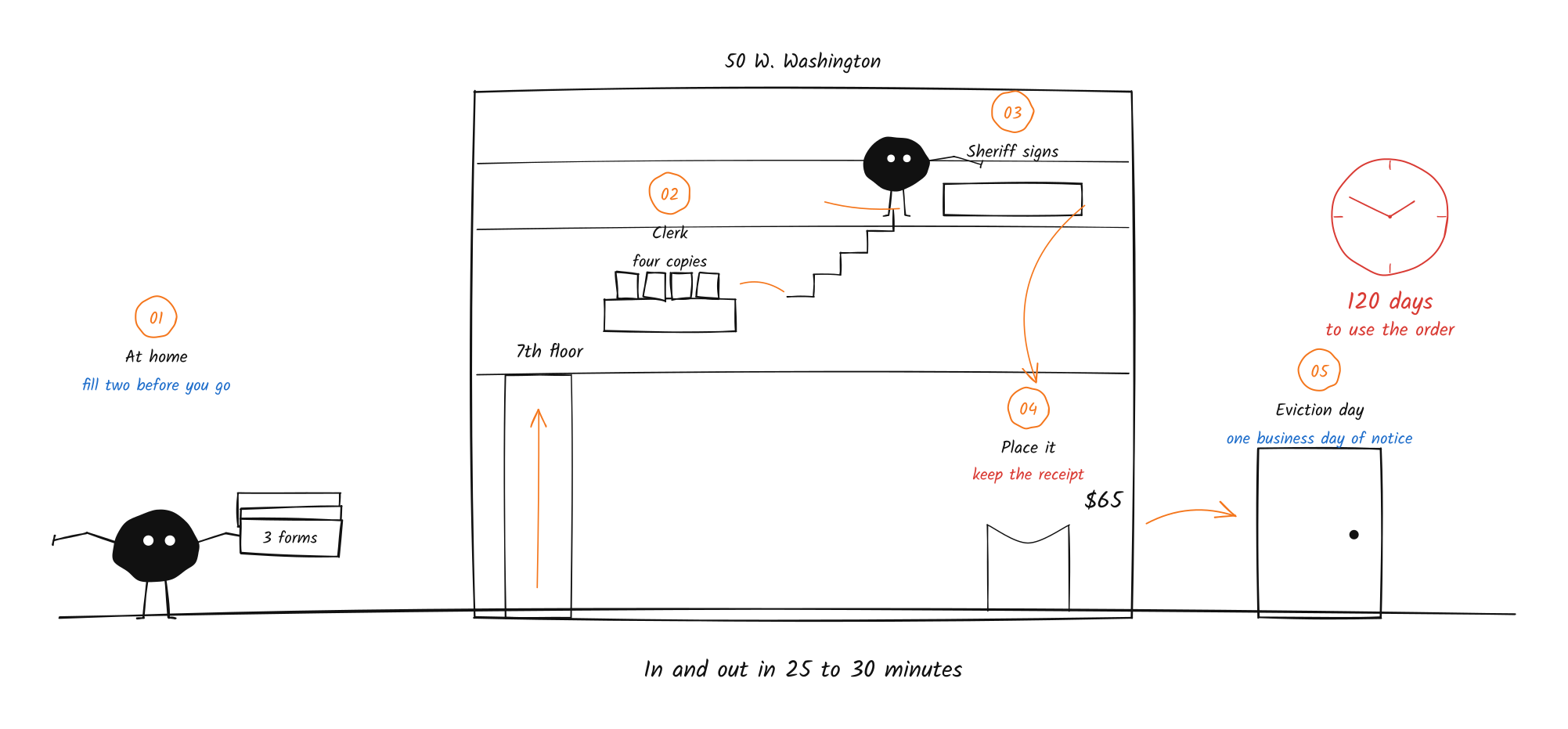
An eviction order is a piece of paper until the Cook County Sheriff enforces it, and the Sheriff enforces nothing until you place the order correctly. This page is the exact trip, the way I give it to my own clients: the three documents, the Daley Center route floor by floor, the $65 placement, and what happens before eviction day. Done right, you are in and out in 25 to 30 minutes.

The road ahead
This walkthrough covers a Chicago case placed at the Daley Center. Suburban Cook cases place at the district courthouses, and the same documents apply. Your eviction order is enforceable for 120 days, so make this trip the week the judgment enters. If the sheriff still has not come, read what to do when enforcement stalls and the 120 day clock is running.
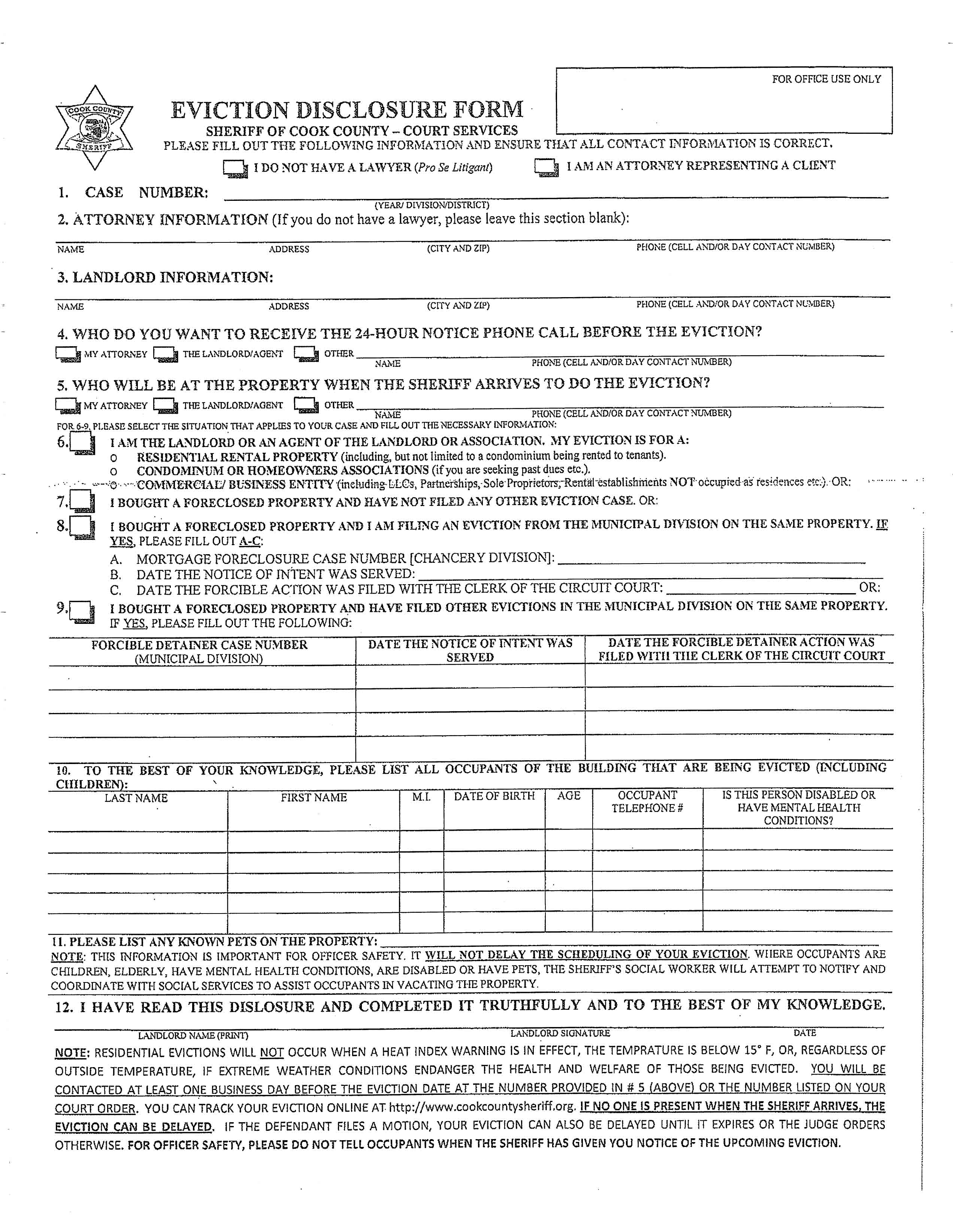
You need all three of these: your eviction order (the court's signed order, which we send our clients when the case concludes), the Verification of Non-Rental Assistance, and the Sheriff's Eviction Disclosure Form. Fill out the verification and the disclosure form at home, before you get there. The Sheriff does not publish the disclosure form as a PDF, so we host a scan of it here.
Get this right
The verification has four boxes and all four must be checked. It certifies no rental assistance funds restrict the eviction and that the order stands unchanged. The Sheriff will not schedule your eviction until this form is filed, by email to CCSO.EVICTIONUPDATE@ccsheriff.org or in person with the rest of your packet. If assistance money with strings attached is in play, stop and talk to your attorney before signing.
The disclosure form decides who gets the call. It asks who receives the 24-hour notice call before the eviction and who will be at the property when the Sheriff arrives. Accurate phone numbers here are what prevent delays. It also asks for every occupant, including children, and any pets, for officer safety and social service coordination.
Bring your case number. It is on the order. You will type it into a terminal in Stage 2.
Verification of Non-Rental Assistance (CCS.VERIFICATION.RENTAL, Circuit Court of Cook County); Eviction Disclosure Form (Sheriff of Cook County, Court Services).
Go to the Daley Center, 50 W. Washington, and take the elevator to the 7th floor. Turn out of the elevator and head down to the Clerk's office. Inside, go to the public access terminals: type in your case number, pull up the eviction order, and print it. You want four copies total: two certified and two not certified. Then walk to the cashier and tell her you printed. She will charge you a few dollars, stamp the certified copies, and you have your documents.
Get this right
Print first, then pay. The terminals print on the honor system; the cashier reconciles when you tell her what you printed. Cash or card, a few dollars.
Count your stamps. Two copies get the certification stamp, two stay plain. The Sheriff's office wants the full set, so keep all four together.
Clerk of the Circuit Court of Cook County, Daley Center, 50 W. Washington St., Chicago.
Exit the Clerk's office and go up the staircase into the Sheriff's office. Walk past the entry area to the counter all the way at the end of the table. That counter verifies eviction orders. Show them your packet: the four copies of the order, the signed verification, and the completed disclosure form. The Sheriff reviews and signs the orders.
Get this right
Hand over the whole packet at once. Order copies, verification, disclosure form. Incomplete packets are the number one reason this trip takes two visits instead of one.
Sheriff of Cook County, Court Services, Daley Center.
With signed orders in hand, go back to the roped-in area right as you entered the room and place your order. It costs $65. They hand you a receipt. Keep that receipt: the number on it is how you check on your case and track your eviction from here forward. That is the whole trip. Door to door, 25 to 30 minutes.
Cook County Sheriff eviction placement; track at cookcountysheriff.org.
The Sheriff contacts whoever you listed on the disclosure form at least one business day before the eviction date. Someone must be at the property when the deputies arrive: if no one is present, the eviction can be delayed and a cancelled placement costs a reinstatement fee. Deputies remove the occupants, not their belongings. And through all of it, one statutory clock governs: your order is enforceable for 120 days from entry unless the court grants an extension, so backlogs and winter cancellations are eating your window from the day the judgment enters.
Get this right
Plan for weather. Residential evictions do not happen during a heat index warning, when the temperature is below 15 degrees, or when extreme weather endangers the people being evicted. A winter judgment needs the 120-day math done in advance; day 90 goes on the calendar as an alarm for an extension motion.
Say nothing to the occupants. The Sheriff's own form asks you not to tell occupants when the eviction notice comes, for officer safety. Let the deputies run their process.
Be ready at the door. You or your representative meets the deputies, identifies entry points, and takes possession. Bring a locksmith if the locks are changing that day, and know that a defendant's last-minute motion can delay enforcement until a judge rules.
735 ILCS 5/9-117 (120-day rule); Sheriff's Eviction Disclosure Form notes; Cook County Sheriff's Office plaintiff's guide.
Post-judgment questions
Here is the honest answer. In my experience, almost no landlord collects a money judgment against a residential tenant. The judgment is real. The tenant's wages and bank accounts are usually not there to find. Treat the possession order as the win. Treat the money judgment as a credit mark on the tenant, and as a tool you use only if wages or property turn up. Do not spend new money chasing it on hope.
The placement fee is $65, paid at the Sheriff's office when you place the order, plus a few dollars to the Clerk for printing and certifying copies of your eviction order. Keep the receipt from the Sheriff's counter; it is how you check on your case.
Plan for 25 to 30 minutes once you are in the building: print and certify copies at the Clerk's public access terminals on the 7th floor, pay the cashier, take the staircase up to the Sheriff's office for verification and signature, then place the order at the intake area. Filling out the verification and disclosure forms at home is what keeps the trip that short.
Scheduling depends on the Sheriff's queue, and you will be contacted at least one business day before the eviction date at the number you listed on the disclosure form. Someone must be at the property when the deputies arrive or the eviction can be delayed. Residential evictions do not happen when the temperature is below 15 degrees, during a heat index warning, or in extreme weather. Your order is enforceable for 120 days from the date it was entered, so place it immediately and calendar day 90.
The Sheriff will not schedule your eviction until the Verification of Non-Rental Assistance is filed, and all four of its certifications must be true: no assistance funds received or pending with conditions that block the eviction, no stay tied to an assistance program, and an order that remains valid and unchanged. If assistance money with conditions attached touched your case, talk to your attorney before you sign it.
Or skip the trip
My clients get their judgment, their forms, and these exact instructions the day the case concludes, or I make the trip for them. If you are holding a judgment and want the enforcement handled, call me. Cook County sent nearly 12,000 eviction orders to the Sheriff in 2023. Not every one becomes a lockout, and my Chicago eviction statistics report shows what each stage actually counts. My Chicago eviction fee is $1,600 flat, notice through judgment.