
How to Fill Out the Illinois Eviction Summons

Part of the guide: Illinois Eviction Process, Step by Step.
The Eviction Summons (ATJ 3510.4) tells each Defendant about the case and the first court date. Fill out one summons for each Defendant. Add one for Unknown Occupants if your complaint names them. Get the court date from the Circuit Clerk before you fill in page 2. Attach the Court-Based Rental Assistance Notice in English and Spanish to every summons, in every county. File it with the complaint, and the clerk issues it. The Sheriff or a private process server must serve each Defendant at least 3 days before the court date. In Cook County, the minimum is 7 days. You cannot serve the summons yourself.
The official forms, current versions. These are the Illinois Supreme Court approved forms, hosted here and checked against the court's list each month.
- Eviction Summons (ATJ 3510.4, version 10/26)
- Letter to Sheriff (ATJ 1505.4, version 09/25)
- Court-Based Rental Assistance Notice (English and Spanish) (court form, version current)
- Court-Based Rental Assistance: Cook County (court form, version current)
- DuPage County Eviction Mediation Program (court form, version current)
How Do I Fill It Out, Field by Field?
Eviction Summons (ATJ 3510.4)
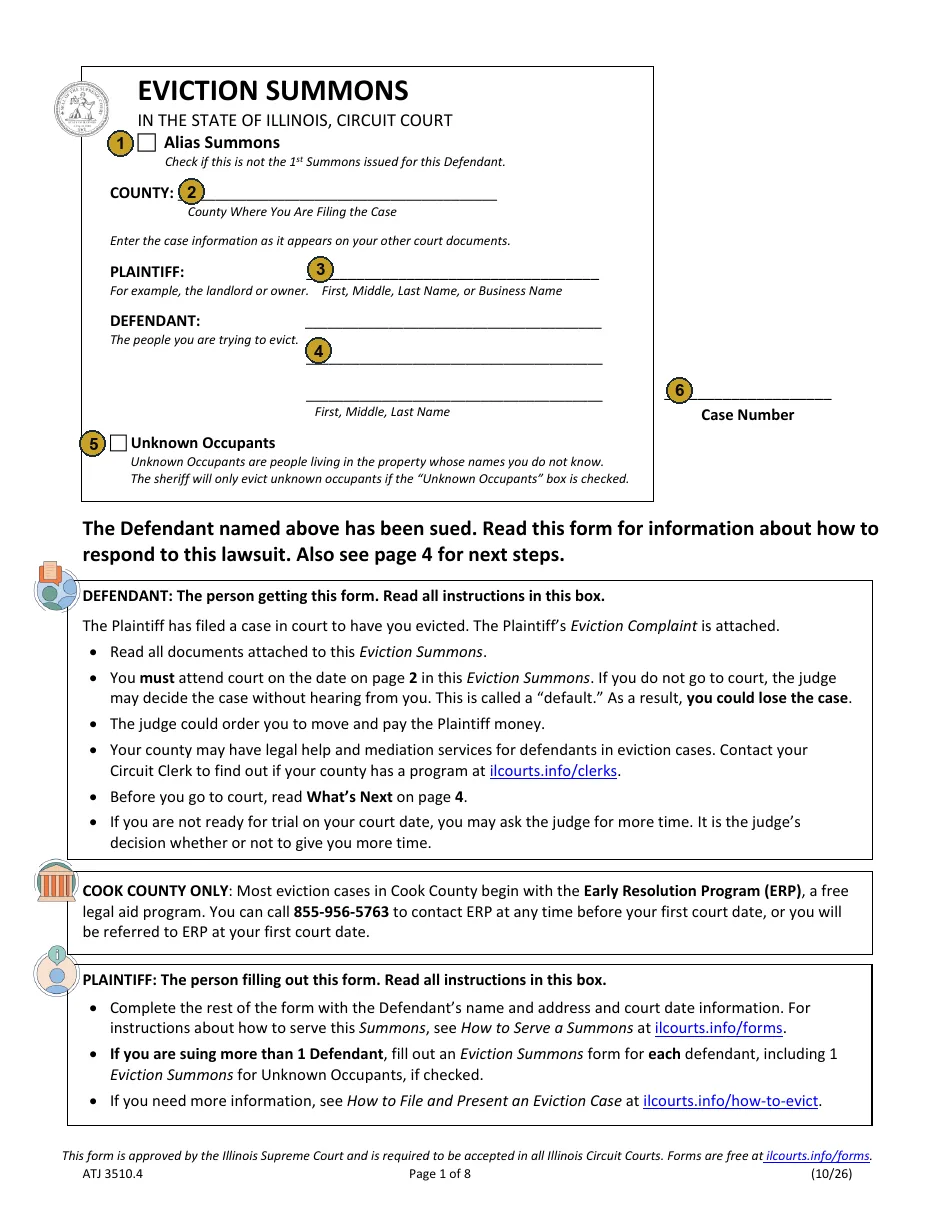
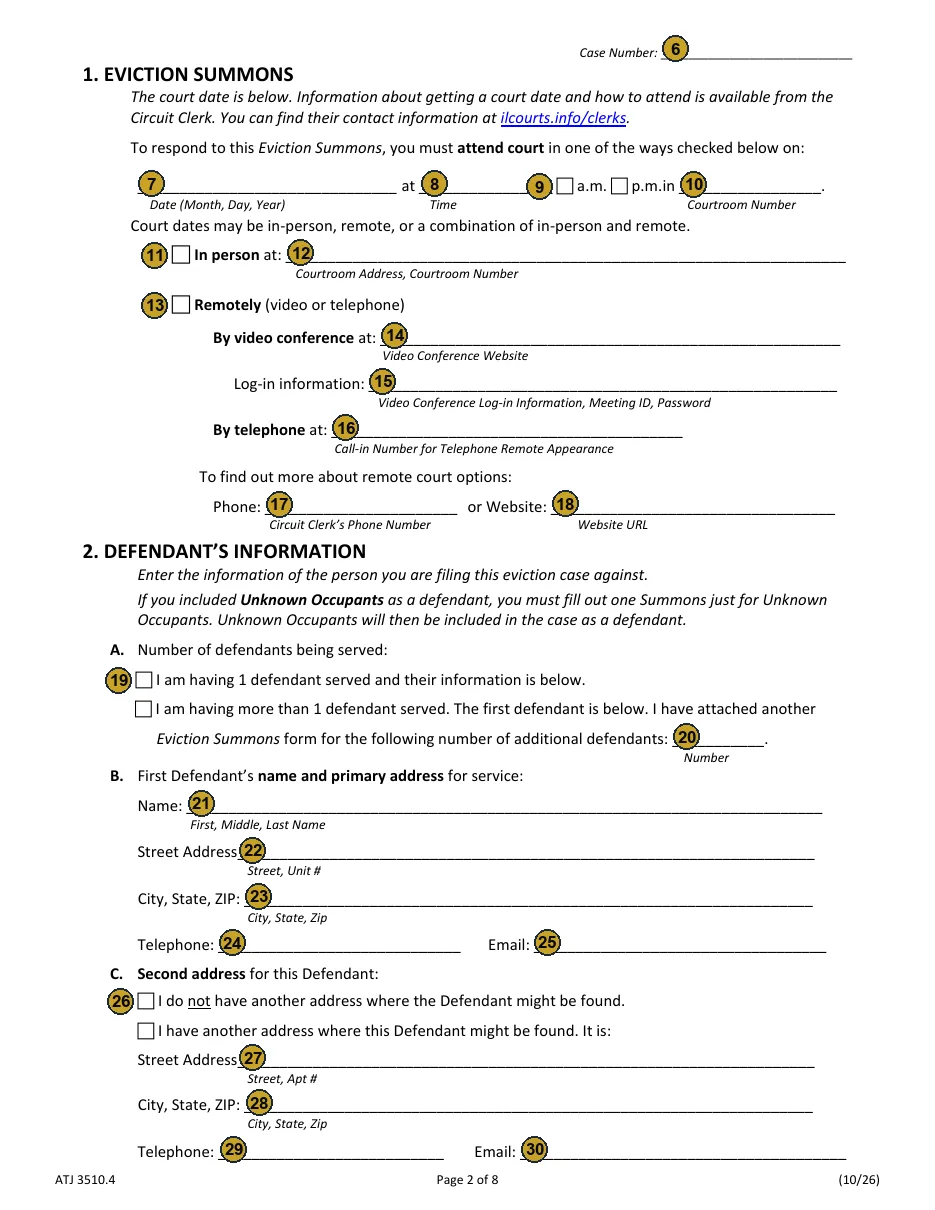
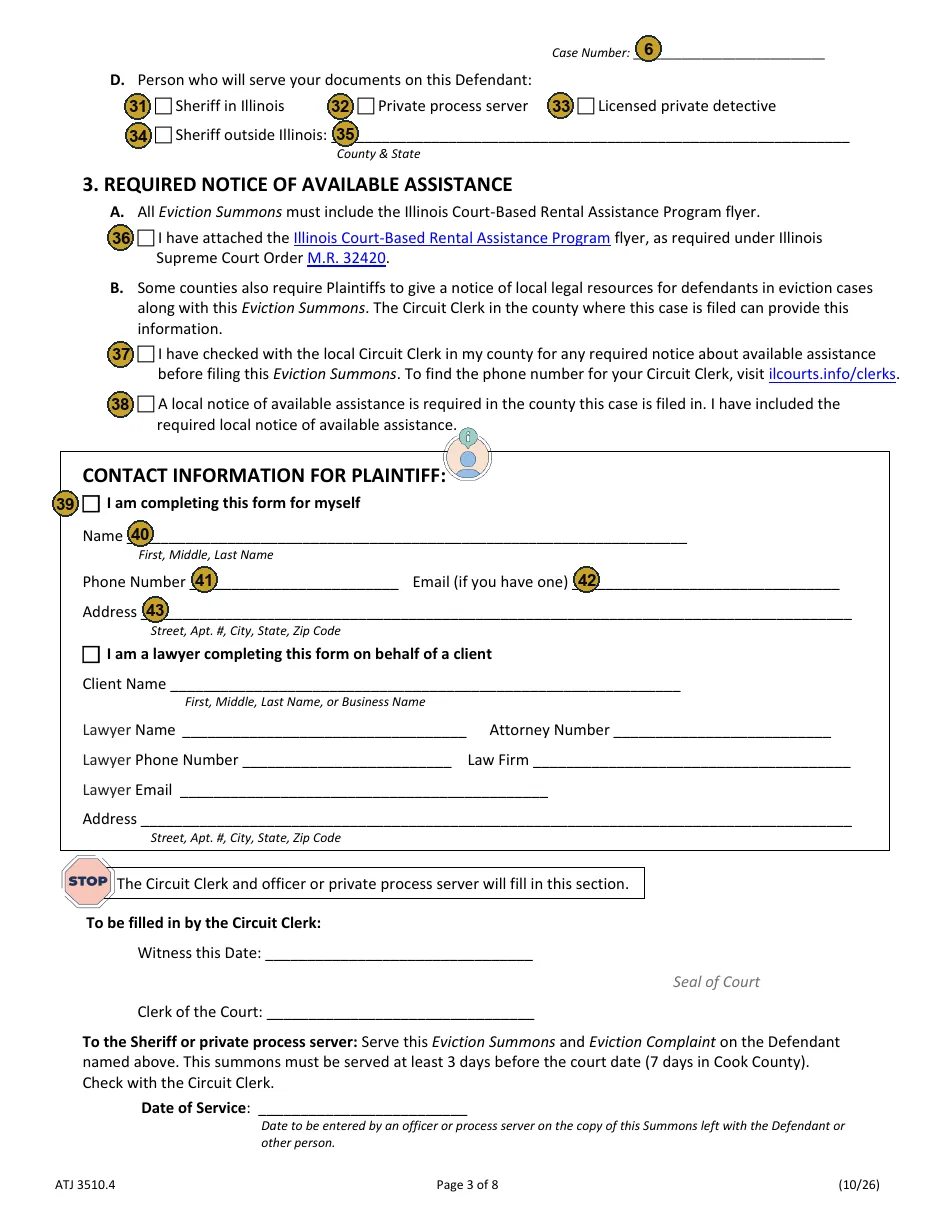
Fill out one summons for each Defendant, and skip the lawyer block (fields 44 to 51). Leave fields 52 to 54 and 61 to 122 blank for the clerk and the server. Download the form (PDF, version 10/26).
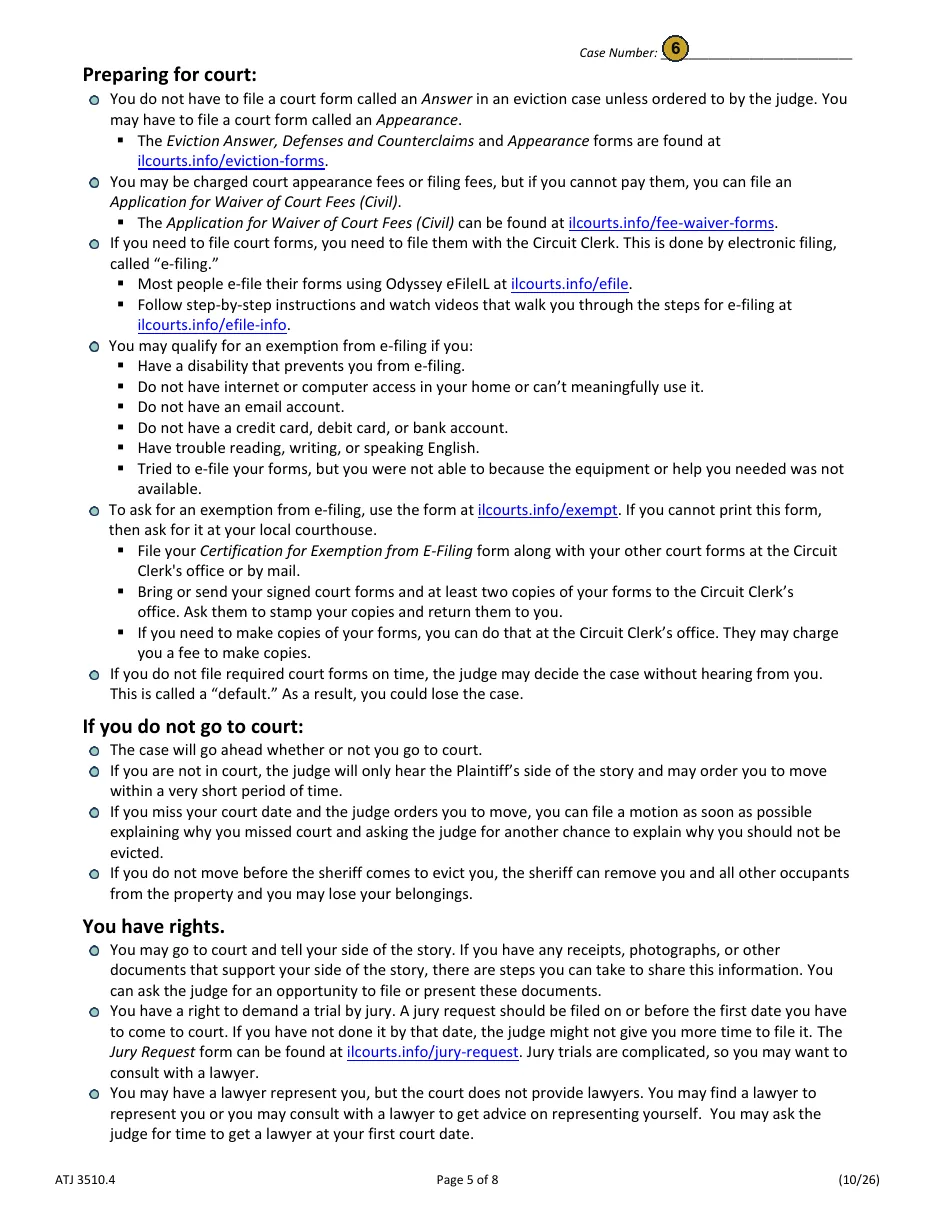
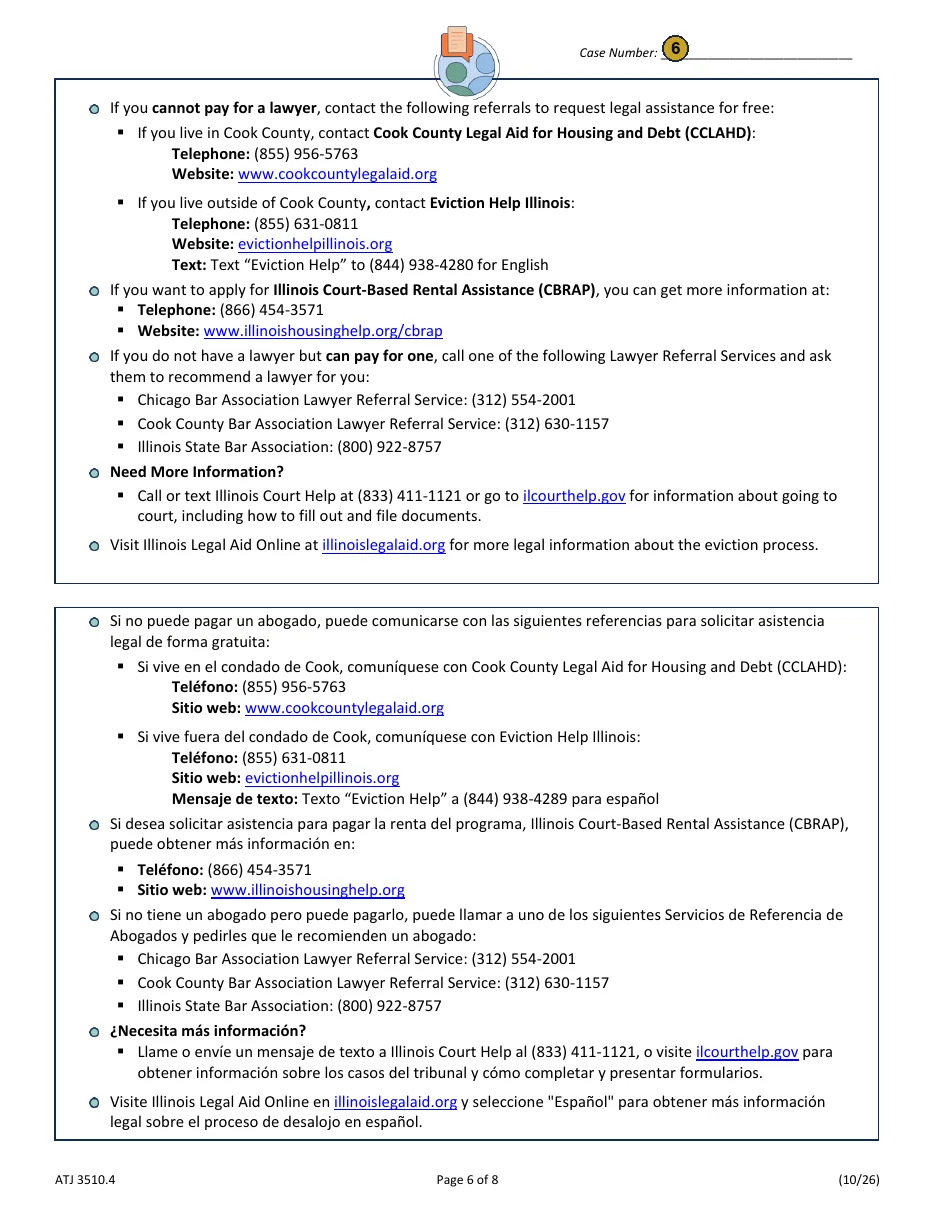
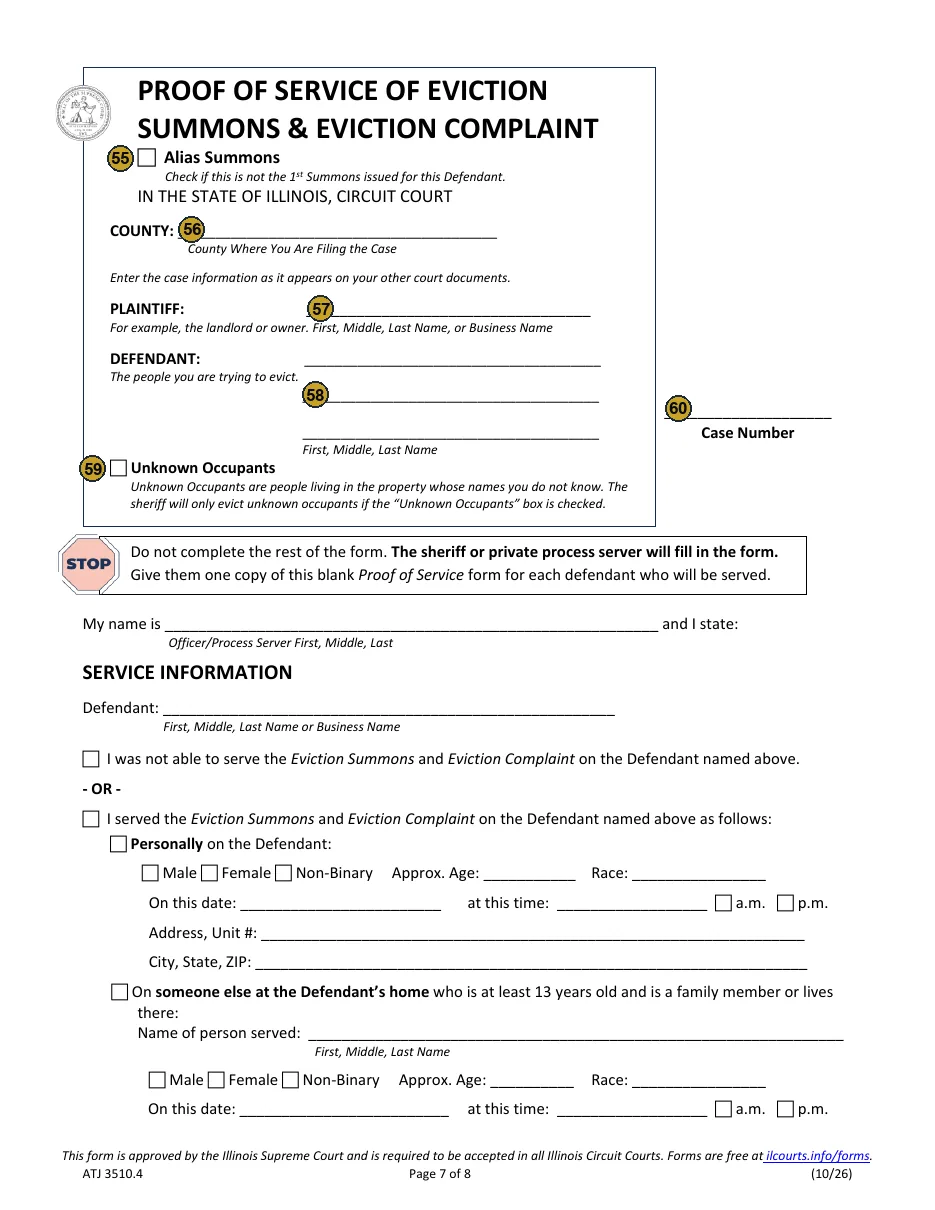
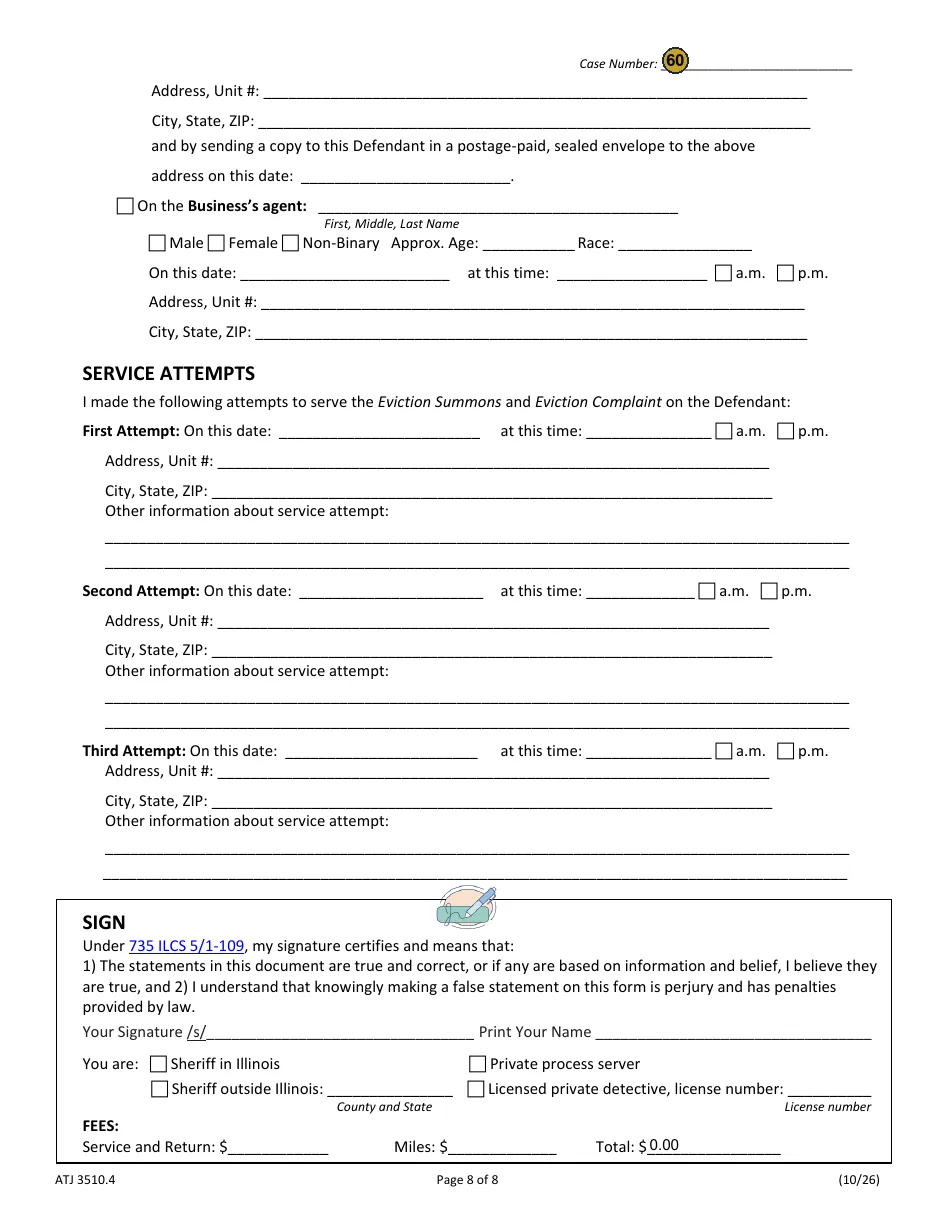
| # | Field | What to write |
|---|---|---|
| 1 | Alias Summons | Leave it blank on a first summons. Check it only on a new summons that replaces one the server could not serve. |
| 2 | County | The county where the rental property is. You file the case in that county. |
| 3 | Plaintiff's Name | Your full name, exactly as it appears on your Eviction Complaint. |
| 4 | Defendant's Name | Every Defendant named on your Eviction Complaint, spelled the same way. |
| 5 | Unknown Occupants | Check it if your Eviction Complaint names Unknown Occupants. The Sheriff evicts unknown occupants only when this box is checked. |
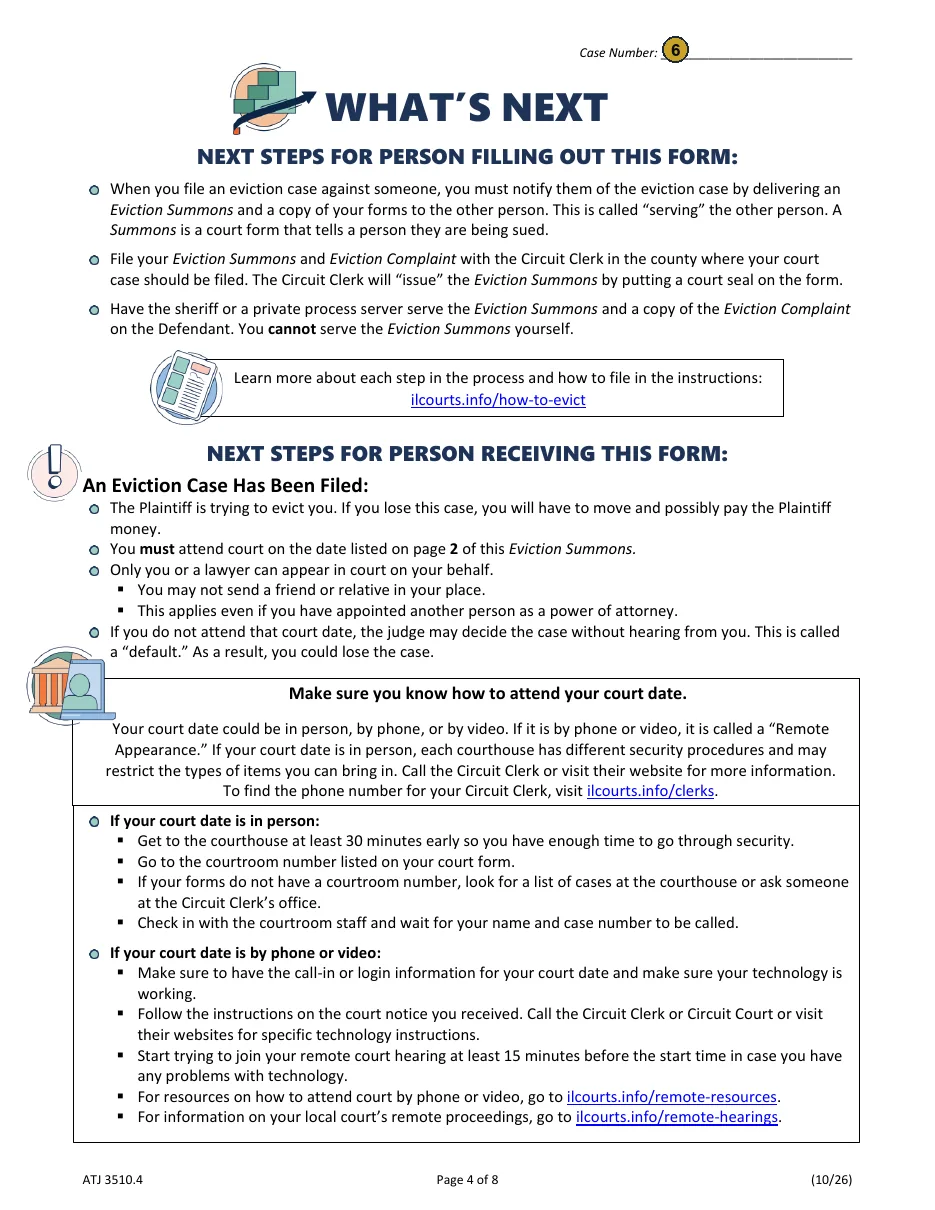
| 6 | Case Number | Leave it blank on a new case. The Circuit Clerk assigns the number at filing. It repeats at the top of pages 2 to 6. |
| 7-9 | Date, Court Time, a.m. or p.m. | The first court date and time the Circuit Clerk gives you. Check a.m. or p.m. |
| 10 | Courtroom | The courtroom number for that court date. |
| 11-12 | In person | Check it if the court date is in person. Write the courthouse address and the courtroom number. |
| 13-16 | Remotely | Check it if the court date is by video or phone. Copy the website, log-in details and call-in number the clerk gives you. |
| 17-18 | Circuit Clerk's Phone Number and Website | The Circuit Clerk's phone number and website. The tenant uses them to learn about remote court options. |
| 19-20 | Number of defendants being served | Check 1 defendant or more than 1. If more, write how many other summons forms you attached. |
| 21-25 | First Defendant's name and address | Full name, the best address for service, and phone and email if known. On the Unknown Occupants summons, write Unknown Occupants. |
| 26-30 | Second address for this Defendant | Check the second box and write a work or other address if you have one. Otherwise check the first box. |
| 31-35 | Person who will serve your documents | Check who will serve this Defendant. For a Sheriff outside Illinois, write that county and state. |
| 36 | Rental Assistance Program flyer | Check it. Attach the Court-Based Rental Assistance Notice in English and Spanish to this summons. |
| 37 | Checked with the local Circuit Clerk | Check it after you ask the Circuit Clerk whether your county requires a local notice of available assistance. |
| 38 | Local notice is required | Check it only if your county requires a local notice. Attach that notice to this summons. |
| 39-43 | Contact information for Plaintiff | Check "I am completing this form for myself." Write your name, phone, email if you have one, and mailing address. |
| 55-60 | Proof of Service caption (page 7) | Repeat the page 1 caption: Alias box, county, Plaintiff, Defendant, Unknown Occupants box and case number. Leave the rest blank. |
Letter to Sheriff (ATJ 1505.4)
Use this letter only when you mail the papers to the Sheriff, one letter for each Defendant. The court's PDF does not number its fields, so these numbers follow the form from top to bottom. Download the form (PDF, version 09/25).
| # | Field | What to write |
|---|---|---|
| 1 | Date | The date you mail the letter. |
| 2-3 | Sheriff of ___ County, State of | The county where the Defendant lives, and the state. Send the letter to that Sheriff. |
| 4 | Address of Sheriff | The mailing address of that Sheriff's office. Ask the office which address handles civil service. |
| 5-6 | Re: Plaintiff v. Defendant | Your name, then the Defendant names, as they appear on the Eviction Summons caption. |
| 7 | Case Number | The case number from the issued Eviction Summons. |
| 8 | Name of Defendant | The one Defendant this letter covers. Use a separate letter for each Defendant. |
| 9-10 | Full fee waiver | Check it only if a judge granted a full fee waiver. Write the county and enclose the Order for Waiver of Court Fees. |
| 11-12 | Partial fee waiver | Check it if a judge granted a partial fee waiver. Write the county, enclose the order and pay your share. |
| 13 | I do not have a fee waiver | Check it if no judge waived your fees. |
| 14-15 | Payment enclosed | Check it and write the amount. The Sheriff's office tells you the fee and how to pay it. |
| 16-17 | Signature and Print Name | Sign and print your name. |
| 18-20 | Your Address, Phone Number, Email | Your mailing address, phone and email, so the Sheriff can reach you about service. |
What goes into the summons packet?
The summons packet is everything the Sheriff or process server hands to each Defendant. The court's instructions list each piece. Give the server one full set for each Defendant.
- One Eviction Summons for each Defendant, and one for Unknown Occupants if the complaint names them.
- A copy of the Eviction Complaint with every page you filed with it, including the notice and the lease.
- The Court-Based Rental Assistance Notice in English and Spanish.
- Any local notice your county requires. The Circuit Clerk can tell you.
- One blank Proof of Service (pages 7 and 8 of the summons) for each Defendant.
- A Letter to Sheriff (ATJ 1505.4) for each Defendant, if you mail the papers to the Sheriff.
Two tenants plus Unknown Occupants means three summonses. On the first summons, check "more than 1 defendant" and write 2 in field 20.
How do I get the court date for the summons?
The summons must carry the first court date. The court's instructions tell you to call the Circuit Clerk before you file. Ask how that clerk's office sets eviction court dates.
Ask for a date that leaves time for service. The server must serve each Defendant at least 3 days before the court date. In Cook County, the minimum is 7 days.
Each county sets dates its own way. In Cook County, the court date is printed on the complaint that comes back from the Clerk after filing. Copy that date onto each summons. In DuPage County, filing does not produce a court date. I set the hearing myself through the county's case schedule portal.
Some filers have an e-filing exemption and file on paper. They ask the Circuit Clerk for a court date at filing. Write it on the summons then.
Illinois Supreme Court Rule 101(b)(2) sets the return date 7 to 40 days after the summons issues. The service deadline is a separate rule. Serve each Defendant at least 3 days before court in DuPage County, and at least 7 days before court in Cook County.
Who can serve the eviction summons?
The Sheriff or a private process server serves the summons. The summons form also lists a licensed private detective and a Sheriff outside Illinois. You cannot serve the summons yourself.
Any other server needs the court's permission first. The court's form for that request is the Motion to Approve Process Server Who is Not Licensed.
Until 2025, a Chicago case always started with a Cook County Sheriff attempt. The Sheriff is now optional. In Chicago, I use private special process servers for faster, verified service. In my suburban Cook County cases, the summons designates a licensed private detective for service.
Service costs depend on the county and the server. The Cook County Sheriff charges $60 for each Defendant when you e-file. The Cook County Sheriff charges $95 for paper or mail service. A private process server costs about $155. The Kane County Sheriff charges $75 for each Defendant plus $1 a mile.
The court's summons states that you cannot serve the Eviction Summons yourself. Use the Sheriff, a licensed process server, a licensed private detective, or a server the court approves.
When must the rental assistance notice go with the summons?
Every residential eviction summons in Illinois must include the Court-Based Rental Assistance Notice in English and Spanish. The rule applies in every county. The Illinois Supreme Court ordered it in M.R. 32420.
The order applies even when the program is closed to new applications. Local courts may add local information to the notice. Check box 36 on page 3 of every summons to confirm that you attached it.
Some counties also require a local notice of legal resources. Call the Circuit Clerk before you file, then check box 37. If your county requires a local notice, attach it and check box 38.
Cook County has a local notice. General Administrative Order 2025-08 governs it. Attach the Early Resolution Program notice to every Cook County eviction summons. A summons without it is defective. The notice is in English, Spanish and Polish. The court posts it as Court-Based Rental Assistance: Cook County.
The program pays past due rent and up to two months of future rent to eligible households. The tenant and the landlord apply together at IllinoisHousingHelp.org. Awards depend on available funding.
What does the DuPage mediation notice tell my tenant?
The court posts the DuPage County Eviction Mediation Program notice with the statewide eviction forms. The notice tells the tenant about the program. It also lists free legal help and rental help.
In mediation, a neutral mediator helps the landlord and the tenant reach an agreement. Mediation is free, and the discussions are confidential. If the parties do not agree, the case goes on in court.
Attach the DuPage mediation notice to each DuPage summons. Either side can enroll by calling 630-407-8807 or by email to evictionmediation@dupagecourts.gov. In my DuPage cases, a tenant who appears goes to the DuPage Mediation Program.
How do I send the summons to the Sheriff?
The court's instructions give three ways to get the papers to the Sheriff.
- In person: bring the documents to the Sheriff's office.
- By mail: mail copies with a Letter to Sheriff for each Defendant. Mail may delay your case.
- Electronically, if that Sheriff's office has a process for it. Ask the office.
Send copies of the summons and complaint with the Sheriff's fee. Add a self-addressed stamped envelope for the Proof of Service. Add your Order for Waiver of Court Fees if you have one. Every Illinois sheriff must accept an approved order. Sheriffs in other states do not have to. Do not file the Letter to Sheriff with the Circuit Clerk.
What happens after the server tries to serve the tenant?
The server fills in the Proof of Service on pages 7 and 8. The server then files it with the Circuit Clerk or mails it to you. Call the Circuit Clerk to check whether it was filed. If the server mails it to you, e-file it yourself.
The server may not reach a Defendant before the court date. Go to court on that date anyway. Ask the judge for leave to file a new summons, called an alias summons. Ask for a new court date too. Check the Alias Summons box on the new summons. Give the server a new copy of the complaint with it.
If repeated attempts fail, the Sheriff may be able to serve by posting. Posting has its own forms and rules. My guide to service by posting in an Illinois eviction covers them. Posting is not often required. When it is, add about 35 days to the high end of the timeline.
What Mistakes Get These Forms Rejected?
- Serving the summons yourself. The court's form says you cannot.
- Picking a court date too soon for service. Each Defendant needs service 3 days before court, or 7 in Cook County.
- Leaving off the Court-Based Rental Assistance Notice. Every residential eviction summons in Illinois needs it, in English and Spanish.
- Skipping the separate summons for Unknown Occupants, or leaving the Unknown Occupants box blank. The Sheriff will not evict an unknown occupant without it.
- Giving the server one copy for the whole household. The server needs a full set for each Defendant, with all filed pages.
- Filling in the Proof of Service yourself. You fill in only the caption on page 7.
- Filing the Letter to Sheriff with the Circuit Clerk. The letter goes to the Sheriff only.
- Skipping the court date when service failed. Go to court and ask the judge for an alias summons and a new date.
- Sending a fee waiver order to a Sheriff outside Illinois and expecting it to be honored.
Related Guides
- Previous step: how to fill out the Illinois Eviction Complaint
- Service by posting in an Illinois eviction
- The Illinois eviction process, step by step
- Chicago evictions
- Suburban Cook County evictions
- DuPage County evictions
- Kane County evictions
- The Cook County Early Resolution Program
- What an Illinois eviction costs
Frequently Asked Questions
Can a landlord serve an Illinois eviction summons personally?
No. The Illinois Eviction Summons states that you cannot serve it yourself. The Sheriff, a private process server, or a licensed private detective serves it. A Sheriff outside Illinois can serve a Defendant who is out of state. Any other server needs the court's permission first. Ask for it with a Motion to Approve Process Server Who is Not Licensed.
How many days before court must the tenant be served with the eviction summons?
The court's summons sets the deadline. Each Defendant must be served at least 3 days before the first court date. In Cook County, the minimum is 7 days. Ask the Circuit Clerk for a court date that leaves enough time for service. If service fails in time, ask the judge for an alias summons and a new court date.
Do I need a separate eviction summons for each tenant?
Yes. The court's form tells the Plaintiff to fill out an Eviction Summons for each Defendant. If your Eviction Complaint names Unknown Occupants, fill out one more summons just for Unknown Occupants. On the first summons, check "more than 1 defendant." Write how many other summons forms you attached. The server also needs a full set of papers for each Defendant.
Which Illinois counties require the Court-Based Rental Assistance notice with the summons?
All of them. Illinois Supreme Court order M.R. 32420 requires the notice, in English and Spanish, with every residential eviction summons. The rule applies even when the program is not taking new applications. Some counties also require a local notice of legal resources. Cook County summonses carry the Early Resolution Program notice. Ask the Circuit Clerk in your county before you file.
What is the Letter to Sheriff and do I file it?
The Letter to Sheriff (ATJ 1505.4) is a cover letter for papers you mail to the Sheriff for service. Fill out one letter for each Defendant. Enclose copies of the summons and complaint and the Sheriff's fee or your fee waiver order. Add a self-addressed stamped envelope. Send it to the Sheriff in the county where the Defendant lives. Do not file it with the Circuit Clerk.
How much does it cost to serve an eviction summons in the Chicago area?
The Cook County Sheriff charges $60 for each Defendant when you e-file, and $95 for paper or mail service. A private process server costs about $155. The Kane County Sheriff charges $75 for each Defendant plus $1 a mile. Ask the Sheriff's office in your county for its current fee before you send payment. These costs are separate from the court filing fee.
Sources
The Illinois Supreme Court publishes these forms and instructions at ilcourts.info/eviction-forms. This guide follows the court's current versions:
- Eviction Summons (ATJ 3510.4)
- Letter to Sheriff (ATJ 1505.4)
- Court-Based Rental Assistance Notice (English and Spanish)
- Court-Based Rental Assistance: Cook County
- DuPage County Eviction Mediation Program
- How to File & Present an Eviction Complaint (ATJ 3501.5)