
How to Fill Out the Illinois Eviction Complaint

Part of the guide: Illinois Eviction Process, Step by Step.
The Eviction Complaint (ATJ 3508.4) is the Illinois Supreme Court's three-page form that starts an eviction case. You write the county, your name as Plaintiff, each adult occupant as a Defendant, and the property address. You check the reason for the eviction and the money you ask for. You attach the notice you served, the Affidavit of Service of a Demand or Notice, and the lease. If one of those is missing, you attach the Missing Documents Affidavit (ATJ 3509.3). You file the complaint and the Eviction Summons with the Circuit Clerk in the property's county.
The official forms, current versions. These are the Illinois Supreme Court approved forms, hosted here and checked against the court's list each month.
- Eviction Complaint (ATJ 3508.4, version 10/26)
- Missing Documents Affidavit (ATJ 3509.3, version 10/26)
How Do I Fill It Out, Field by Field?
Eviction Complaint (ATJ 3508.4)
These rows cover every field a self-represented landlord fills on the October 2026 version of the form. Skip fields 34 to 41: that block is for a lawyer who files for a client. Download the form (PDF, version 10/26).
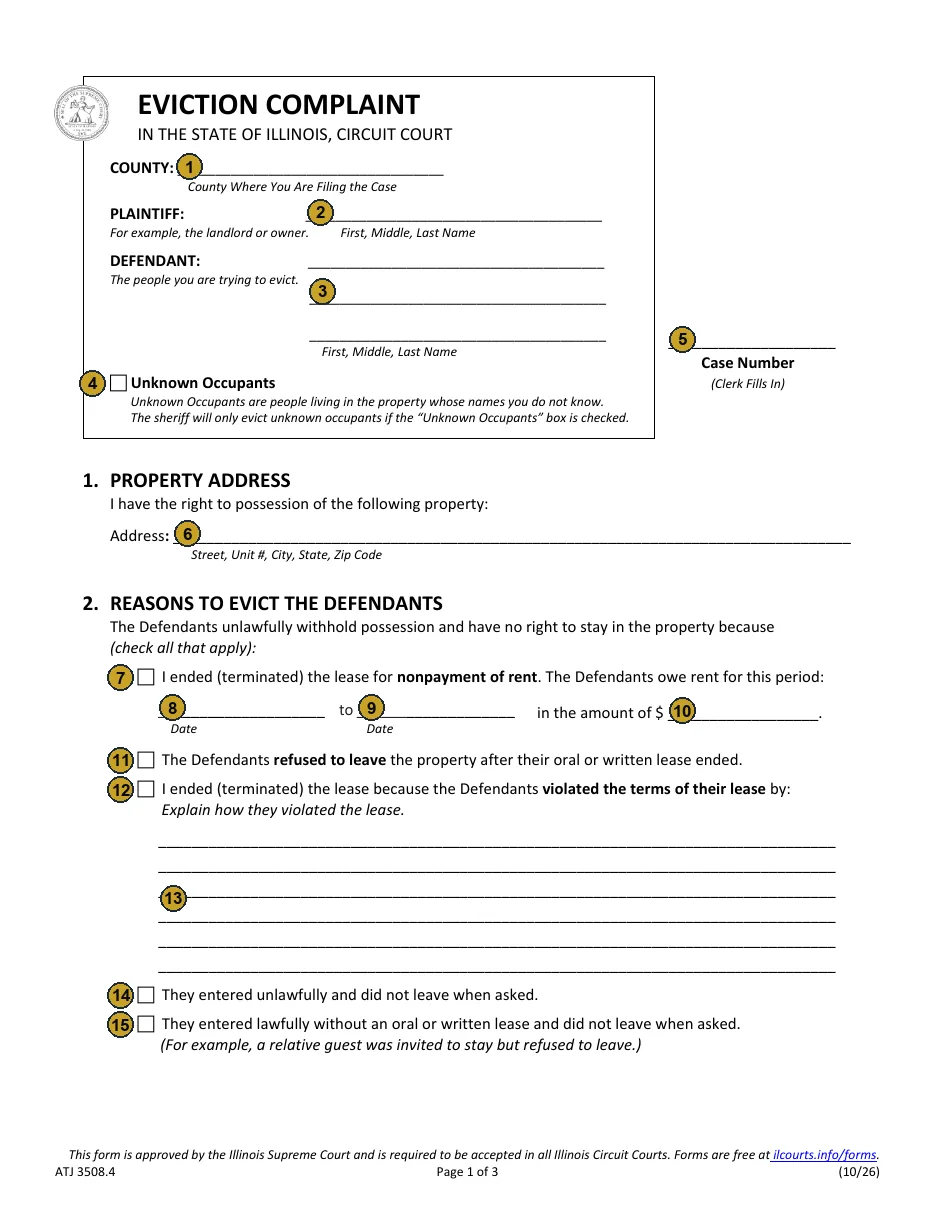
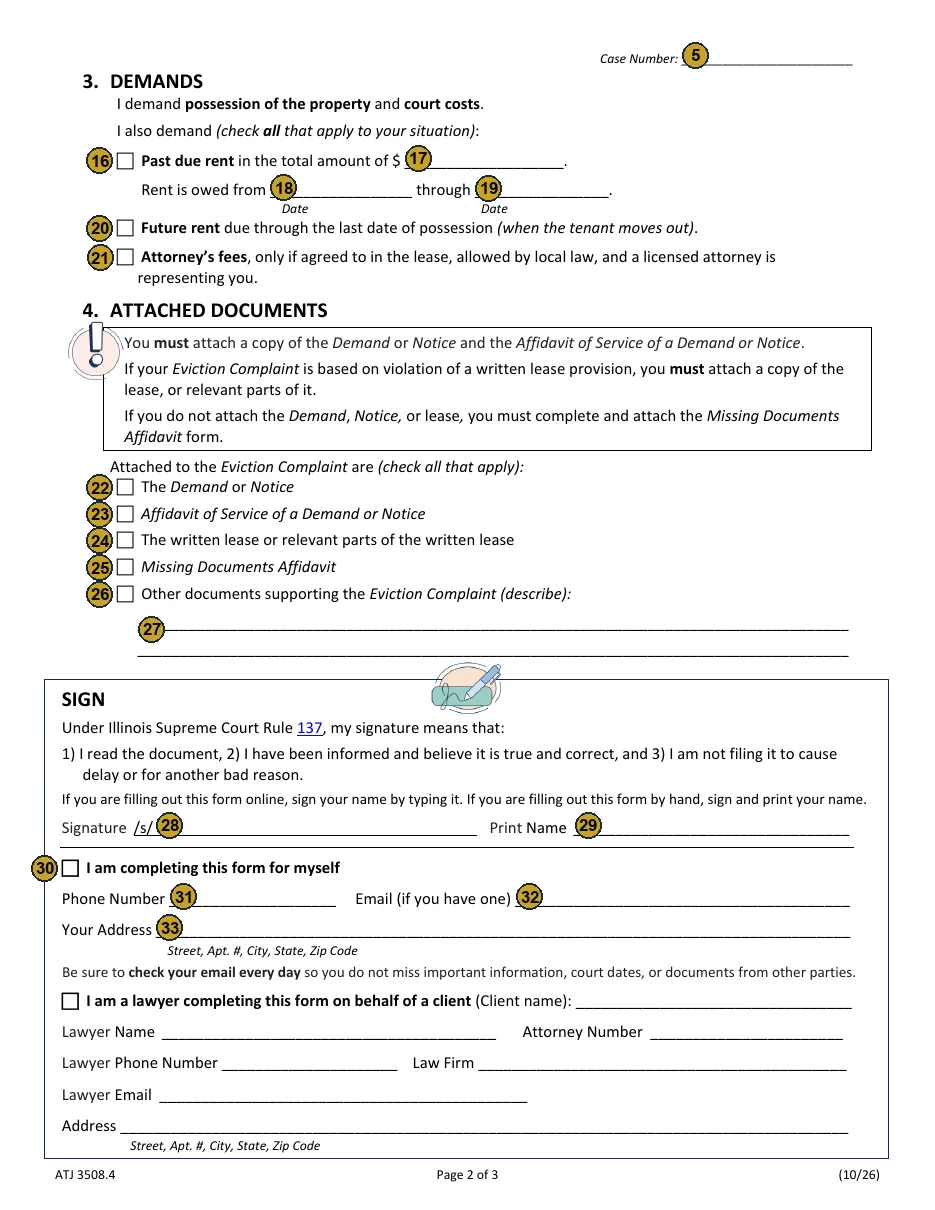
| # | Field | What to write |
|---|---|---|
| 1 | County | The county where the property is located. In Cook County, the case files in the district where the property is located. |
| 2 | Plaintiff's Name | Your full name as the landlord or owner. An LLC or a corporation cannot fill this in without a lawyer. |
| 3 | Defendant's Name | The full name of each adult who lives in the property. Use the same spelling as the lease and the notice. Never name a minor. |
| 4 | Unknown Occupants | Check it. The sheriff removes a person you did not name only when this box is checked. |
| 5 | Case Number | Leave it blank on page 1 and page 2. The clerk assigns the case number. |
| 6 | Property Address | Street, unit number, city, state and ZIP code of the rental. Use the same address that is on your notice. |
| 7-10 | Box A: unpaid rent | Check it after a Notice of Termination for Unpaid Rent expires without full payment. Enter the past-due rent period (8, 9) and the amount due today (10). |
| 11 | Box B: lease ended | Check it when the tenant stays after an oral or written lease ends. A notice that the lease is ending usually comes first. |
| 12-13 | Box C: lease violation | Check it after the lease violation notice period ends. In 13, describe each violation from the notice: who, what and when. |
| 14 | Box D: unlawful entry | Check it for a person who entered without permission and did not leave when asked. |
| 15 | Box E: lawful entry, no lease | Check it for a person you let in without a lease who did not leave when asked. An example is a relative guest. |
| 16-19 | Past due rent | Check 16. In 17, write all rent past due on the day you file. Write the first and last dates it covers in 18 and 19. |
| 20 | Future rent | Check it when there is an oral or written lease. It asks for rent that comes due until the tenant moves out. |
| 21 | Attorney's fees | Leave it blank if you file without a lawyer. The form allows fees only when a licensed attorney represents you. |
| 22 | The Demand or Notice | Check it and attach a copy of the notice or demand you served. |
| 23 | Affidavit of Service of a Demand or Notice | Check it and attach the affidavit, signed by the person who served the notice or demand. |
| 24 | Written lease | Check it and attach the lease or its relevant parts. A lease violation case requires it. |
| 25 | Missing Documents Affidavit | Check it only when you leave out the notice, the affidavit of service or the lease. Attach the signed affidavit. |
| 26-27 | Other documents | Check 26 and describe each extra attachment in 27, such as the USPS green card from certified mail service. |
| 28-29 | Signature and Print Name | Online, type your name after /s/. On paper, sign by hand. Print your name in 29. |
| 30 | Completing this form myself | Check it. You are the Plaintiff and you sign for yourself. |
| 31-33 | Phone, Email, Address | Your own phone number, email and mailing address. The form tells you to check that email every day. |
Who Can File the Eviction Complaint Without a Lawyer?
The court's forms are for a residential eviction by a landlord or owner who has no lawyer. You must be the named Plaintiff. You must also complete and sign each filing on your own behalf.
A person who is not a lawyer cannot represent another person's interest in court. If an LLC or a corporation owns the property, it must hire a lawyer. A property manager cannot file for the owner either. Filing a case for another person is the practice of law.
The instructions also list cases that do not use these forms. They include commercial, post-foreclosure and mobile home evictions. They also include condominium actions against owners and public or project-based subsidized housing. Land-only leases and contracts for deed are also excluded.
Do not file the case yourself. An LLC or a corporation cannot file an Illinois eviction without a lawyer. I explain the entity rule in DIY eviction vs hiring an attorney.
Which Reason Box Do I Check in Paragraph 2?
Paragraph 2 lists five reasons, marked A to E. Check each box that applies to your case. Each box should match the notice or demand you served before you filed.
- Box A, unpaid rent (fields 7 to 10). Use it after a Notice of Termination for Unpaid Rent (ATJ 3502.3) expires without full payment. See the Illinois 5-Day Notice guide.
- Box B, the lease ended (field 11). Use it when a tenant stays after an oral or written lease ends. You usually serve a Notice That Your Lease or Tenancy is Ending (Non-Renewal/Termination) (ATJ 3505.3) first. My non-renewal notice guide gives the notice period.
- Box C, a lease violation (fields 12 and 13). Use it after a Notice of Termination for Lease Violation (Other than Unpaid Rent) (ATJ 3503.3) expires. See the 10-Day Notice guide.
- Box D, unlawful entry (field 14). Use it for a squatter or trespasser who entered without permission and did not leave when asked.
- Box E, lawful entry without a lease (field 15). Use it for an occupant you let in without a lease who did not leave when asked. An example is a relative guest.
The court's instructions say a lease violation must be on the notice before you can evict for it. The notice should name the person, describe the violation and say when it happened. Copy those same facts into field 13.
How Do I Fill In Box A for Unpaid Rent?
Box A has three blanks. Fields 8 and 9 take the first and last dates of the unpaid rent period. Field 10 takes the amount.
Enter the rent that is past due on the day you file. It is often more than the amount on your 5-day notice, because more rent came due after you served it.
The tenant can pay the full amount during the notice period. If the tenant pays in full, the notice is satisfied. You then cannot evict for that rent.
When Do I Use Box D or Box E?
Boxes D and E are for occupants who never had a lease with you. The court's instructions pair them with the Demand for Immediate Possession (ATJ 3506.3).
That demand cannot be used for anyone who ever had an oral or written lease with you. The rule includes a month-to-month tenancy and a subtenant.
A person who paid you rent to live in the property is a tenant, even without a written lease. For a tenant, use box A, B or C with the notice that matches. My guide to evicting a tenant without a lease covers that case.
Family members, guests and romantic partners can still have a right to stay until a court evicts them. The instructions tell you to talk with a lawyer before you file if these issues can come up.
What Money Can I Ask For in Paragraph 3?
Paragraph 3 already asks for possession of the property and court costs. Court costs include your filing fee and your service fees. You add other demands with boxes 16, 20 and 21.
- Past due rent (fields 16 to 19). Write the total unpaid rent and the dates it covers. Bring a rent ledger, receipt book or payment history to court to prove it.
- Future rent (field 20). This box asks for rent that comes due until the tenant moves out. The court's instructions allow it when there is an oral or written lease.
- Attorney's fees (field 21). The form sets three conditions. The lease must provide for fees, and local law must allow them. A licensed attorney must also represent you. A landlord who files without a lawyer leaves this box blank.
You cannot ask for money for damage the Defendants caused to the property. You also cannot ask for money on claims unrelated to possession. Those claims may need a different type of court case.
Can I Collect Anything While the Case Is Open?
Yes. During the case, you can ask the judge for permission to accept use and occupancy payments. That is the reasonable rental value of the property while the Defendants live there. You can ask for it even when there is no oral or written lease.
The court's instructions warn that some local laws prohibit a request for attorney's fees. Check your local rules before you check box 21.
One adjustment applies if service becomes difficult. Sometimes the sheriff serves the Defendants by posting, and they do not come to court. The judge can then award possession only. The court cannot award rent or use and occupancy in that case.
What Do I Attach to the Eviction Complaint?
Paragraph 4 lists the attachments. Check a box for each document you attach. The form requires the notice or demand and the Affidavit of Service of a Demand or Notice (ATJ 3507.3). A complaint based on a written lease provision also needs the lease or its relevant parts.
- Field 22: a copy of the notice or demand you served. One notice covers every tenant and unknown occupant.
- Field 23: the Affidavit of Service of a Demand or Notice. The person who served the notice completes and signs it.
- Field 24: the written lease or its relevant parts. If the lease ended and you still accepted rent, attach the most recent lease.
- Field 25: the Missing Documents Affidavit. Attach it only when the notice, the affidavit of service or the lease is missing.
- Fields 26 and 27: other documents. If you served by certified mail and have the USPS green card, attach a copy and describe it here.
I attach the lease whenever one exists, even an expired one. I keep a copy of every form for the file. I bring the notice, the affidavit of service and the lease to the first court date.
When Do I Need the Missing Documents Affidavit?
The Missing Documents Affidavit (ATJ 3509.3) is a one-page form. You file it with the complaint only when the notice, the proof of service or the lease is missing.
The form has three numbered parts, one for each document. Fill in only the parts for documents you do not attach. Check the Unknown Occupants box on it only if you checked that box on the complaint and the summons.
- Part 1 (fields 6 to 10), the notice or demand. One box says "I cannot find or did not save my copy." Another says "A Demand or Notice is not required in this case." A third lets you write another reason.
- Part 2 (fields 11 to 15), the proof of service. The same choices apply to the affidavit or proof of service of the notice.
- Part 3 (fields 16 to 21), the written lease. The first box says "There is no written lease." The second says "I am not required to file a written lease." The third says "I cannot find or did not save a copy of the written lease." A last box lets you write another reason.
You sign under 735 ILCS 5/1-109. A knowingly false statement on the form is perjury. A lease that never existed and a lost copy are different sworn statements. Check the one that is true. Never file without serving a demand or a notice first, so do not rely on the box that says "A Demand or Notice is not required in this case." My no-lease eviction guide covers the no-lease case in detail.
Why Does the Unknown Occupants Box Matter?
Unknown Occupants are people living in the property whose names you do not know. The sheriff evicts unknown occupants only if the Unknown Occupants box is checked.
The sheriff can find a person at the property that you did not name. That person stays unless you included Unknown Occupants as a Defendant.
I name every known adult occupant and check Unknown Occupants in every case. Check the same box on the Eviction Summons and on any Missing Documents Affidavit.
Only adults who live in the property can be Defendants. If you name a minor, the law requires the court to dismiss the case, and you start over.
When Can I File After Serving the Notice?
Wait until the notice period ends. The day you serve the notice does not count. The period starts the next day. If you served by certified or registered mail, the period starts at delivery.
The period ends at midnight on its last day. A last day on a Saturday, Sunday or court holiday moves to midnight on the next court day. You can file the day after the period ends.
The court's instructions give an example. A 5-Day Notice served on a Monday has its fifth day on Saturday. The period runs to the next Monday, so you can file on Tuesday.
If you file early, the judge may dismiss the case, and you must start over. If you are unsure of the end date, the instructions suggest that you wait a day or two.
Chicago and some other cities add requirements that the court's instructions do not cover. Check your local ordinances before you file.
Where Do I File the Eviction Complaint, and What Does It Cost?
File the Eviction Complaint and the Eviction Summons together. File them with the Circuit Clerk in the county where the property is located.
In Cook County, file in the district where the property is located. Chicago properties go to the Daley Center. Suburban Cook properties go to the district courthouse for their township, listed on my suburban Cook eviction page.
Call the Circuit Clerk before you file and ask about the local process. You need a court date for the Eviction Summons. Ask for a date that allows service at least 3 days before court, or 7 days in Cook County.
Most people e-file through Odyssey eFileIL. You can file paper forms only if you qualify for an exemption. You claim it with a Certification for Exemption from E-Filing.
The filing fee depends on the county:
- Cook County: $389.25, paid by card at the clerk's office.
- DuPage County: $300.
- Kane County: $314.
You can ask the court to let you file for free or at a reduced cost. Use the Application for Waiver of Court Fees. It is a separate statewide form.
What Happens After I File the Complaint?
The sheriff or a process server serves the Eviction Complaint and the Eviction Summons on each Defendant. You cannot serve them yourself.
Give the server one copy of the summons, the complaint and every attachment for each Defendant. You must also attach the Court-Based Rental Assistance Notice, in English and in Spanish, to the summons.
The full sequence, from notice to sheriff, is on my Illinois eviction process page.
The summons carries the court date and the server's affidavit of service. My guide to the Illinois Eviction Summons covers each field.
What Mistakes Get These Forms Rejected?
- Filing the complaint before the notice period ends. The judge may dismiss the case, and you start over.
- Naming a minor as a Defendant. The law requires dismissal of the case.
- Leaving the Unknown Occupants box unchecked. The sheriff will not remove a person you did not name.
- Spelling a Defendant's name differently on the complaint, the summons and the affidavits.
- Filing for an LLC or a corporation without a lawyer.
- Having a property manager file for the owner. That is the practice of law, so the owner or the owner's lawyer must file.
- Asking for money for property damage. The Eviction Complaint covers possession, rent and court costs.
- Checking the attorney's fees box when no licensed attorney represents you.
- Listing a lease violation in field 13 that is not on the notice you served.
- Leaving out the USPS green card when the notice went by certified mail.
- Using a Demand for Immediate Possession against a person who ever had an oral or written lease with you.
- Trying to serve the complaint and summons yourself. Only the sheriff or a process server can serve them.
- Filing with no demand and no notice. Serve one first, every time.
Related Guides
- Next step: how to fill out the Illinois Eviction Summons
- Illinois 5-Day Notice for unpaid rent
- Illinois 10-Day Notice for a lease violation
- Illinois non-renewal notice periods
- How to serve an eviction notice yourself
- Evicting a tenant without a written lease
- The Illinois eviction process, step by step
- DIY eviction vs hiring an attorney
Frequently Asked Questions
Can I file an Illinois eviction complaint without a lawyer?
Yes, if you own the property in your own name. You must be the named Plaintiff and sign each filing yourself. If an LLC or a corporation owns the property, it must hire a lawyer. A property manager cannot file for the owner, because filing for another person is the practice of law. The statewide forms cover residential evictions only. Do not use them for commercial, post-foreclosure or mobile home cases.
What do I attach to the Illinois Eviction Complaint?
Attach a copy of the notice or demand you served. Attach the Affidavit of Service of a Demand or Notice. If there is a written lease, attach it or its relevant parts. If you accepted rent after the lease ended, attach the most recent lease. If you served by certified mail, attach the green card. If the notice, the proof of service or the lease is missing, attach the Missing Documents Affidavit.
When do I need the Missing Documents Affidavit?
You need the Missing Documents Affidavit (ATJ 3509.3) only when a document is missing from the complaint. The missing document can be the notice or demand, the proof of service, or the written lease. The form has one part for each missing document. You check the true reason, such as no written lease or a lost copy. You sign it under 735 ILCS 5/1-109, so a knowingly false statement is perjury. File it with the complaint.
Should I check the Unknown Occupants box on the eviction complaint?
Yes. I check it in every case. Unknown Occupants are people living in the property whose names you do not know. The sheriff evicts them only if the box is checked. Without it, the sheriff leaves an unnamed person in the property. Check the same box on the Eviction Summons. Also check it on the Missing Documents Affidavit if you file one.
Can I ask for attorney's fees on the eviction complaint?
Only in limited cases. The form sets three conditions. The lease must provide for attorney's fees, and local law must allow them. A licensed attorney must also represent you. A landlord who files without a lawyer leaves that box blank. The court's instructions also warn that some local laws prohibit a request for attorney's fees. Every complaint already asks for possession and court costs.
Can I sue for property damage in an Illinois eviction case?
Not in the Eviction Complaint. The court's instructions say it cannot ask for money for damage the Defendants caused to the property. It also cannot ask for money on claims unrelated to possession. You can ask for possession, past due rent, rent that comes due during the case, and court costs. A damage claim may need a different type of court case.
How much does it cost to file an eviction complaint in Illinois?
The filing fee depends on the county. In Cook County, the fee is $389.25 when you pay by card at the clerk's office. DuPage County charges $300. Kane County charges $314. Service of the summons by the sheriff or a process server costs extra. If you cannot afford the fees, you can file an Application for Waiver of Court Fees.
When can I file the eviction complaint after serving a notice?
File the day after the notice period ends. The day you serve the notice does not count. If you served by certified or registered mail, the period starts at delivery. A period that ends on a weekend or court holiday runs to the next court day. If you file early, the judge may dismiss the case, and you must start over.
Sources
The Illinois Supreme Court publishes these forms and instructions at ilcourts.info/eviction-forms. This guide follows the court's current versions:
- Eviction Complaint (ATJ 3508.4), version 10/26
- Missing Documents Affidavit (ATJ 3509.3), version 10/26
- How to File & Present an Eviction Case (ATJ 3501.5), version 10/26
- Affidavit of Service of a Demand or Notice (ATJ 3507.3), version 10/26
- Notice of Termination for Unpaid Rent (ATJ 3502.3), version 10/26
- Notice of Termination for Lease Violation (Other than Unpaid Rent) (ATJ 3503.3), version 10/26
- Notice That Your Lease or Tenancy is Ending (Non-Renewal/Termination) (ATJ 3505.3), version 10/26
- Demand for Immediate Possession (ATJ 3506.3), version 10/26