
Chicago’s Residential Landlord and Tenant Ordinance governs almost every rental relationship in the city, and both sides of the lease need to know what it says. The RLTO sets mandatory requirements for security deposits, notice timelines, lockout prohibitions, and tenant remedies that override whatever your lease might say. Violations carry real penalties. Landlords who mishandle deposits or retaliate against tenants can face statutory damages, and tenants who ignore their own obligations risk losing their right to cure. This is part five of a five-part series, following our guides on eviction notices, the early resolution program, tenant’s rights, and common landlord lawsuits.
Updated April 2026
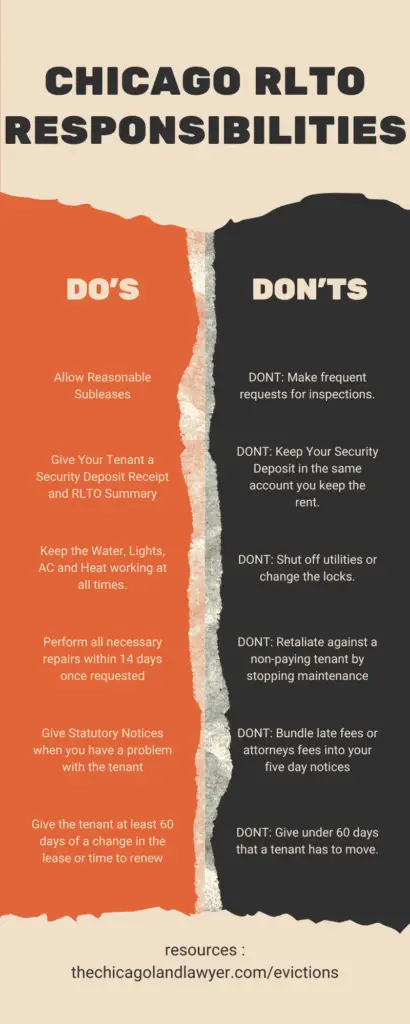
Table of Contents
Which Rental Units Are Covered by the RLTO?
The RLTO applies to most Chicago rental units, whether the lease is written or oral. That includes subsidized housing like CHA, IHDA, and Section 8 units. But several categories fall outside the ordinance’s reach:
- Units in owner-occupied buildings with six or fewer units (this is the most common exemption landlords rely on)
- Units in short-term rentals, hotels, motels, and rooming houses, unless rented monthly for more than 32 days
- School dormitories, shelters, employee quarters, and non-residential rental properties
- Owner-occupied co-ops and condominiums
The owner-occupied exemption trips up a lot of people. If a landlord lives in a six-flat and rents out the other five units, none of those tenancies are covered by the RLTO. The moment that landlord moves out, every unit becomes subject to the ordinance. This matters because it determines whether tenants can access the RLTO’s statutory remedies or whether they’re limited to common law claims. If you are unsure whether the RLTO applies to your situation, talk to a landlord-tenant attorney before making assumptions.
Need a Chicago Lease That Actually Holds Up in Court?
An attorney-drafted lease costs $350 and can save you tens of thousands in RLTO penalties. We draft RLTO-compliant leases for Chicago landlords every week.
What Tenants Must Do Under the RLTO
Tenants have obligations too. The RLTO is not a one-sided statute, and landlords can enforce these requirements when tenants fall short:
- Provide working batteries for smoke and carbon monoxide detectors
- Keep the unit clean and sanitary
- Use equipment and facilities in a reasonable manner
- Refrain from deliberately or negligently damaging the unit
- Avoid disturbing other residents in the building
- Refrain from criminal activity on the premises
A tenant who violates these duties exposes themselves to a 10-day notice to cure. If the violation goes uncorrected, the landlord can move to terminate the lease. That said, the landlord still needs to follow the proper notice procedures under the RLTO; skipping steps is how landlords lose in court, even when the tenant was clearly in the wrong.
Landlord’s Right of Access
A landlord cannot show up unannounced. Under the RLTO, tenants must allow reasonable access, but only after the landlord provides at least two days’ notice. The notice must state the date, approximate time, and purpose of the entry.
Emergencies are the exception. If a pipe bursts or there is an active fire risk, the landlord can enter without advance notice, but must give notice within two days after the emergency entry explaining what happened and why. A “last-minute showing” is not an emergency, and landlords who treat it as one risk an RLTO violation claim.
Security Deposits and Prepaid Rent
Security deposit violations are the single most litigated area of the RLTO. The rules are strict, the deadlines are unforgiving, and the statutory penalties add up fast. Landlords must comply with every one of these requirements:
- Provide a written receipt for every security deposit collected
- Hold deposits in a federally insured, interest-bearing account at an Illinois financial institution
- Pay accrued interest on deposits and prepaid rent held for more than six months
- Provide an itemized statement of damages within 30 days after the tenant vacates
- Return deposits and required interest within 45 days after the tenant vacates
Missing any of these deadlines can entitle the tenant to two times the deposit amount plus attorney’s fees. Our office regularly sees landlords who held deposits in non-interest-bearing accounts or failed to send an itemized statement within the 30-day window. These are not technicalities that courts overlook. Read our full security deposit breakdown for the specific penalty calculations.
Dealing with a Security Deposit Dispute?
Landlords facing deposit claims and tenants whose deposits were not returned on time both need experienced counsel. We handle RLTO security deposit cases every week. Free consultations.
RLTO Quick-Reference: Key Deadlines and Penalties
The RLTO imposes specific timelines that landlords and tenants cannot afford to miss. Below is a quick-reference table covering the most commonly triggered deadlines and their consequences.
| Requirement | Deadline | Penalty for Violation |
|---|---|---|
| Landlord notice before entry | 2 days | Tenant claim for RLTO violation |
| Notice after emergency entry | 2 days after entry | Tenant claim for RLTO violation |
| Nonpayment of rent notice | 5-day written notice | Tenant can cure by paying before order of possession |
| Lease/code violation notice | 10-day written notice to cure | Termination if uncorrected |
| Major defect repair (tenant remedy) | 14 days after notice | Tenant may terminate lease |
| Essential services failure (tenant remedy) | 24 hrs (heat/water) or 72 hrs (other) | Tenant may withhold rent or procure substitute |
| Itemized damage statement | 30 days after tenant vacates | 2x deposit + attorney’s fees |
| Return security deposit + interest | 45 days after tenant vacates | 2x deposit + attorney’s fees |
| Lease renewal demand (max advance) | No earlier than 90 days before expiration | Unenforceable provision |
| Lockout / self-help eviction | Prohibited at all times | $500/day fine + tenant damages |
If you want to understand how the notice timelines work in practice, our article on 5-day, 10-day, and 30-day eviction notices walks through each scenario step by step.
Landlord’s General Duties Under the RLTO
The RLTO imposes a broad set of affirmative duties on landlords. These are not suggestions. Failure to comply with any of them gives the tenant grounds for an RLTO claim:
- Provide contact information for the property owner or managing agent
- Notify tenants of code citations, pending enforcement actions, and utility shutoffs
- Maintain the property in compliance with the Chicago Municipal Code
- Refrain from requiring tenants to sign renewal agreements more than 90 days before the current lease expires
- Avoid enforcing prohibited lease provisions (the RLTO voids certain clauses automatically)
- Educate tenants about bed bug prevention and treatment
- Provide a heating disclosure before the tenant signs
- Deliver the City of Chicago RLTO summary and all receipts required by law
The prohibited lease provisions clause catches a lot of landlords off guard. Standard form leases downloaded from the internet often contain terms that the RLTO expressly forbids, like waivers of the right to a jury trial or provisions that let landlords confess judgment. Using those provisions in a Chicago lease does not just make the clause unenforceable; it can expose the landlord to statutory damages.
Tenant Remedies for Minor and Major Defects
When a landlord fails to maintain the property, the RLTO gives tenants a graduated set of remedies depending on how serious the problem is.
For minor defects, tenants can send written notice requesting repairs. If the landlord does not act within a reasonable time, the tenant may withhold a portion of rent or file a lawsuit for damages. Minor defects include things like a broken garbage disposal, a malfunctioning intercom, or cracked tiles.
For major defects that materially affect the habitability of the unit, tenants can demand repairs and terminate the lease if those repairs are not completed within 14 days. A major defect might be severe mold, a non-functional heating system in winter, or significant water intrusion. The tenant must give written notice before taking any of these steps.
Failure to Provide Essential Services
Losing heat in January or having the water shut off is not the same as a dripping faucet, and the RLTO treats these situations with corresponding urgency. When a landlord fails to provide essential services, tenants have several options:
- Procure substitute services (like space heaters or temporary water delivery) and deduct the reasonable cost from rent
- File a lawsuit for actual damages caused by the service failure
- Procure substitute housing and withhold rent for the period the unit was uninhabitable
- Withhold rent entirely if the landlord fails to restore service within 24 hours (for heat and water) or 72 hours (for other essential services)
Tenants need to document everything. Photograph the conditions, save text messages with the landlord, and keep receipts for any substitute services. Documentation is what separates a winning case from a credibility contest, and judges expect to see it. For more on what qualifies as a habitability issue, see our guide on how eviction and tenant cases are priced.
Fire or Casualty Damage
When a fire or other casualty damages a rental unit, the RLTO provides tenants with clear options. These protections exist because tenants should not be trapped in a lease for a unit they cannot safely occupy:
- If the tenant moves out immediately, they can terminate the rental agreement outright
- If the tenant stays but cannot use a portion of the unit due to damage, they can reduce rent proportionally
- If the landlord fails to diligently pursue repairs, the tenant can terminate the lease and move out
The key word in the statute is “diligently.” A landlord does not have to complete repairs overnight, but they do need to show consistent, good-faith progress. Sitting on an insurance claim for three months while the tenant lives around construction debris is not diligence.
Subleases Under the RLTO
Chicago Municipal Code Chapter 5-12-120 gives tenants the right to propose a reasonable subtenant without paying additional fees to the landlord. If a tenant needs to vacate before the lease term ends, the landlord has an affirmative obligation to make a good-faith effort to re-rent the unit at a fair market rate.
If the landlord cannot find a replacement tenant, the original tenant remains responsible for the rent plus reasonable advertising costs. But the landlord cannot simply refuse to look and then hold the tenant liable for the remaining months. That obligation to mitigate damages is real, and courts enforce it.
For landlords, the practical advice is straightforward: set objective qualification standards in the lease itself. We typically recommend requiring a 30% debt-to-income ratio and a minimum credit score of 700 for any proposed sublessee. That way, you have a clear, defensible basis for approving or rejecting a sublease candidate without running afoul of the RLTO.
Late Rent Payments and Fees
Municipal Code Chapter 5-12-140(h) caps late fees in Chicago, and the formula is not optional. For monthly rents under $500, the maximum late fee is $10. For rents above $500, it is $10 plus 5% of the amount over $500.
Landlords cannot charge more than this. The statute is not waivable, meaning a lease provision that sets a higher late fee is void on its face. Our firm regularly represents tenants who were charged $100 or $150 late fees on apartments renting for $1,200 a month. The maximum permitted fee on that rent would be $45 ($10 + 5% of $700). Charging anything above that amount gives the tenant an RLTO claim, and it is one of the easiest cases for a tenant’s attorney to win.
Paying Rent After a Termination Notice Expires
This rule catches landlords in Chicago eviction cases more than almost any other. Under Municipal Code Chapters 5-12-140(g) and 5-12-130(g), if a landlord accepts rent after the termination notice period has expired, the tenant is allowed to stay. The acceptance of payment waives the termination.
The practical consequence is severe: a landlord in Chicago cannot accept partial payment during an eviction proceeding without restarting the entire process. Every dollar accepted resets the clock. Landlords who are in the middle of an eviction need to refuse all payments and direct the tenant to bring the full amount to court. Accepting even a small check out of sympathy or confusion can cost months of delay and thousands of dollars in additional legal fees.
Chicago Landlord-Tenant Attorney
We represent landlords and property owners in evictions, RLTO disputes, lease enforcement, and security deposit litigation across Chicago and Cook County. Free consultations.
Landlord Remedies for Tenant Violations
Chapter 5-12-130 gives landlords a structured process for addressing tenant violations. The specific remedy depends on the type of breach. We cover the notice requirements in detail in our eviction notice guide, but here is the framework.
Nonpayment of Rent
The landlord must serve a five-day written notice demanding payment. If the tenant pays the back rent plus any court filing fees before a judge enters an order of possession, the tenant can stay. On a second nonpayment within twelve months, the tenant still gets a five-day notice, but the right to cure becomes more limited. Landlords who skip the five-day notice or serve it improperly will have their eviction case dismissed.
Other Lease or Code Violations
For violations like unauthorized pets, property damage, or unapproved occupants, the landlord serves a 10-day notice giving the tenant an opportunity to correct the problem. If the tenant fails to cure within those 10 days, the landlord can proceed to terminate the lease. In emergency situations, such as conditions that create immediate safety hazards, the landlord can demand correction within 14 days or as soon as reasonably possible. If the tenant still does not act, the landlord may enter the unit to make necessary repairs and charge the costs to the tenant.
Lockouts Are Illegal in Chicago
Self-help evictions are prohibited under the RLTO, and the Chicago Police Department enforces the ban. A landlord cannot change the locks, remove doors or windows, bar access to the unit, or shut off utilities to force a tenant out. There is no exception for nonpayment, no exception for lease expiration, and no exception for frustration.
Landlords who attempt lockouts face fines starting at $500 per day, and the tenant can sue for possession of the unit plus damages. Our firm has filed lockout cases seeking more than $25,000 in damages for tenants subjected to prolonged illegal lockouts. These are among the most expensive mistakes a landlord can make, and they are entirely avoidable by using the proper eviction process. If you are dealing with a squatter situation, our guide on how to evict squatters in Illinois explains the legal options available to property owners.
The RLTO’s Prohibition on Retaliation
Municipal Code Chapter 5-12-150 protects tenants from retaliation when they exercise their rights under the ordinance. A landlord cannot respond to a tenant’s complaint about conditions, a report to a building inspector, or participation in a tenant’s organization by terminating the tenancy, raising rent, decreasing services, threatening eviction, or refusing to renew the lease.
The retaliation presumption is powerful. If a landlord takes an adverse action within a certain period after the tenant complains, courts will presume the action was retaliatory unless the landlord can prove otherwise. As a practical matter, telling a tenant “I am not fixing anything until you pay rent” is the kind of statement that ends up as Exhibit A in a retaliation lawsuit. Landlords need to keep maintenance obligations and rent collection completely separate, both in practice and in every written communication.
Attorney’s Fees Under the RLTO
Municipal Code Chapter 5-12-180 creates a one-way fee-shifting rule. The prevailing plaintiff in any RLTO case (excluding eviction actions) can recover court costs and reasonable attorney’s fees from the landlord. But the statute does not work in the other direction. If the landlord wins, the landlord does not get attorney’s fees.
This asymmetry is intentional. It was designed to encourage tenants to bring meritorious claims without fear of a fee award if they lose, and it means landlords face real financial exposure in every RLTO dispute. A case that starts as a $1,500 security deposit dispute can easily generate $10,000 or more in attorney’s fees for the tenant’s lawyer if the case goes to trial.
Where to Find the Full Ordinance
The complete text of the RLTO is available through the Office of the City Clerk online database or in person at the Harold Washington Library. The city also publishes an English-language summary that landlords are required to provide to every tenant.
Need Help with an RLTO Issue?
We represent both landlords and tenants in RLTO disputes across Chicago. If you have questions about your rights or obligations under the ordinance, we offer free consultations by phone or video.
About the Author

Justin Abdilla
Attorney at Law
Justin Abdilla is a Chicago landlord-tenant attorney who represents both property owners and renters in RLTO disputes, eviction proceedings, and lease negotiations. He founded The Chicagoland Lawyer to give practical, straightforward legal guidance to people navigating Chicago’s rental laws.